 Add to Chrome
 Add to Firefox
 Add to Edge
PN-QNN: Harnessing Physical Noise as a Native Regularizer in Photonic Hybrid Quantum Neural Networks
Jul 22, 2026
Physical noise in near-term quantum hardware is usually treated as a nuisance to suppress. We ask whether it can instead act as a hardware-native regularizer for photonic hybrid quantum-classical neural networks (PHQCNNs), analogous to noise-injection regularization in classical deep learning. Using Quandela's Perceval simulator and the MerLin framework, we build PHQCNNs for Iris, Digits, and MNIST and inject Perceval's seven-parameter physical noise model directly into training. A genetic algorithm searches the six continuous noise dimensions and 1 boolean parameter to find, per dataset, the configuration maximizing validation accuracy, compared against a noiseless baseline across five seeds. GA-tuned noise yields modest accuracy gains on Iris (+0.82pp) and Digits (+1.45pp), but a clear degradation on MNIST (-1.21pp). Per-parameter sweeps show that no individual noise parameter is consistently beneficial, motivating the joint search, while a second-order loss expansion shows that physical noise induces a Tikhonov-like regularization term whose effect is dataset-dependent. Physical photonic noise can thus act as a free regularizer, but not universally.

Enhancing Blood Cells Classification using Hybrid Quantum Neural Networks
May 22, 2026Accurate classification of microscopic blood cells is still a critical task in medical image analysis, where subtle variations and limited data can challenge conventional deep learning models. As such, we investigate in this work the potential of Hybrid Quantum-Classical Neural Networks (HQNNs) to enhance feature representation and improve classification performance in this domain. We propose a modular architecture combining a pre-trained ResNet-50 backbone with a low-dimensional latent bottleneck and a variational quantum circuit, enabling a direct comparison between quantum-enhanced and purely classical transformation mechanisms. To isolate the contribution of the quantum component, we evaluate three architectures: a HQNN model, a Classical Matched Model with an additional nonlinear transformation layer of comparable capacity, and a baseline model without an intermediate transformation stage. Experiments conducted on two publicly available blood cell datasets, namely the Blood Cell Images dataset and the PBC dataset, demonstrate that HQNNs consistently achieve superior or more balanced performance across evaluation metrics. In the Blood Cell Images Dataset, the proposed approach improves macro F1-score by up to 3.7% compared to classical baselines, while improving the F1-score from 98.54% to 98.69% in the more challenging 8-class scenario with near-saturated performance. Additional evaluation on IBM quantum hardware shows that the model remains robust under noise, with only a modest performance degradation relative to simulated results. These results indicate that quantum feature transformations can enhance discriminative representations, particularly in challenging classification scenarios, and highlight the practical potential of HQNN models for medical imaging tasks.
Q-PhotoNAS: Hybrid Quantum Neural Architecture Search Framework on Photonic Devices
May 21, 2026Photonic quantum computing is a promising platform for scalable quantum machine learning, but designing effective hybrid architectures remains challenging under hardware and optimization constraints. Existing approaches rely on manually tuned architectures that fail to account for the collaboration between classical preprocessing, phase encoding, and photonic circuit structure, limiting both accuracy and hardware compatibility. In this paper, we propose a neural architecture search framework for hybrid photonic quantum-classical models that combines genetic algorithm-based search with learnable quantum phase encoding to systematically explore the joint design space of classical and quantum components. Our framework encodes 19 hyperparameters across six gene groups and evolves a population of hybrid architectures using group-based crossover, per-gene mutation, and elitism, evaluating each candidate on a short training budget before full retraining of the best found design. We evaluate our framework on two image classification benchmarks, Digits and MNIST, achieving final validation accuracies of 99.44% and 98.78%, respectively, with first-principles execution time estimates on the Quandela Ascella photonic QPU projecting single-image inference at 67 ms (Digits) and 149 ms (MNIST). Our quantum contribution analysis further shows that the photonic layer extracts non-redundant features orthogonal to the classical pathway, providing a measurable accuracy advantage over classical-only baselines. Our results demonstrate that automated architecture search is both practical and impactful for hybrid photonic systems, opening the way for systematic design space exploration of quantum AI on photonic devices.
An Experimental Exploration of In-Memory Computing for Multi-Layer Perceptrons
Aug 10, 2025In modern computer architectures, the performance of many memory-bound workloads (e.g., machine learning, graph processing, databases) is limited by the data movement bottleneck that emerges when transferring large amounts of data between the main memory and the central processing unit (CPU). Processing-in-memory is an emerging computing paradigm that aims to alleviate this data movement bottleneck by performing computation close to or within the memory units, where data resides. One example of a prevalent workload whose performance is bound by the data movement bottleneck is the training and inference process of artificial neural networks. In this work, we analyze the potential of modern general-purpose PiM architectures to accelerate neural networks. To this end, we selected the UPMEM PiM system, the first commercially available real-world general-purpose PiM architecture. We compared the implementation of multilayer perceptrons (MLPs) in PiM with a sequential baseline running on an Intel Xeon CPU. The UPMEM implementation achieves up to $259\times$ better performance for inference of large batch sizes when compared against the CPU that exploits the size of the available PiM memory. Additionally, two smaller MLPs were implemented using UPMEM's working SRAM (WRAM), a scratchpad memory, to evaluate their performance against a low-power Nvidia Jetson graphics processing unit (GPU), providing further insights into the efficiency of UPMEM's PiM for neural network inference. Results show that using WRAM achieves kernel execution times for MLP inference of under $3$ ms, which is within the same order of magnitude as low-power GPUs.
Vehicle-to-Vehicle Charging: Model, Complexity, and Heuristics
Apr 12, 2024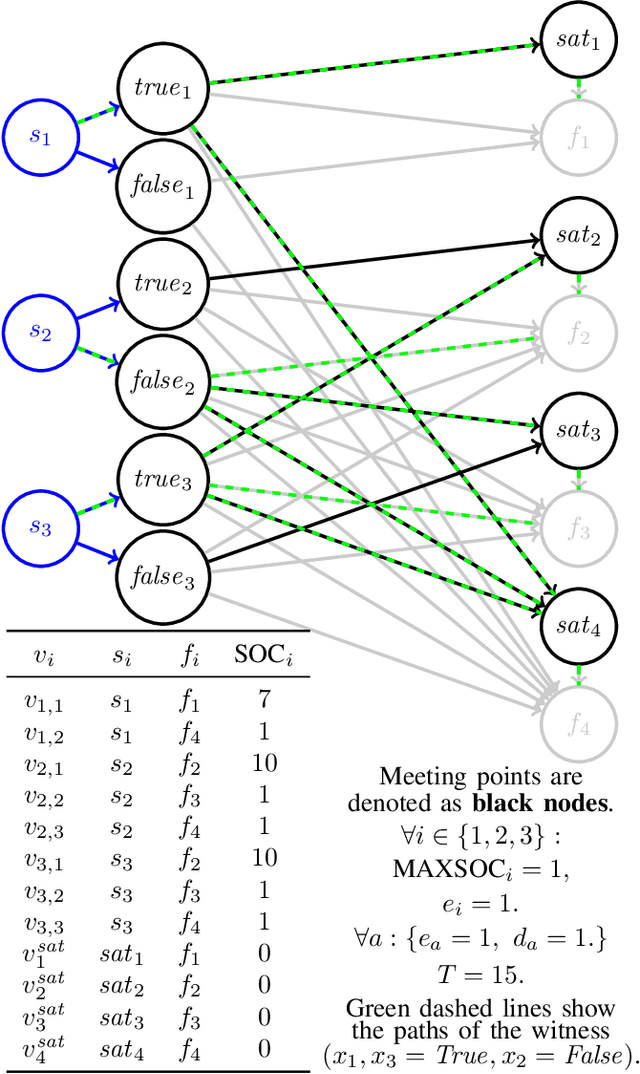


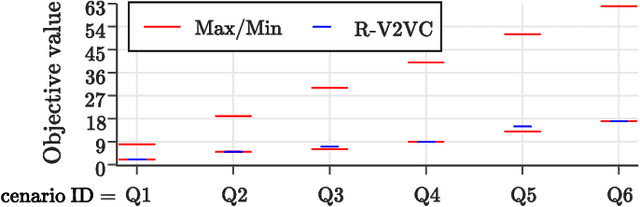
The rapid adoption of Electric Vehicles (EVs) poses challenges for electricity grids to accommodate or mitigate peak demand. Vehicle-to-Vehicle Charging (V2VC) has been recently adopted by popular EVs, posing new opportunities and challenges to the management and operation of EVs. We present a novel V2VC model that allows decision-makers to take V2VC into account when optimizing their EV operations. We show that optimizing V2VC is NP-Complete and find that even small problem instances are computationally challenging. We propose R-V2VC, a heuristic that takes advantage of the resulting totally unimodular constraint matrix to efficiently solve problems of realistic sizes. Our results demonstrate that R-V2VC presents a linear growth in the solution time as the problem size increases, while achieving solutions of optimal or near-optimal quality. R-V2VC can be used for real-world operations and to study what-if scenarios when evaluating the costs and benefits of V2VC.
RedBit: An End-to-End Flexible Framework for Evaluating the Accuracy of Quantized CNNs
Jan 15, 2023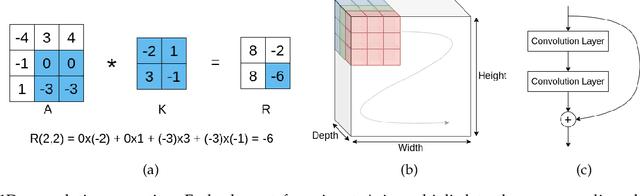
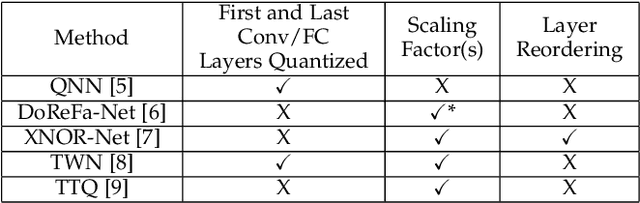
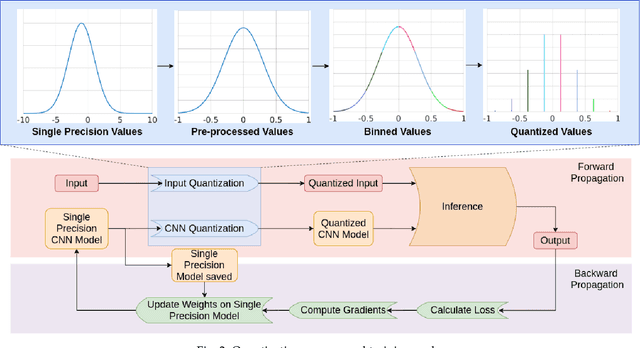
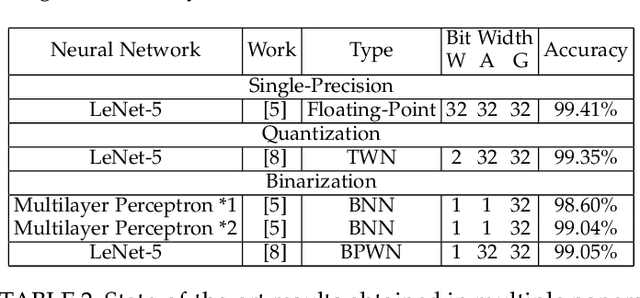
In recent years, Convolutional Neural Networks (CNNs) have become the standard class of deep neural network for image processing, classification and segmentation tasks. However, the large strides in accuracy obtained by CNNs have been derived from increasing the complexity of network topologies, which incurs sizeable performance and energy penalties in the training and inference of CNNs. Many recent works have validated the effectiveness of parameter quantization, which consists in reducing the bit width of the network's parameters, to enable the attainment of considerable performance and energy efficiency gains without significantly compromising accuracy. However, it is difficult to compare the relative effectiveness of different quantization methods. To address this problem, we introduce RedBit, an open-source framework that provides a transparent, extensible and easy-to-use interface to evaluate the effectiveness of different algorithms and parameter configurations on network accuracy. We use RedBit to perform a comprehensive survey of five state-of-the-art quantization methods applied to the MNIST, CIFAR-10 and ImageNet datasets. We evaluate a total of 2300 individual bit width combinations, independently tuning the width of the network's weight and input activation parameters, from 32 bits down to 1 bit (e.g., 8/8, 2/2, 1/32, 1/1, for weights/activations). Upwards of 20000 hours of computing time in a pool of state-of-the-art GPUs were used to generate all the results in this paper. For 1-bit quantization, the accuracy losses for the MNIST, CIFAR-10 and ImageNet datasets range between [0.26%, 0.79%], [9.74%, 32.96%] and [10.86%, 47.36%] top-1, respectively. We actively encourage the reader to download the source code and experiment with RedBit, and to submit their own observed results to our public repository, available at https://github.com/IT-Coimbra/RedBit.