 Add to Chrome
 Add to Firefox
 Add to Edge
RPRA: Predicting an LLM-Judge for Efficient but Performant Inference
Apr 14, 2026
Large language models (LLMs) face a fundamental trade-off between computational efficiency (e.g., number of parameters) and output quality, especially when deployed on computationally limited devices such as phones or laptops. One way to address this challenge is by following the example of humans and have models ask for help when they believe they are incapable of solving a problem on their own; we can overcome this trade-off by allowing smaller models to respond to queries when they believe they can provide good responses, and deferring to larger models when they do not believe they can. To this end, in this paper, we investigate the viability of Predict-Answer/Act (PA) and Reason-Predict-Reason-Answer/Act (RPRA) paradigms where models predict -- prior to responding -- how an LLM judge would score their output. We evaluate three approaches: zero-shot prediction, prediction using an in-context report card, and supervised fine-tuning. Our results show that larger models (particularly reasoning models) perform well when predicting generic LLM judges zero-shot, while smaller models can reliably predict such judges well after being fine-tuned or provided with an in-context report card. Altogether, both approaches can substantially improve the prediction accuracy of smaller models, with report cards and fine-tuning achieving mean improvements of up to 55% and 52% across datasets, respectively. These findings suggest that models can learn to predict their own performance limitations, paving the way for more efficient and self-aware AI systems.

Supervised and Unsupervised Alignments for Spoofing Behavioral Biometrics
Aug 14, 2024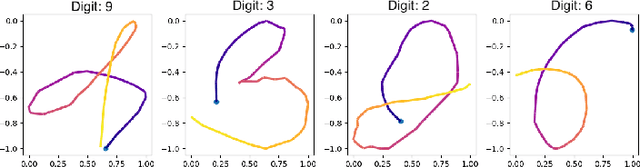
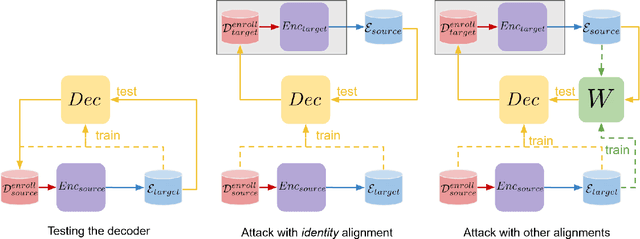
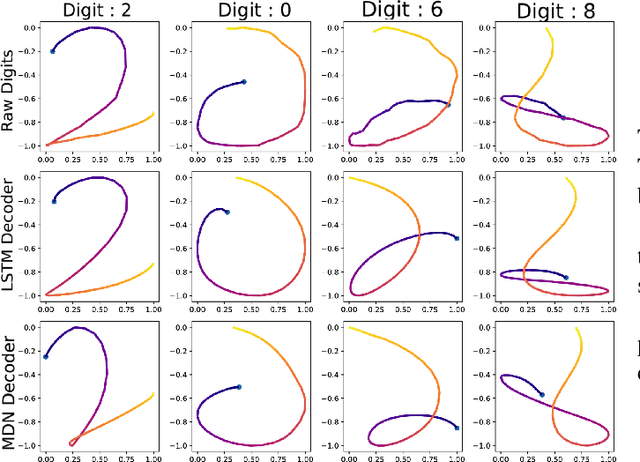
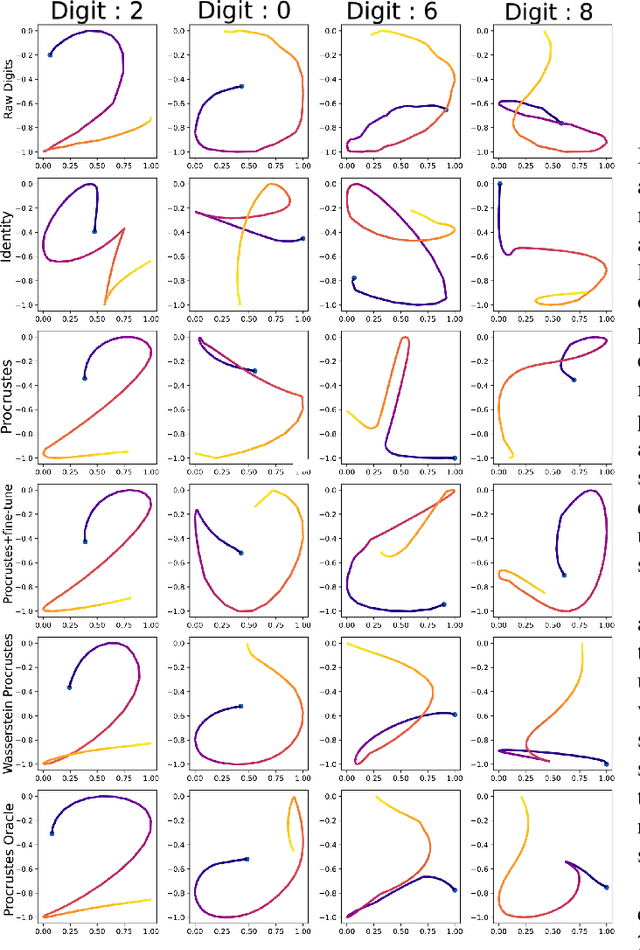
Biometric recognition systems are security systems based on intrinsic properties of their users, usually encoded in high dimension representations called embeddings, which potential theft would represent a greater threat than a temporary password or a replaceable key. To study the threat of embedding theft, we perform spoofing attacks on two behavioral biometric systems (an automatic speaker verification system and a handwritten digit analysis system) using a set of alignment techniques. Biometric recognition systems based on embeddings work in two phases: enrollment - where embeddings are collected and stored - then authentication - when new embeddings are compared to the stored ones -.The threat of stolen enrollment embeddings has been explored by the template reconstruction attack literature: reconstructing the original data to spoof an authentication system is doable with black-box access to their encoder. In this document, we explore the options available to perform template reconstruction attacks without any access to the encoder. To perform those attacks, we suppose general rules over the distribution of embeddings across encoders and use supervised and unsupervised algorithms to align an unlabeled set of embeddings with a set from a known encoder. The use of an alignment algorithm from the unsupervised translation literature gives promising results on spoofing two behavioral biometric systems.
On the invertibility of a voice privacy system using embedding alignement
Oct 08, 2021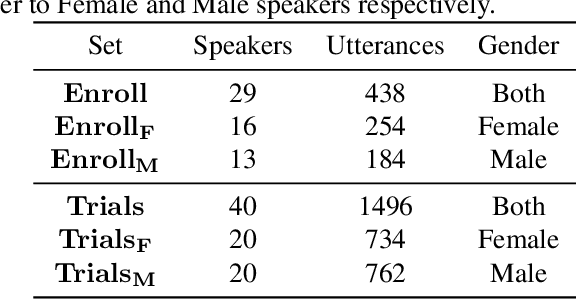
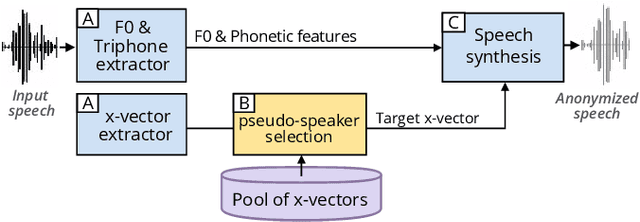
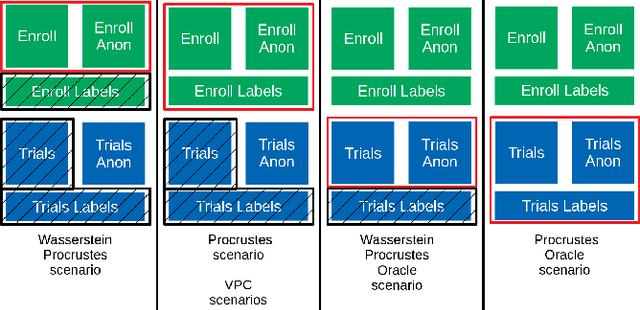
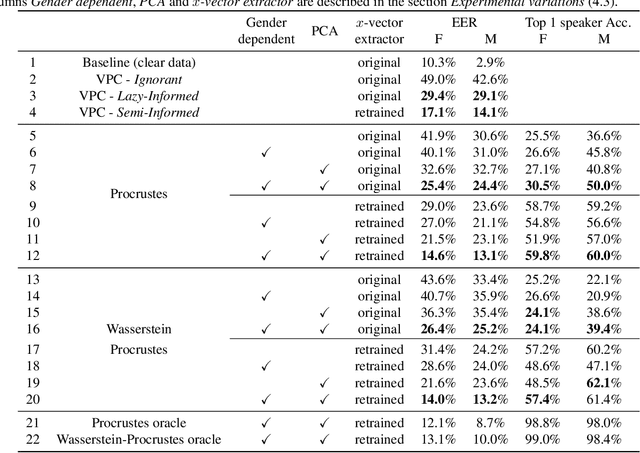
This paper explores various attack scenarios on a voice anonymization system using embeddings alignment techniques. We use Wasserstein-Procrustes (an algorithm initially designed for unsupervised translation) or Procrustes analysis to match two sets of x-vectors, before and after voice anonymization, to mimic this transformation as a rotation function. We compute the optimal rotation and compare the results of this approximation to the official Voice Privacy Challenge results. We show that a complex system like the baseline of the Voice Privacy Challenge can be approximated by a rotation, estimated using a limited set of x-vectors. This paper studies the space of solutions for voice anonymization within the specific scope of rotations. Rotations being reversible, the proposed method can recover up to 62% of the speaker identities from anonymized embeddings.