 Add to Chrome
 Add to Firefox
 Add to Edge
Pareto Optimal Benchmarking of AI Models on ARM Cortex Processors for Sustainable Embedded Systems
Feb 19, 2026
This work presents a practical benchmarking framework for optimizing artificial intelligence (AI) models on ARM Cortex processors (M0+, M4, M7), focusing on energy efficiency, accuracy, and resource utilization in embedded systems. Through the design of an automated test bench, we provide a systematic approach to evaluate across key performance indicators (KPIs) and identify optimal combinations of processor and AI model. The research highlights a nearlinear correlation between floating-point operations (FLOPs) and inference time, offering a reliable metric for estimating computational demands. Using Pareto analysis, we demonstrate how to balance trade-offs between energy consumption and model accuracy, ensuring that AI applications meet performance requirements without compromising sustainability. Key findings indicate that the M7 processor is ideal for short inference cycles, while the M4 processor offers better energy efficiency for longer inference tasks. The M0+ processor, while less efficient for complex AI models, remains suitable for simpler tasks. This work provides insights for developers, guiding them to design energy-efficient AI systems that deliver high performance in realworld applications.
* 11 pages, 7 figures, Funding: GreenICT@FMD (BMFTR grant 16ME0491K)

Refining Diffusion Models for Motion Synthesis with an Acceleration Loss to Generate Realistic IMU Data
Dec 09, 2025We propose a text-to-IMU (inertial measurement unit) motion-synthesis framework to obtain realistic IMU data by fine-tuning a pretrained diffusion model with an acceleration-based second-order loss (L_acc). L_acc enforces consistency in the discrete second-order temporal differences of the generated motion, thereby aligning the diffusion prior with IMU-specific acceleration patterns. We integrate L_acc into the training objective of an existing diffusion model, finetune the model to obtain an IMU-specific motion prior, and evaluate the model with an existing text-to-IMU framework that comprises surface modelling and virtual sensor simulation. We analysed acceleration signal fidelity and differences between synthetic motion representation and actual IMU recordings. As a downstream application, we evaluated Human Activity Recognition (HAR) and compared the classification performance using data of our method with the earlier diffusion model and two additional diffusion model baselines. When we augmented the earlier diffusion model objective with L_acc and continued training, L_acc decreased by 12.7% relative to the original model. The improvements were considerably larger in high-dynamic activities (i.e., running, jumping) compared to low-dynamic activities~(i.e., sitting, standing). In a low-dimensional embedding, the synthetic IMU data produced by our refined model shifts closer to the distribution of real IMU recordings. HAR classification trained exclusively on our refined synthetic IMU data improved performance by 8.7% compared to the earlier diffusion model and by 7.6% over the best-performing comparison diffusion model. We conclude that acceleration-aware diffusion refinement provides an effective approach to align motion generation and IMU synthesis and highlights how flexible deep learning pipelines are for specialising generic text-to-motion priors to sensor-specific tasks.
Deep learning and differential equations for modeling changes in individual-level latent dynamics between observation periods
Feb 15, 2022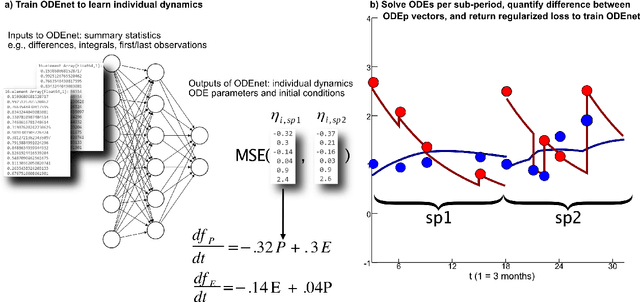
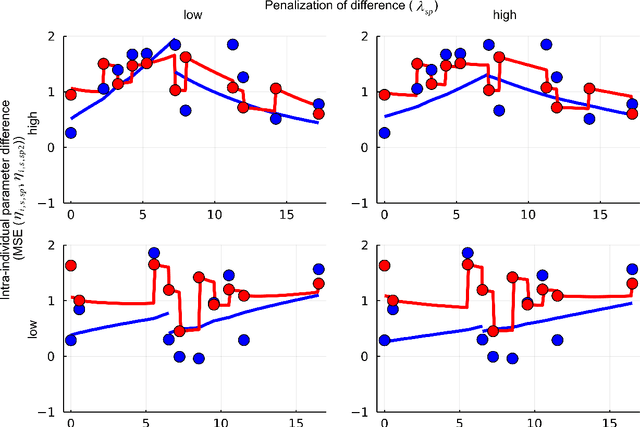
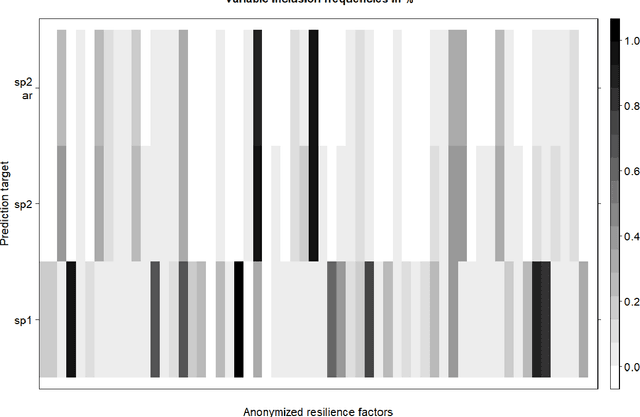
When modeling longitudinal biomedical data, often dimensionality reduction as well as dynamic modeling in the resulting latent representation is needed. This can be achieved by artificial neural networks for dimension reduction, and differential equations for dynamic modeling of individual-level trajectories. However, such approaches so far assume that parameters of individual-level dynamics are constant throughout the observation period. Motivated by an application from psychological resilience research, we propose an extension where different sets of differential equation parameters are allowed for observation sub-periods. Still, estimation for intra-individual sub-periods is coupled for being able to fit the model also with a relatively small dataset. We subsequently derive prediction targets from individual dynamic models of resilience in the application. These serve as interpretable resilience-related outcomes, to be predicted from characteristics of individuals, measured at baseline and a follow-up time point, and selecting a small set of important predictors. Our approach is seen to successfully identify individual-level parameters of dynamic models that allows us to stably select predictors, i.e., resilience factors. Furthermore, we can identify those characteristics of individuals that are the most promising for updates at follow-up, which might inform future study design. This underlines the usefulness of our proposed deep dynamic modeling approach with changes in parameters between observation sub-periods.