 Add to Chrome
 Add to Firefox
 Add to Edge
LACUNA: Safe Agents as Recursive Program Holes
May 27, 2026
LLM agents increasingly act by writing code, yet a split persists between the runtime that drives the agent and the code the model writes. The runtime owns the loop, context, and control flow, and the model has little say over any of them. Letting model-written code shape the runtime itself would make agents more expressive, but it would also sharpen safety problems. A model can be diverted by a prompt injection, call the wrong tool, or fail partway and leave an inconsistent state, and each such failure reaches further when the code shapes the runtime than when it expresses a single action. We present LACUNA, a programming model for agents that closes this split while preserving safety. Each agent action is a typed call $\texttt{agent[T](task)}$ that the LLM fills with code when execution reaches it, and the code is type-checked against the surrounding program before it runs. Because each action is accepted or rejected as a whole, a rejected one leaves the environment untouched, and its compiler diagnostics drive a retry. The same check also bounds which tools and data an action may use and how they flow. Our primitive expresses ReAct loops, sub-agents, skills, parallel decomposition, and multi-model planning as ordinary control flow. We evaluate LACUNA on a collection of test cases, BrowseComp-Plus, and $τ^2$-bench. On BrowseComp-Plus, $8.6\%$ of generations are rejected before execution, with 0.7 retries per query on average, and the agent reaches $27.1\%$ accuracy. On $τ^2$-bench, LACUNA solves $76.0\%$ of $392$ tasks across four domains with a capable model, on par with the baseline agent.

Layer-wise Quantization for Quantized Optimistic Dual Averaging
May 20, 2025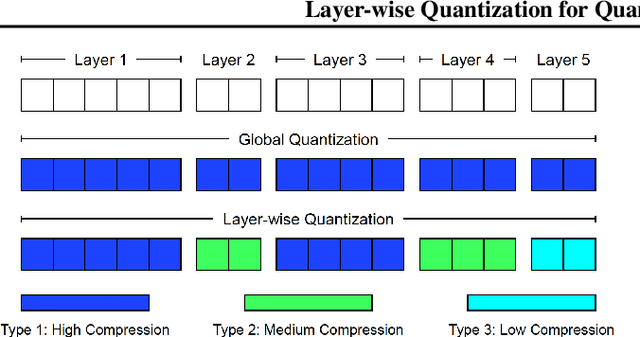
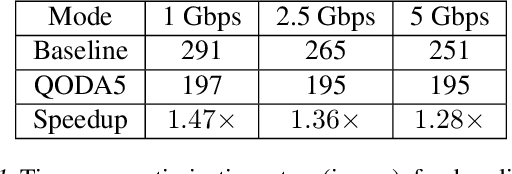
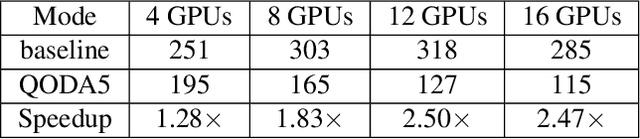
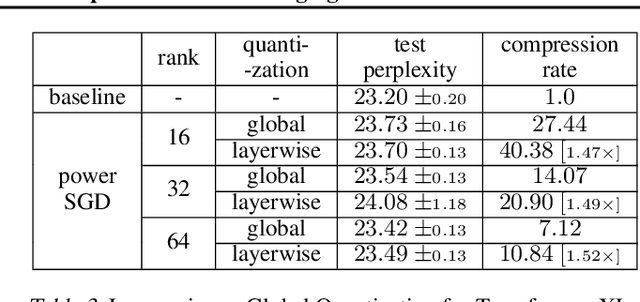
Modern deep neural networks exhibit heterogeneity across numerous layers of various types such as residuals, multi-head attention, etc., due to varying structures (dimensions, activation functions, etc.), distinct representation characteristics, which impact predictions. We develop a general layer-wise quantization framework with tight variance and code-length bounds, adapting to the heterogeneities over the course of training. We then apply a new layer-wise quantization technique within distributed variational inequalities (VIs), proposing a novel Quantized Optimistic Dual Averaging (QODA) algorithm with adaptive learning rates, which achieves competitive convergence rates for monotone VIs. We empirically show that QODA achieves up to a $150\%$ speedup over the baselines in end-to-end training time for training Wasserstein GAN on $12+$ GPUs.
Quantum-PEFT: Ultra parameter-efficient fine-tuning
Mar 07, 2025This paper introduces Quantum-PEFT that leverages quantum computations for parameter-efficient fine-tuning (PEFT). Unlike other additive PEFT methods, such as low-rank adaptation (LoRA), Quantum-PEFT exploits an underlying full-rank yet surprisingly parameter efficient quantum unitary parameterization. With the use of Pauli parameterization, the number of trainable parameters grows only logarithmically with the ambient dimension, as opposed to linearly as in LoRA-based PEFT methods. Quantum-PEFT achieves vanishingly smaller number of trainable parameters than the lowest-rank LoRA as dimensions grow, enhancing parameter efficiency while maintaining a competitive performance. We apply Quantum-PEFT to several transfer learning benchmarks in language and vision, demonstrating significant advantages in parameter efficiency.