 Add to Chrome
 Add to Firefox
 Add to Edge
Contract-Based Compositional Shielding for Safe Multi-Agent Reinforcement Learning
Jun 12, 2026
Safe coordination problems surface in multi-agent reinforcement learning when global safety cannot be enforced by any agent unilaterally: the admissibility of one agent's action may depend on the dynamics of other agents. Decentralised shields can enforce safety at runtime, but purely factorised permissions often exclude optimal team behaviour that is safe only through coordination. We study deterministic safety guarantees for agents trained and deployed under decentralised execution, recovering team-optimal safe behaviour without centralised runtime control. Agents have a shared global specification $φ$ in the safety fragment of Linear Temporal Logic ($\mathsf{LTL}_{\mathsf{safe}}$ ), and select among tuples of local $\mathsf{LTL}_{\mathsf{safe}}$ obligations whose conjunction implies the global specification $φ$. Each agent may rely on the other agents' local obligations as assumptions because the whole contract tuple is certified simultaneously and allows projection into local action masks. At learning time, a non-stationary multi-armed bandit chooses among a library of local $\mathsf{LTL}_{\mathsf{safe}}$ obligations to select the tuple that optimises team reward, all without forgoing end-to-end safety. We evaluate the approach across 6 environments and 15 algorithmic variants.

Robust Shielding for Safe Reinforcement Learning
May 29, 2026Shielding is an effective approach to formally guarantee the safety of reinforcement learning agents in Markov decision processes (MDPs). However, existing shielding techniques typically assume knowledge of the safety-relevant transition dynamics - a requirement that is seldom met in practice. To address this limitation, we introduce a novel shielding framework for robust MDPs (RMDPs), i.e., MDPs with sets of transition probabilities. We define safety as the satisfaction of a linear temporal logic (LTL) formula with a certain threshold probability under the worst-case transition probabilities of the RMDP. We prove that our shielding framework is both sound and optimal for the RMDP: every policy admissible by the shield is safe, and conversely, every safe RMDP policy is admissible by the shield. We combine our approach with existing sampling methods for learning transition probabilities of MDPs with probably approximately correct (PAC) guarantees. This combination enables the construction of shields for MDPs that, with high confidence, guarantee safety while remaining minimally restrictive. Our experiments show that our shields for learned RMDPs guarantee safety in unknown MDPs while recovering strong expected return as the number of samples increases.
Behaviour Policy Optimization: Provably Lower Variance Return Estimates for Off-Policy Reinforcement Learning
Nov 13, 2025Many reinforcement learning algorithms, particularly those that rely on return estimates for policy improvement, can suffer from poor sample efficiency and training instability due to high-variance return estimates. In this paper we leverage new results from off-policy evaluation; it has recently been shown that well-designed behaviour policies can be used to collect off-policy data for provably lower variance return estimates. This result is surprising as it means collecting data on-policy is not variance optimal. We extend this key insight to the online reinforcement learning setting, where both policy evaluation and improvement are interleaved to learn optimal policies. Off-policy RL has been well studied (e.g., IMPALA), with correct and truncated importance weighted samples for de-biasing and managing variance appropriately. Generally these approaches are concerned with reconciling data collected from multiple workers in parallel, while the policy is updated asynchronously, mismatch between the workers and policy is corrected in a mathematically sound way. Here we consider only one worker - the behaviour policy, which is used to collect data for policy improvement, with provably lower variance return estimates. In our experiments we extend two policy-gradient methods with this regime, demonstrating better sample efficiency and performance over a diverse set of environments.
Probabilistic Shielding for Safe Reinforcement Learning
Mar 09, 2025

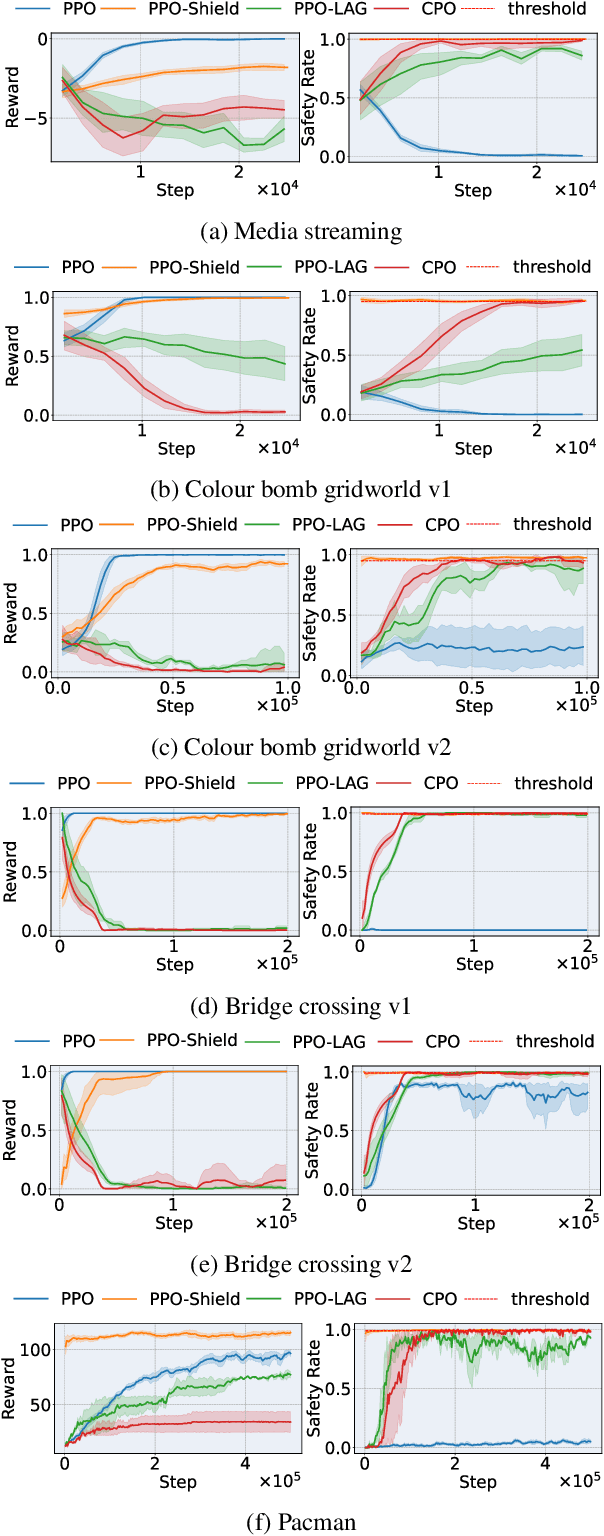

In real-life scenarios, a Reinforcement Learning (RL) agent aiming to maximise their reward, must often also behave in a safe manner, including at training time. Thus, much attention in recent years has been given to Safe RL, where an agent aims to learn an optimal policy among all policies that satisfy a given safety constraint. However, strict safety guarantees are often provided through approaches based on linear programming, and thus have limited scaling. In this paper we present a new, scalable method, which enjoys strict formal guarantees for Safe RL, in the case where the safety dynamics of the Markov Decision Process (MDP) are known, and safety is defined as an undiscounted probabilistic avoidance property. Our approach is based on state-augmentation of the MDP, and on the design of a shield that restricts the actions available to the agent. We show that our approach provides a strict formal safety guarantee that the agent stays safe at training and test time. Furthermore, we demonstrate that our approach is viable in practice through experimental evaluation.