 Add to Chrome
 Add to Firefox
 Add to Edge
Interp3R: Continuous-time 3D Geometry Estimation with Frames and Events
Mar 15, 2026
In recent years, 3D visual foundation models pioneered by pointmap-based approaches such as DUSt3R have attracted a lot of interest, achieving impressive accuracy and strong generalization across diverse scenes. However, these methods are inherently limited to recovering scene geometry only at the discrete time instants when images are captured, leaving the scene evolution during the blind time between consecutive frames largely unexplored. We introduce Interp3R, to the best of our knowledge the first method that enhances pointmap-based models to estimate depth and camera poses at arbitrary time instants. Interp3R leverages asynchronous event data to interpolate pointmaps produced by frame-based models, enabling temporally continuous geometric representations. Depth and camera poses are then jointly recovered by aligning the interpolated pointmaps together with those predicted by the underlying frame-based models into a consistent spatial framework. We train Interp3R exclusively on a synthetic dataset, yet demonstrate strong generalization across a wide range of synthetic and real-world benchmarks. Extensive experiments show that Interp3R outperforms by a considerable margin state-of-the-art baselines that follow a two-stage pipeline of 2D video frame interpolation followed by 3D geometry estimation.

Event-based Tracking of Any Point with Motion-Robust Correlation Features
Nov 28, 2024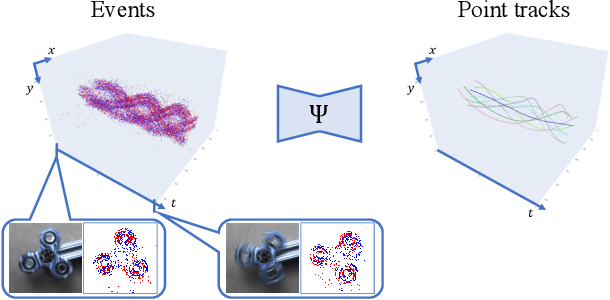

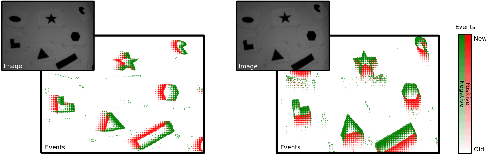
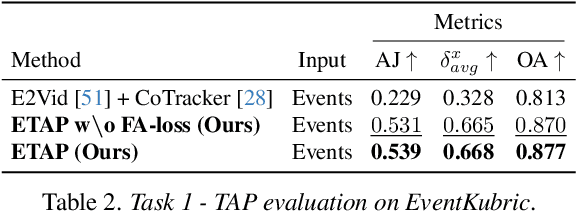
Tracking any point (TAP) recently shifted the motion estimation paradigm from focusing on individual salient points with local templates to tracking arbitrary points with global image contexts. However, while research has mostly focused on driving the accuracy of models in nominal settings, addressing scenarios with difficult lighting conditions and high-speed motions remains out of reach due to the limitations of the sensor. This work addresses this challenge with the first event camera-based TAP method. It leverages the high temporal resolution and high dynamic range of event cameras for robust high-speed tracking, and the global contexts in TAP methods to handle asynchronous and sparse event measurements. We further extend the TAP framework to handle event feature variations induced by motion - thereby addressing an open challenge in purely event-based tracking - with a novel feature alignment loss which ensures the learning of motion-robust features. Our method is trained with data from a new data generation pipeline and systematically ablated across all design decisions. Our method shows strong cross-dataset generalization and performs 135% better on the average Jaccard metric than the baselines. Moreover, on an established feature tracking benchmark, it achieves a 19% improvement over the previous best event-only method and even surpasses the previous best events-and-frames method by 3.7%.