 Add to Chrome
 Add to Firefox
 Add to Edge
AI Co-Mathematician: Accelerating Mathematicians with Agentic AI
May 07, 2026
We introduce the AI co-mathematician, a workbench for mathematicians to interactively leverage AI agents to pursue open-ended research. The AI co-mathematician is optimized to provide holistic support for the exploratory and iterative reality of mathematical workflows, including ideation, literature search, computational exploration, theorem proving and theory building. By providing an asynchronous, stateful workspace that manages uncertainty, refines user intent, tracks failed hypotheses, and outputs native mathematical artifacts, the system mirrors human collaborative workflows. In early tests, the AI co-mathematician helped researchers solve open problems, identify new research directions, and uncover overlooked literature references. Besides demonstrating a highly interactive paradigm for AI-assisted mathematical discovery, the AI co-mathematician also achieves state of the art results on hard problem-solving benchmarks, including scoring 48% on FrontierMath Tier 4, a new high score among all AI systems evaluated.

Intentmaking and Sensemaking: Human Interaction with AI-Guided Mathematical Discovery
May 07, 2026Artificial intelligence offers powerful new tools for scientific discovery, but the interaction paradigms required to effectively harness these systems remain underexplored. In this paper, we present findings from a formative user study with 11 expert mathematicians who used AlphaEvolve, an evolutionary coding agent, to tackle advanced problems in their fields of expertise. We identify and characterize a distinct workflow we term intentmaking, the iterative process of discovering, defining, and refining one's experimental goals through active system interaction. We frame this as a natural extension to sensemaking, the cognitive process of building an understanding of complex or novel data. We suggest that users enter a cycle of intentmaking (defining and updating their experiment) and sensemaking (interpreting the results) which repeats many times during the course of an investigation. Our documentation of these themes suggests an approach to designing AI tools for scientific discovery that goes beyond the existing question/answer model of many current systems, treating them as collaborative instruments rather than opaque black-box assistants.
The What-If Tool: Interactive Probing of Machine Learning Models
Jul 09, 2019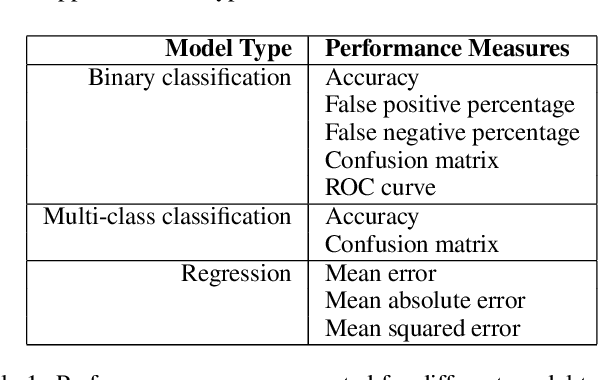
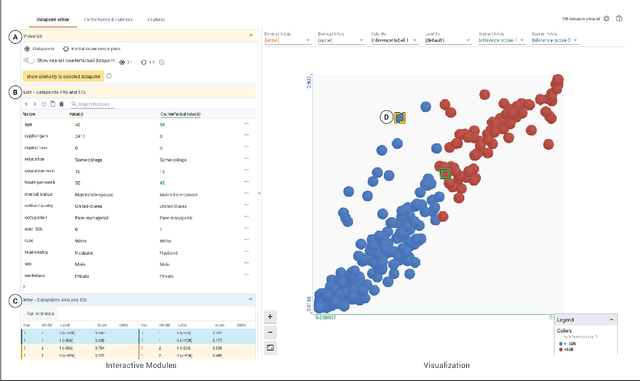
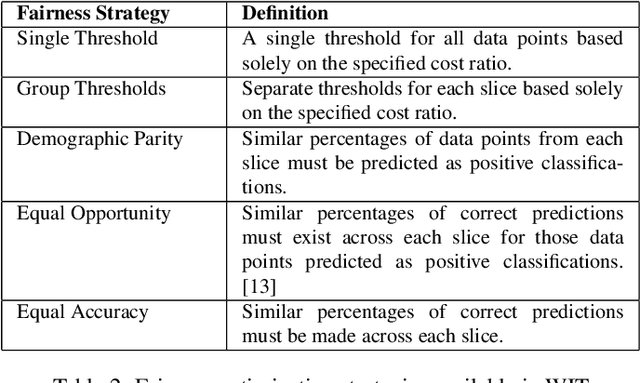
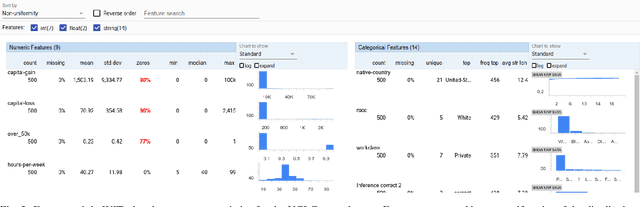
A key challenge in developing and deploying Machine Learning (ML) systems is understanding their performance across a wide range of inputs. To address this challenge, we created the What-If Tool, an open-source application that allows practitioners to probe, visualize, and analyze ML systems, with minimal coding. The What-If Tool lets practitioners test performance in hypothetical situations, analyze the importance of different data features, and visualize model behavior across multiple models and subsets of input data. It also lets practitioners measure systems according to multiple ML fairness metrics. We describe the design of the tool, and report on real-life usage at different organizations.
Interpretability Beyond Feature Attribution: Quantitative Testing with Concept Activation Vectors (TCAV)
Jun 07, 2018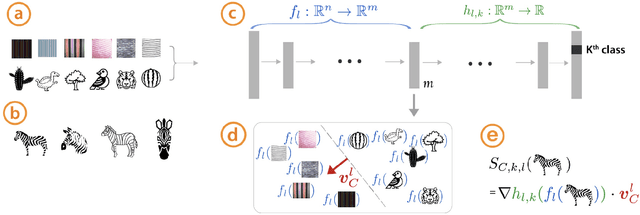

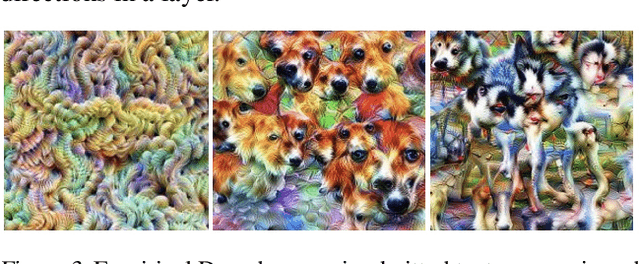
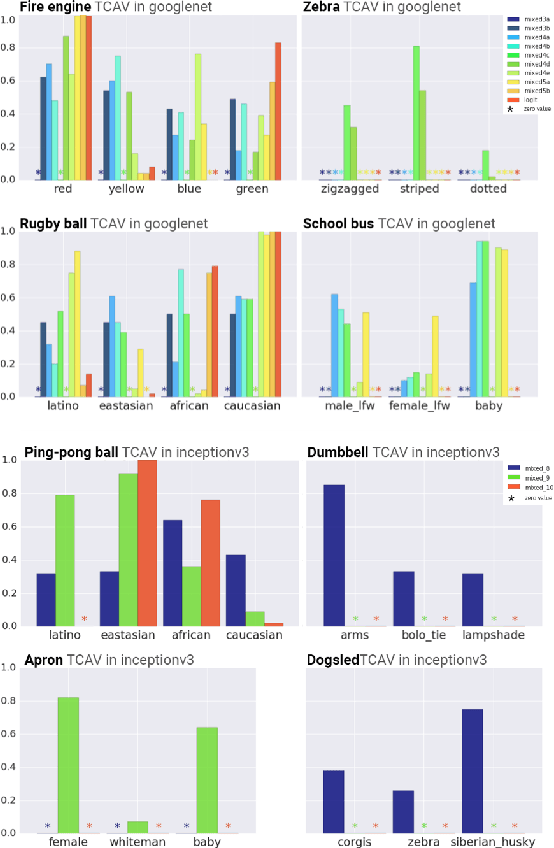
The interpretation of deep learning models is a challenge due to their size, complexity, and often opaque internal state. In addition, many systems, such as image classifiers, operate on low-level features rather than high-level concepts. To address these challenges, we introduce Concept Activation Vectors (CAVs), which provide an interpretation of a neural net's internal state in terms of human-friendly concepts. The key idea is to view the high-dimensional internal state of a neural net as an aid, not an obstacle. We show how to use CAVs as part of a technique, Testing with CAVs (TCAV), that uses directional derivatives to quantify the degree to which a user-defined concept is important to a classification result--for example, how sensitive a prediction of "zebra" is to the presence of stripes. Using the domain of image classification as a testing ground, we describe how CAVs may be used to explore hypotheses and generate insights for a standard image classification network as well as a medical application.
TensorFlow: Large-Scale Machine Learning on Heterogeneous Distributed Systems
Mar 16, 2016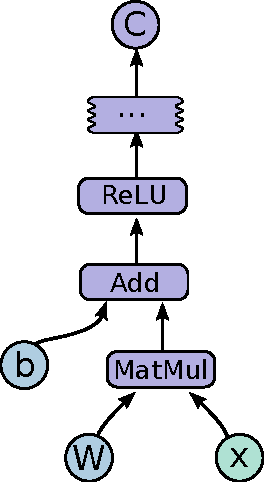
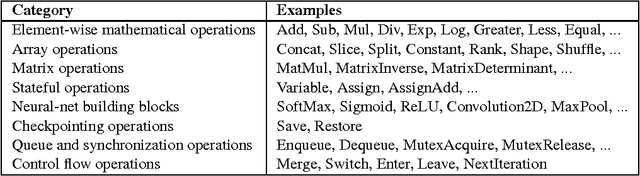
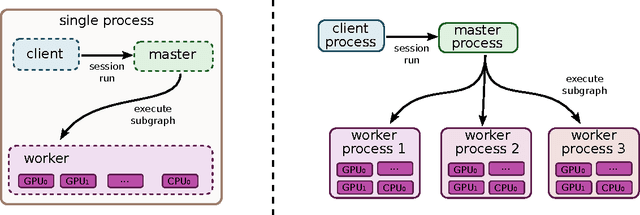
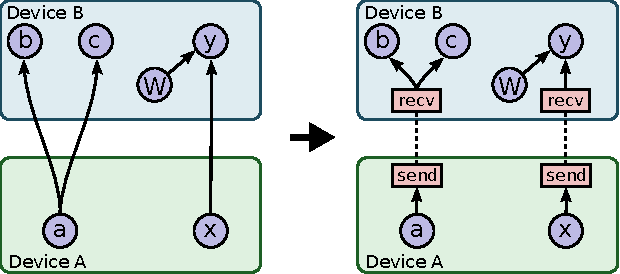
TensorFlow is an interface for expressing machine learning algorithms, and an implementation for executing such algorithms. A computation expressed using TensorFlow can be executed with little or no change on a wide variety of heterogeneous systems, ranging from mobile devices such as phones and tablets up to large-scale distributed systems of hundreds of machines and thousands of computational devices such as GPU cards. The system is flexible and can be used to express a wide variety of algorithms, including training and inference algorithms for deep neural network models, and it has been used for conducting research and for deploying machine learning systems into production across more than a dozen areas of computer science and other fields, including speech recognition, computer vision, robotics, information retrieval, natural language processing, geographic information extraction, and computational drug discovery. This paper describes the TensorFlow interface and an implementation of that interface that we have built at Google. The TensorFlow API and a reference implementation were released as an open-source package under the Apache 2.0 license in November, 2015 and are available at www.tensorflow.org.