 Add to Chrome
 Add to Firefox
 Add to Edge
Fundus Image-based Glaucoma Screening via Retinal Knowledge-Oriented Dynamic Multi-Level Feature Integration
Apr 14, 2026
Automated diagnosis based on color fundus photography is essential for large-scale glaucoma screening. However, existing deep learning models are typically data-driven and lack explicit integration of retinal anatomical knowledge, which limits their robustness across heterogeneous clinical datasets. Moreover, pathological cues in fundus images may appear beyond predefined anatomical regions, making fixed-region feature extraction insufficient for reliable diagnosis. To address these challenges, we propose a retinal knowledge-oriented glaucoma screening framework that integrates dynamic multi-scale feature learning with domain-specific retinal priors. The framework adopts a tri-branch structure to capture complementary retinal representations, including global retinal context, structural features of the optic disc/cup, and dynamically localized pathological regions. A Dynamic Window Mechanism is devised to adaptively identify diagnostically informative regions, while a Knowledge-Enhanced Convolutional Attention Module incorporates retinal priors extracted from a pre-trained foundation model to guide attention learning. Extensive experiments on the large-scale AIROGS dataset demonstrate that the proposed method outperforms diverse baselines, achieving an AUC of 98.5% and an accuracy of 94.6%. Additional evaluations on multiple datasets from the SMDG-19 benchmark further confirm its strong cross-domain generalization capability, indicating that knowledge-guided attention combined with adaptive lesion localization can significantly improve the robustness of automated glaucoma screening systems.

Knowledge-Enhanced Attentive Learning for Answer Selection in Community Question Answering Systems
Dec 17, 2019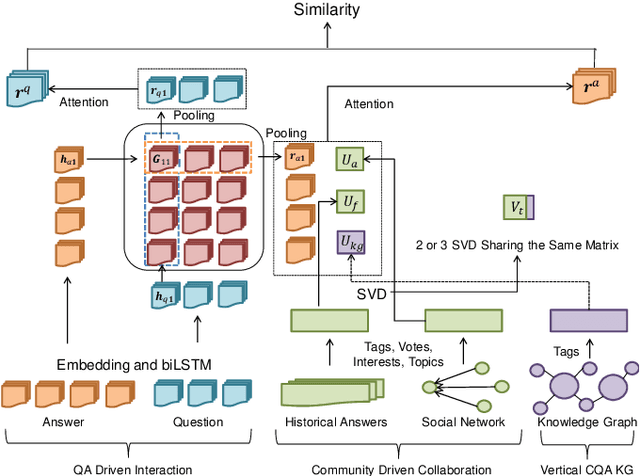
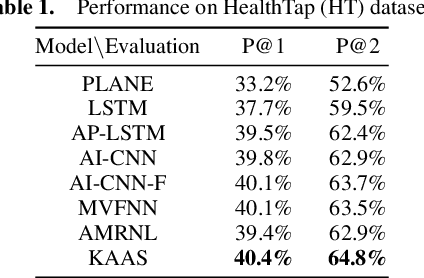
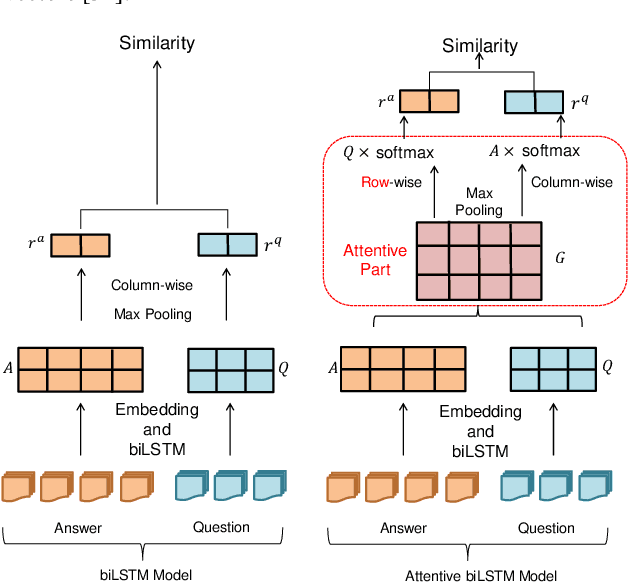
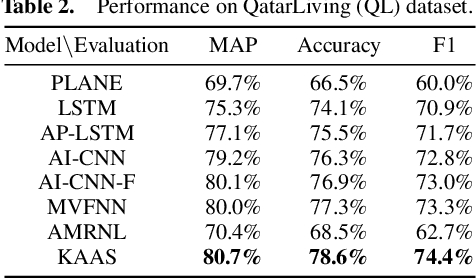
In the community question answering (CQA) system, the answer selection task aims to identify the best answer for a specific question, and thus is playing a key role in enhancing the service quality through recommending appropriate answers for new questions. Recent advances in CQA answer selection focus on enhancing the performance by incorporating the community information, particularly the expertise (previous answers) and authority (position in the social network) of an answerer. However, existing approaches for incorporating such information are limited in (a) only considering either the expertise or the authority, but not both; (b) ignoring the domain knowledge to differentiate topics of previous answers; and (c) simply using the authority information to adjust the similarity score, instead of fully utilizing it in the process of measuring the similarity between segments of the question and the answer. We propose the Knowledge-enhanced Attentive Answer Selection (KAAS) model, which enhances the performance through (a) considering both the expertise and the authority of the answerer; (b) utilizing the human-labeled tags, the taxonomy of the tags, and the votes as the domain knowledge to infer the expertise of the answer; (c) using matrix decomposition of the social network (formed by following-relationship) to infer the authority of the answerer and incorporating such information in the process of evaluating the similarity between segments. Besides, for vertical community, we incorporate an external knowledge graph to capture more professional information for vertical CQA systems. Then we adopt the attention mechanism to integrate the analysis of the text of questions and answers and the aforementioned community information. Experiments with both vertical and general CQA sites demonstrate the superior performance of the proposed KAAS model.