 Add to Chrome
 Add to Firefox
 Add to Edge
DISC: Dense Integrated Semantic Context for Large-Scale Open-Set Semantic Mapping
Mar 04, 2026
Open-set semantic mapping enables language-driven robotic perception, but current instance-centric approaches are bottlenecked by context-depriving and computationally expensive crop-based feature extraction. To overcome this fundamental limitation, we introduce DISC (Dense Integrated Semantic Context), featuring a novel single-pass, distance-weighted extraction mechanism. By deriving high-fidelity CLIP embeddings directly from the vision transformer's intermediate layers, our approach eliminates the latency and domain-shift artifacts of traditional image cropping, yielding pure, mask-aligned semantic representations. To fully leverage these features in large-scale continuous mapping, DISC is built upon a fully GPU-accelerated architecture that replaces periodic offline processing with precise, on-the-fly voxel-level instance refinement. We evaluate our approach on standard benchmarks (Replica, ScanNet) and a newly generated large-scale-mapping dataset based on Habitat-Matterport 3D (HM3DSEM) to assess scalability across complex scenes in multi-story buildings. Extensive evaluations demonstrate that DISC significantly surpasses current state-of-the-art zero-shot methods in both semantic accuracy and query retrieval, providing a robust, real-time capable framework for robotic deployment. The full source code, data generation and evaluation pipelines will be made available at https://github.com/DFKI-NI/DISC.

Agentic AI for Robot Control: Flexible but still Fragile
Feb 13, 2026Recent work leverages the capabilities and commonsense priors of generative models for robot control. In this paper, we present an agentic control system in which a reasoning-capable language model plans and executes tasks by selecting and invoking robot skills within an iterative planner and executor loop. We deploy the system on two physical robot platforms in two settings: (i) tabletop grasping, placement, and box insertion in indoor mobile manipulation (Mobipick) and (ii) autonomous agricultural navigation and sensing (Valdemar). Both settings involve uncertainty, partial observability, sensor noise, and ambiguous natural-language commands. The system exposes structured introspection of its planning and decision process, reacts to exogenous events via explicit event checks, and supports operator interventions that modify or redirect ongoing execution. Across both platforms, our proof-of-concept experiments reveal substantial fragility, including non-deterministic suboptimal behavior, instruction-following errors, and high sensitivity to prompt specification. At the same time, the architecture is flexible: transfer to a different robot and task domain largely required updating the system prompt (domain model, affordances, and action catalogue) and re-binding the same tool interface to the platform-specific skill API.
A Scene Graph Backed Approach to Open Set Semantic Mapping
Feb 03, 2026While Open Set Semantic Mapping and 3D Semantic Scene Graphs (3DSSGs) are established paradigms in robotic perception, deploying them effectively to support high-level reasoning in large-scale, real-world environments remains a significant challenge. Most existing approaches decouple perception from representation, treating the scene graph as a derivative layer generated post hoc. This limits both consistency and scalability. In contrast, we propose a mapping architecture where the 3DSSG serves as the foundational backend, acting as the primary knowledge representation for the entire mapping process. Our approach leverages prior work on incremental scene graph prediction to infer and update the graph structure in real-time as the environment is explored. This ensures that the map remains topologically consistent and computationally efficient, even during extended operations in large-scale settings. By maintaining an explicit, spatially grounded representation that supports both flat and hierarchical topologies, we bridge the gap between sub-symbolic raw sensor data and high-level symbolic reasoning. Consequently, this provides a stable, verifiable structure that knowledge-driven frameworks, ranging from knowledge graphs and ontologies to Large Language Models (LLMs), can directly exploit, enabling agents to operate with enhanced interpretability, trustworthiness, and alignment to human concepts.
LIEREx: Language-Image Embeddings for Robotic Exploration
Feb 02, 2026Semantic maps allow a robot to reason about its surroundings to fulfill tasks such as navigating known environments, finding specific objects, and exploring unmapped areas. Traditional mapping approaches provide accurate geometric representations but are often constrained by pre-designed symbolic vocabularies. The reliance on fixed object classes makes it impractical to handle out-of-distribution knowledge not defined at design time. Recent advances in Vision-Language Foundation Models, such as CLIP, enable open-set mapping, where objects are encoded as high-dimensional embeddings rather than fixed labels. In LIEREx, we integrate these VLFMs with established 3D Semantic Scene Graphs to enable target-directed exploration by an autonomous agent in partially unknown environments.
* This preprint has not undergone peer review or any post-submission improvements or corrections. The Version of Record of this article is published in KI - Künstliche Intelligenz, and is available online at https://doi.org/10.1007/s13218-026-00902-6
ExPrIS: Knowledge-Level Expectations as Priors for Object Interpretation from Sensor Data
Jan 21, 2026While deep learning has significantly advanced robotic object recognition, purely data-driven approaches often lack semantic consistency and fail to leverage valuable, pre-existing knowledge about the environment. This report presents the ExPrIS project, which addresses this challenge by investigating how knowledge-level expectations can serve as to improve object interpretation from sensor data. Our approach is based on the incremental construction of a 3D Semantic Scene Graph (3DSSG). We integrate expectations from two sources: contextual priors from past observations and semantic knowledge from external graphs like ConceptNet. These are embedded into a heterogeneous Graph Neural Network (GNN) to create an expectation-biased inference process. This method moves beyond static, frame-by-frame analysis to enhance the robustness and consistency of scene understanding over time. The report details this architecture, its evaluation, and outlines its planned integration on a mobile robotic platform.
* This preprint has not undergone peer review or any post-submission improvements or corrections. The Version of Record of this article is published in KI - Künstliche Intelligenz, and is available online at https://doi.org/10.1007/s13218-026-00901-7
Online Knowledge Integration for 3D Semantic Mapping: A Survey
Nov 27, 2024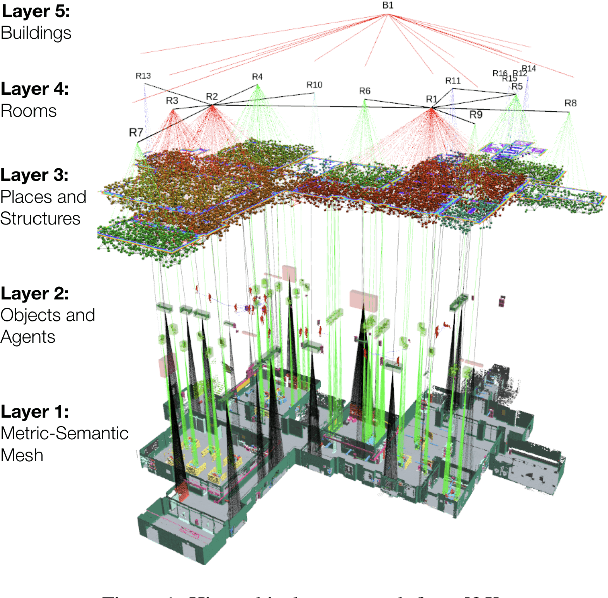
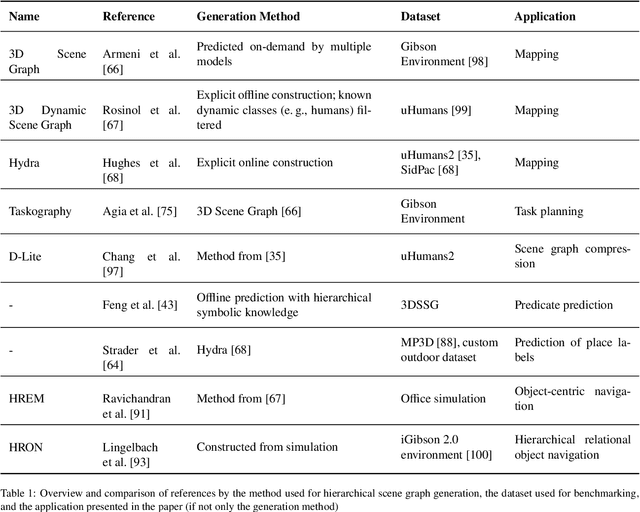
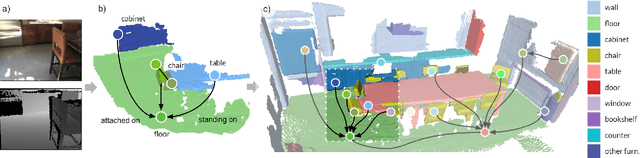
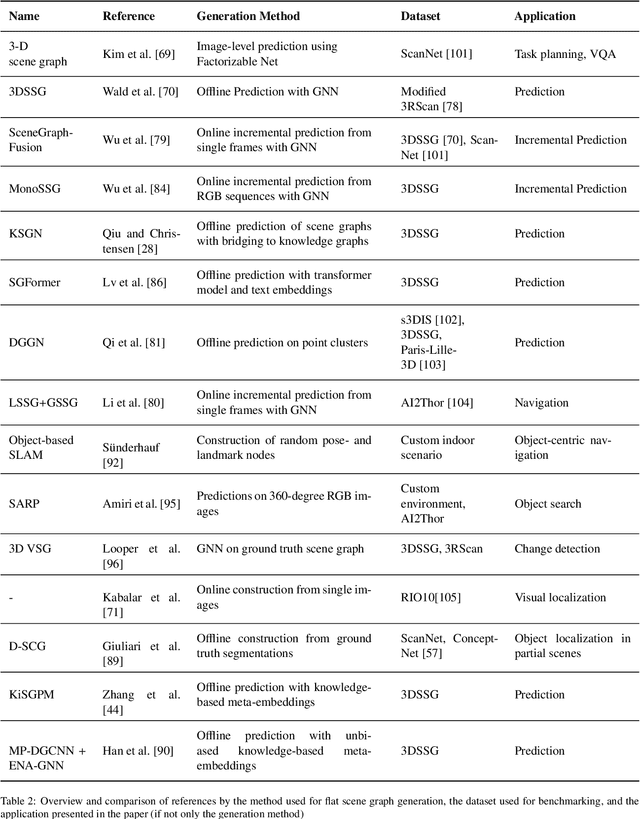
Semantic mapping is a key component of robots operating in and interacting with objects in structured environments. Traditionally, geometric and knowledge representations within a semantic map have only been loosely integrated. However, recent advances in deep learning now allow full integration of prior knowledge, represented as knowledge graphs or language concepts, into sensor data processing and semantic mapping pipelines. Semantic scene graphs and language models enable modern semantic mapping approaches to incorporate graph-based prior knowledge or to leverage the rich information in human language both during and after the mapping process. This has sparked substantial advances in semantic mapping, leading to previously impossible novel applications. This survey reviews these recent developments comprehensively, with a focus on online integration of knowledge into semantic mapping. We specifically focus on methods using semantic scene graphs for integrating symbolic prior knowledge and language models for respective capture of implicit common-sense knowledge and natural language concepts
Mesh-based Object Tracking for Dynamic Semantic 3D Scene Graphs via Ray Tracing
Aug 09, 2024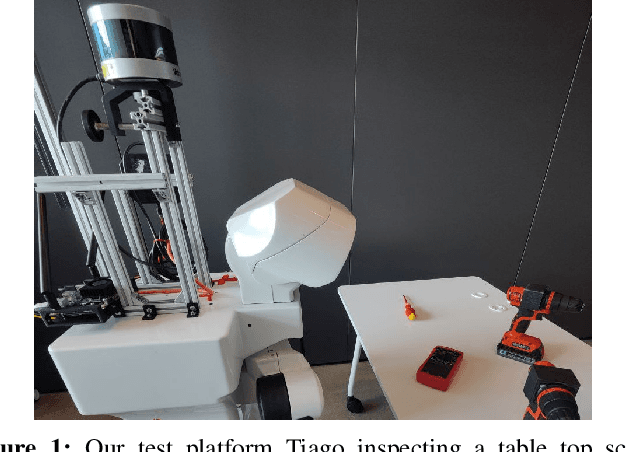
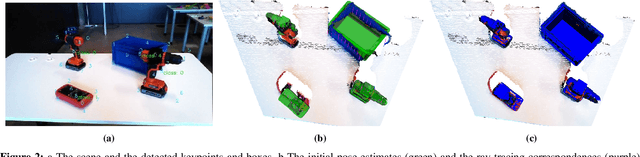
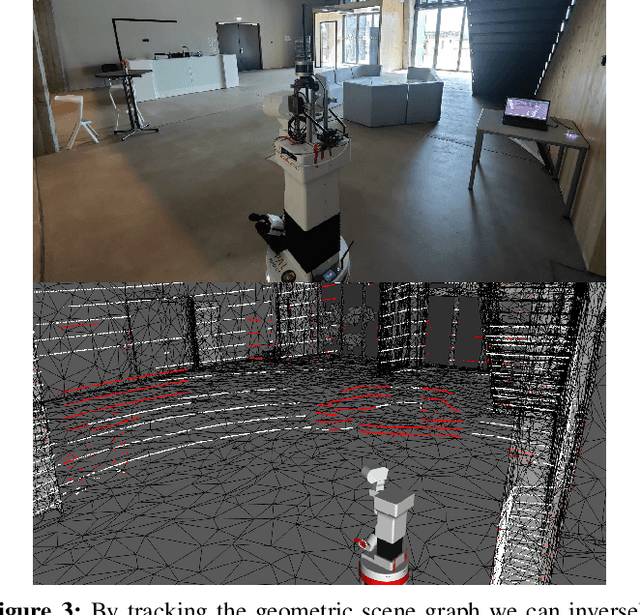
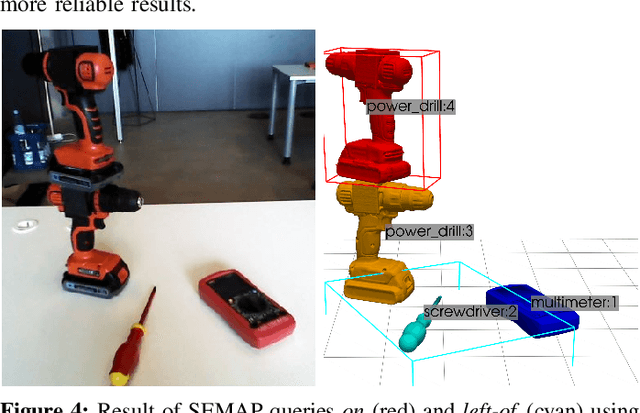
In this paper, we present a novel method for 3D geometric scene graph generation using range sensors and RGB cameras. We initially detect instance-wise keypoints with a YOLOv8s model to compute 6D pose estimates of known objects by solving PnP. We use a ray tracing approach to track a geometric scene graph consisting of mesh models of object instances. In contrast to classical point-to-point matching, this leads to more robust results, especially under occlusions between objects instances. We show that using this hybrid strategy leads to robust self-localization, pre-segmentation of the range sensor data and accurate pose tracking of objects using the same environmental representation. All detected objects are integrated into a semantic scene graph. This scene graph then serves as a front end to a semantic mapping framework to allow spatial reasoning.