 Add to Chrome
 Add to Firefox
 Add to Edge
Agentic AI for Robot Control: Flexible but still Fragile
Feb 13, 2026
Recent work leverages the capabilities and commonsense priors of generative models for robot control. In this paper, we present an agentic control system in which a reasoning-capable language model plans and executes tasks by selecting and invoking robot skills within an iterative planner and executor loop. We deploy the system on two physical robot platforms in two settings: (i) tabletop grasping, placement, and box insertion in indoor mobile manipulation (Mobipick) and (ii) autonomous agricultural navigation and sensing (Valdemar). Both settings involve uncertainty, partial observability, sensor noise, and ambiguous natural-language commands. The system exposes structured introspection of its planning and decision process, reacts to exogenous events via explicit event checks, and supports operator interventions that modify or redirect ongoing execution. Across both platforms, our proof-of-concept experiments reveal substantial fragility, including non-deterministic suboptimal behavior, instruction-following errors, and high sensitivity to prompt specification. At the same time, the architecture is flexible: transfer to a different robot and task domain largely required updating the system prompt (domain model, affordances, and action catalogue) and re-binding the same tool interface to the platform-specific skill API.

Uncertainty-Resilient Active Intention Recognition for Robotic Assistants
Aug 26, 2025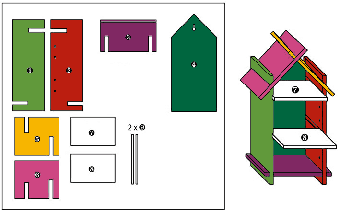
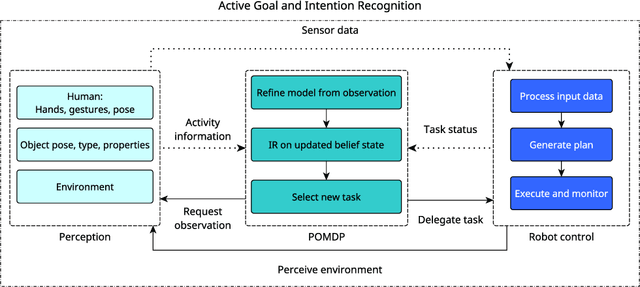
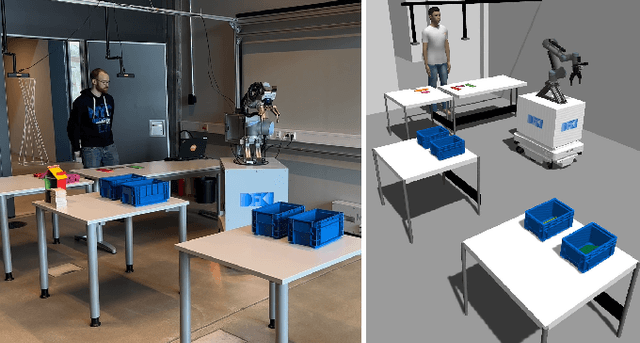
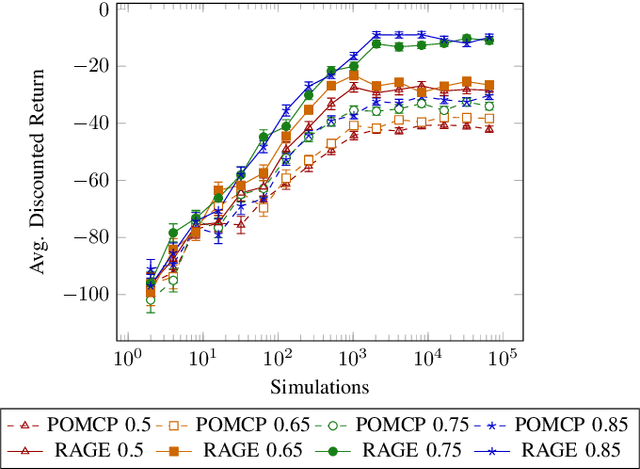
Purposeful behavior in robotic assistants requires the integration of multiple components and technological advances. Often, the problem is reduced to recognizing explicit prompts, which limits autonomy, or is oversimplified through assumptions such as near-perfect information. We argue that a critical gap remains unaddressed -- specifically, the challenge of reasoning about the uncertain outcomes and perception errors inherent to human intention recognition. In response, we present a framework designed to be resilient to uncertainty and sensor noise, integrating real-time sensor data with a combination of planners. Centered around an intention-recognition POMDP, our approach addresses cooperative planning and acting under uncertainty. Our integrated framework has been successfully tested on a physical robot with promising results.