 Add to Chrome
 Add to Firefox
 Add to Edge
Indexing: the Beginning and the End
Jul 24, 2026
We study information bottlenecks in modern deep-learning architectures -- RNNs, softmax transformers, linear-attention transformers and state-space models -- through the lens of the indexing primitive. In this primitive, the input consists of $n$ bits and one integer $i$ from $1$ to $n$ called the index, and the output equals the value of the $i$-th bit. We introduce causal complexity for masked architectures. We show that architectures with low causal complexity cannot solve the indexing primitive in any constant number of layers when the index appears at the end of the input. In particular, this limitation applies to low-parameter RNNs, SSMs and masked linear-attention transformers. In contrast, small softmax transformers can solve it in one layer, while non-masked linear-attention transformers can solve it in 2, which separates them from their masked counterparts. In turn, when the index appears at the beginning, we show that small RNNs are capable of solving this task in 1 layer, while all the other architectures require 2. All our impossibility results are unconditional and apply even to models that employ infinite-precision real arithmetic. Moreover, experiments for up to $n=64$ qualitatively align with our theory: configurations with low-parameter theoretical solutions learn the indexing task easily, while configurations that do not admit such theoretical solutions struggle to learn as the sequence length grows.

Positional versus Symbolic Attention Heads: Learning Dynamics, RoPE Geometry, and Length Generalization
May 29, 2026Transformer-based language models are widespread in today's society. As such, understanding the mechanisms by which they solve structured tasks and predicting how they may behave in novel scenarios is of great importance for safe deployment. We study the learning dynamics of attention heads in a controlled setting by training a decoder-only Transformer (GPT-J) on two structurally equivalent multi-hop reasoning tasks: a number task requiring positional reasoning and a letter task requiring symbolic reasoning. Using a recently introduced metric that classifies attention-head behavior as positional or symbolic for a given prompt, we show that successful learning is associated with the emergence of pure heads, i.e., heads that express themselves as either positional or symbolic. Despite the tasks' structural equivalence, they impose different mechanistic demands: the number task requires both positional and symbolic heads, whereas the letter task requires only symbolic heads. We then identify the computational roles of these heads, characterize the basic functions they implement, and give theoretical constructions showing how single-layer RoPE-based attention can realize these functions through geometrically interpretable query, key, and value operations. This analysis yields a quantitative separation between positional and symbolic mechanisms in their robustness to longer sequences, formalized through a novel notion of discrepancy. We empirically validate the resulting predictions in both controlled and real-world models, showing that symbolic mechanisms extrapolate more reliably to longer sequences while positional mechanisms face sharper limitations.
Continuity and Isolation Lead to Doubts or Dilemmas in Large Language Models
May 15, 2025Understanding how Transformers work and how they process information is key to the theoretical and empirical advancement of these machines. In this work, we demonstrate the existence of two phenomena in Transformers, namely isolation and continuity. Both of these phenomena hinder Transformers to learn even simple pattern sequences. Isolation expresses that any learnable sequence must be isolated from another learnable sequence, and hence some sequences cannot be learned by a single Transformer at the same time. Continuity entails that an attractor basin forms around a learned sequence, such that any sequence falling in that basin will collapse towards the learned sequence. Here, we mathematically prove these phenomena emerge in all Transformers that use compact positional encoding, and design rigorous experiments, demonstrating that the theoretical limitations we shed light on occur on the practical scale.
Strassen Attention: Unlocking Compositional Abilities in Transformers Based on a New Lower Bound Method
Jan 31, 2025


We propose a novel method to evaluate the theoretical limits of Transformers, allowing us to prove the first lower bounds against one-layer softmax Transformers with infinite precision. We establish those bounds for three tasks that require advanced reasoning. The first task, Match3 (Sanford et al., 2023), requires looking at all triples of positions. The second and third tasks address compositionality-based reasoning: one is composition of functions (Peng et al., 2024) and the other is composition of binary relations. We formally prove the inability of one-layer softmax Transformers to solve any of these tasks. In an attempt to overcome these limitations, we introduce Strassen attention and prove that with this mechanism a one-layer Transformer can in principle solve all these tasks. We also show that it enjoys sub-cubic running-time complexity, making it more scalable than similar previously proposed mechanisms, such as higher-order attention (Sanford et al., 2023). To complement our theoretical findings, we experimentally studied Strassen attention and compared it against standard (Vaswani et al, 2017), higher-order attention (Sanford et al., 2023) and triangular attention (Bergen et al. 2021). Our results help to disentangle all these attention mechanisms, highlighting their strengths and limitations. In particular, Strassen attention outperforms standard attention significantly on all the tasks. Altogether, understanding the theoretical limitations can guide research towards scalable attention mechanisms that improve the reasoning abilities of Transformers.
Zero-Shot Decision Tree Construction via Large Language Models
Jan 27, 2025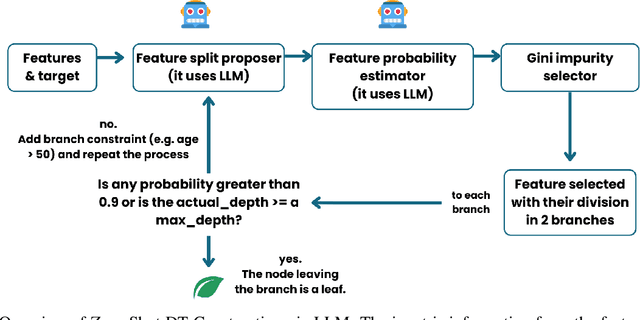
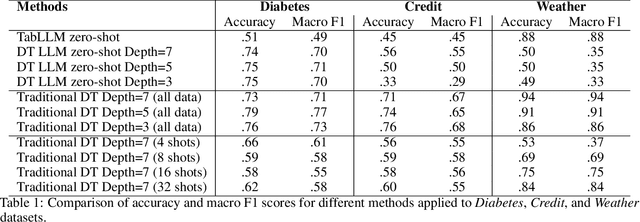
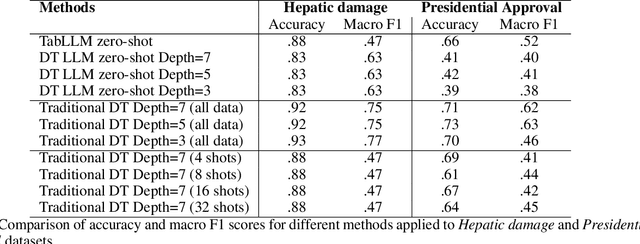
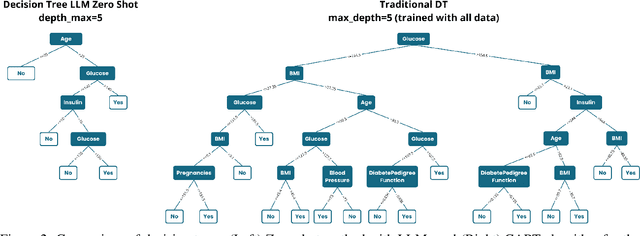
This paper introduces a novel algorithm for constructing decision trees using large language models (LLMs) in a zero-shot manner based on Classification and Regression Trees (CART) principles. Traditional decision tree induction methods rely heavily on labeled data to recursively partition data using criteria such as information gain or the Gini index. In contrast, we propose a method that uses the pre-trained knowledge embedded in LLMs to build decision trees without requiring training data. Our approach leverages LLMs to perform operations essential for decision tree construction, including attribute discretization, probability calculation, and Gini index computation based on the probabilities. We show that these zero-shot decision trees can outperform baseline zero-shot methods and achieve competitive performance compared to supervised data-driven decision trees on tabular datasets. The decision trees constructed via this method provide transparent and interpretable models, addressing data scarcity while preserving interpretability. This work establishes a new baseline in low-data machine learning, offering a principled, knowledge-driven alternative to data-driven tree construction.
Deep Natural Language Feature Learning for Interpretable Prediction
Nov 09, 2023We propose a general method to break down a main complex task into a set of intermediary easier sub-tasks, which are formulated in natural language as binary questions related to the final target task. Our method allows for representing each example by a vector consisting of the answers to these questions. We call this representation Natural Language Learned Features (NLLF). NLLF is generated by a small transformer language model (e.g., BERT) that has been trained in a Natural Language Inference (NLI) fashion, using weak labels automatically obtained from a Large Language Model (LLM). We show that the LLM normally struggles for the main task using in-context learning, but can handle these easiest subtasks and produce useful weak labels to train a BERT. The NLI-like training of the BERT allows for tackling zero-shot inference with any binary question, and not necessarily the ones seen during the training. We show that this NLLF vector not only helps to reach better performances by enhancing any classifier, but that it can be used as input of an easy-to-interpret machine learning model like a decision tree. This decision tree is interpretable but also reaches high performances, surpassing those of a pre-trained transformer in some cases.We have successfully applied this method to two completely different tasks: detecting incoherence in students' answers to open-ended mathematics exam questions, and screening abstracts for a systematic literature review of scientific papers on climate change and agroecology.
Who's the Best Detective? LLMs vs. MLs in Detecting Incoherent Fourth Grade Math Answers
Apr 21, 2023Written answers to open-ended questions can have a higher long-term effect on learning than multiple-choice questions. However, it is critical that teachers immediately review the answers, and ask to redo those that are incoherent. This can be a difficult task and can be time-consuming for teachers. A possible solution is to automate the detection of incoherent answers. One option is to automate the review with Large Language Models (LLM). In this paper, we analyze the responses of fourth graders in mathematics using three LLMs: GPT-3, BLOOM, and YOU. We used them with zero, one, two, three and four shots. We compared their performance with the results of various classifiers trained with Machine Learning (ML). We found that LLMs perform worse than MLs in detecting incoherent answers. The difficulty seems to reside in recursive questions that contain both questions and answers, and in responses from students with typical fourth-grader misspellings. Upon closer examination, we have found that the ChatGPT model faces the same challenges.