 Add to Chrome
 Add to Firefox
 Add to Edge
Positional versus Symbolic Attention Heads: Learning Dynamics, RoPE Geometry, and Length Generalization
May 29, 2026
Transformer-based language models are widespread in today's society. As such, understanding the mechanisms by which they solve structured tasks and predicting how they may behave in novel scenarios is of great importance for safe deployment. We study the learning dynamics of attention heads in a controlled setting by training a decoder-only Transformer (GPT-J) on two structurally equivalent multi-hop reasoning tasks: a number task requiring positional reasoning and a letter task requiring symbolic reasoning. Using a recently introduced metric that classifies attention-head behavior as positional or symbolic for a given prompt, we show that successful learning is associated with the emergence of pure heads, i.e., heads that express themselves as either positional or symbolic. Despite the tasks' structural equivalence, they impose different mechanistic demands: the number task requires both positional and symbolic heads, whereas the letter task requires only symbolic heads. We then identify the computational roles of these heads, characterize the basic functions they implement, and give theoretical constructions showing how single-layer RoPE-based attention can realize these functions through geometrically interpretable query, key, and value operations. This analysis yields a quantitative separation between positional and symbolic mechanisms in their robustness to longer sequences, formalized through a novel notion of discrepancy. We empirically validate the resulting predictions in both controlled and real-world models, showing that symbolic mechanisms extrapolate more reliably to longer sequences while positional mechanisms face sharper limitations.

Continuity and Isolation Lead to Doubts or Dilemmas in Large Language Models
May 15, 2025Understanding how Transformers work and how they process information is key to the theoretical and empirical advancement of these machines. In this work, we demonstrate the existence of two phenomena in Transformers, namely isolation and continuity. Both of these phenomena hinder Transformers to learn even simple pattern sequences. Isolation expresses that any learnable sequence must be isolated from another learnable sequence, and hence some sequences cannot be learned by a single Transformer at the same time. Continuity entails that an attractor basin forms around a learned sequence, such that any sequence falling in that basin will collapse towards the learned sequence. Here, we mathematically prove these phenomena emerge in all Transformers that use compact positional encoding, and design rigorous experiments, demonstrating that the theoretical limitations we shed light on occur on the practical scale.
Gradient-based inference of abstract task representations for generalization in neural networks
Jul 24, 2024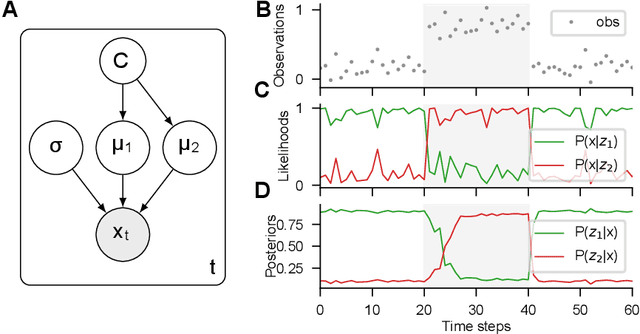
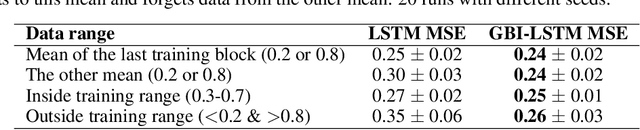
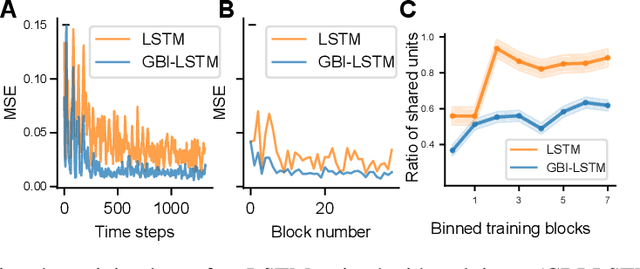
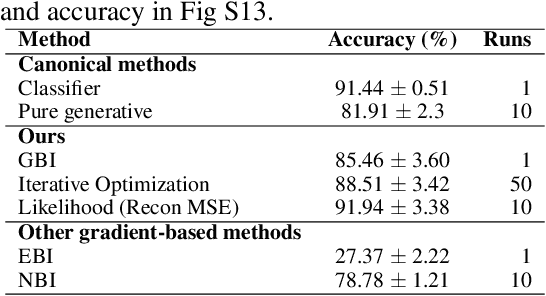
Humans and many animals show remarkably adaptive behavior and can respond differently to the same input depending on their internal goals. The brain not only represents the intermediate abstractions needed to perform a computation but also actively maintains a representation of the computation itself (task abstraction). Such separation of the computation and its abstraction is associated with faster learning, flexible decision-making, and broad generalization capacity. We investigate if such benefits might extend to neural networks trained with task abstractions. For such benefits to emerge, one needs a task inference mechanism that possesses two crucial abilities: First, the ability to infer abstract task representations when no longer explicitly provided (task inference), and second, manipulate task representations to adapt to novel problems (task recomposition). To tackle this, we cast task inference as an optimization problem from a variational inference perspective and ground our approach in an expectation-maximization framework. We show that gradients backpropagated through a neural network to a task representation layer are an efficient heuristic to infer current task demands, a process we refer to as gradient-based inference (GBI). Further iterative optimization of the task representation layer allows for recomposing abstractions to adapt to novel situations. Using a toy example, a novel image classifier, and a language model, we demonstrate that GBI provides higher learning efficiency and generalization to novel tasks and limits forgetting. Moreover, we show that GBI has unique advantages such as preserving information for uncertainty estimation and detecting out-of-distribution samples.