 Add to Chrome
 Add to Firefox
 Add to Edge
Positional versus Symbolic Attention Heads: Learning Dynamics, RoPE Geometry, and Length Generalization
May 29, 2026
Transformer-based language models are widespread in today's society. As such, understanding the mechanisms by which they solve structured tasks and predicting how they may behave in novel scenarios is of great importance for safe deployment. We study the learning dynamics of attention heads in a controlled setting by training a decoder-only Transformer (GPT-J) on two structurally equivalent multi-hop reasoning tasks: a number task requiring positional reasoning and a letter task requiring symbolic reasoning. Using a recently introduced metric that classifies attention-head behavior as positional or symbolic for a given prompt, we show that successful learning is associated with the emergence of pure heads, i.e., heads that express themselves as either positional or symbolic. Despite the tasks' structural equivalence, they impose different mechanistic demands: the number task requires both positional and symbolic heads, whereas the letter task requires only symbolic heads. We then identify the computational roles of these heads, characterize the basic functions they implement, and give theoretical constructions showing how single-layer RoPE-based attention can realize these functions through geometrically interpretable query, key, and value operations. This analysis yields a quantitative separation between positional and symbolic mechanisms in their robustness to longer sequences, formalized through a novel notion of discrepancy. We empirically validate the resulting predictions in both controlled and real-world models, showing that symbolic mechanisms extrapolate more reliably to longer sequences while positional mechanisms face sharper limitations.

Find a witness or shatter: the landscape of computable PAC learning
Feb 23, 2023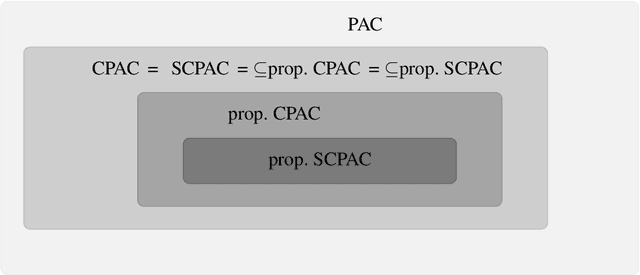
This paper contributes to the study of CPAC learnability -- a computable version of PAC learning -- by solving three open questions from recent papers. Firstly, we prove that every improperly CPAC learnable class is contained in a class which is properly CPAC learnable with polynomial sample complexity. This confirms a conjecture by Agarwal et al (COLT 2021). Secondly, we show that there exists a decidable class of hypothesis which is properly CPAC learnable, but only with uncomputably fast growing sample complexity. This solves a question from Sterkenburg (COLT 2022). Finally, we construct a decidable class of finite Littlestone dimension which is not improperly CPAC learnable, strengthening a recent result of Sterkenburg (2022) and answering a question posed by Hasrati and Ben-David (ALT 2023). Together with previous work, our results provide a complete landscape for the learnability problem in the CPAC setting.