 Add to Chrome
 Add to Firefox
 Add to Edge
MaxSAT-Based Feedback for Guiding Vision-Language Models in Sudoku
Jul 14, 2026
Vision--Language Models (VLMs) have recently demonstrated promising performance on structured visual reasoning tasks, including grid-based puzzles. However, despite strong perceptual capabilities, these models lack explicit mechanisms for enforcing logical consistency and frequently generate assignments that violate underlying constraints. In this paper, we propose a neuro-symbolic approach that integrates formal constraint reasoning into the VLM solving process via a Maximum Satisfiability (MaxSAT) oracle. Rather than computing solutions directly, the symbolic component acts as a consistency validator and refinement engine. Candidate placements generated by the VLM are encoded as soft clauses in a partial MaxSAT formulation, while Sudoku constraints remain hard clauses. When inconsistencies arise, the MaxSAT solver identifies a largest mutually consistent subset of assignments, which is then translated into structured textual and visual feedback to guide subsequent refinements. We evaluate our approach on a Sudoku dataset across multiple open-source and closed-access VLMs. Results show that MaxSAT-based feedback improves logical consistency and increases the number of solved instances, particularly in full-board refinement mode. These findings demonstrate that symbolic optimisation can enhance the reliability of vision-language reasoning.

Reliable Reasoning with Large Language Models via Preference-Based Maximum Satisfiability
May 28, 2026Large Language Models (LLMs) excel at understanding natural language but struggle with optimisation tasks involving multiple constraints and user-defined preferences, which commonly arise in domains such as robotics. We propose a hybrid reasoning approach in which LLMs externalise reasoning through code generation. Given a natural language problem description, an LLM generates Python code that encodes user-defined constraints and preferences as a preference-based Maximum Satisfiability (MaxSAT) problem, which is then solved by an exact MaxSAT solver. To ensure correctness, solutions returned by the model-generated code are independently verified for feasibility and optimality against a canonical MaxSAT encoding, allowing for different encodings and multiple optimal solutions. We evaluate our approach using both open-source and closed-access LLMs on three families of preference-based reasoning tasks, and compare it against direct-answer, chain-of-thought, and program-of-thought baselines using the same models. While these baselines rarely produce feasible solutions, the MaxSAT-based pipeline achieves substantially higher acceptance rates, in some cases exceeding 80%. Our results demonstrate that LLM-driven code generation combined with preference-based MaxSAT enables solver-verifiable optimisation with respect to generated encodings, and substantially improves correctness under independently verified reference semantics.
Incorporating Multi-armed Bandit with Local Search for MaxSAT
Nov 29, 2022Partial MaxSAT (PMS) and Weighted PMS (WPMS) are two practical generalizations of the MaxSAT problem. In this paper, we propose a local search algorithm for these problems, called BandHS, which applies two multi-armed bandits to guide the search directions when escaping local optima. One bandit is combined with all the soft clauses to help the algorithm select to satisfy appropriate soft clauses, and the other bandit with all the literals in hard clauses to help the algorithm select appropriate literals to satisfy the hard clauses. These two bandits can improve the algorithm's search ability in both feasible and infeasible solution spaces. We further propose an initialization method for (W)PMS that prioritizes both unit and binary clauses when producing the initial solutions. Extensive experiments demonstrate the excellent performance and generalization capability of our proposed methods, that greatly boost the state-of-the-art local search algorithm, SATLike3.0, and the state-of-the-art SAT-based incomplete solver, NuWLS-c.
Incomplete MaxSAT Approaches for Combinatorial Testing
May 26, 2021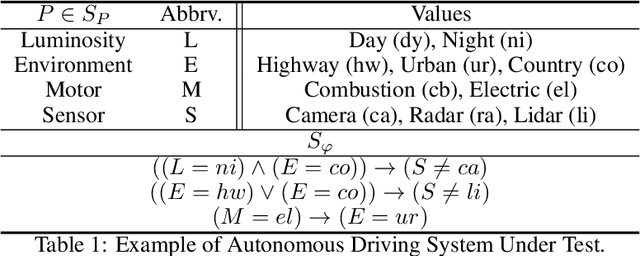
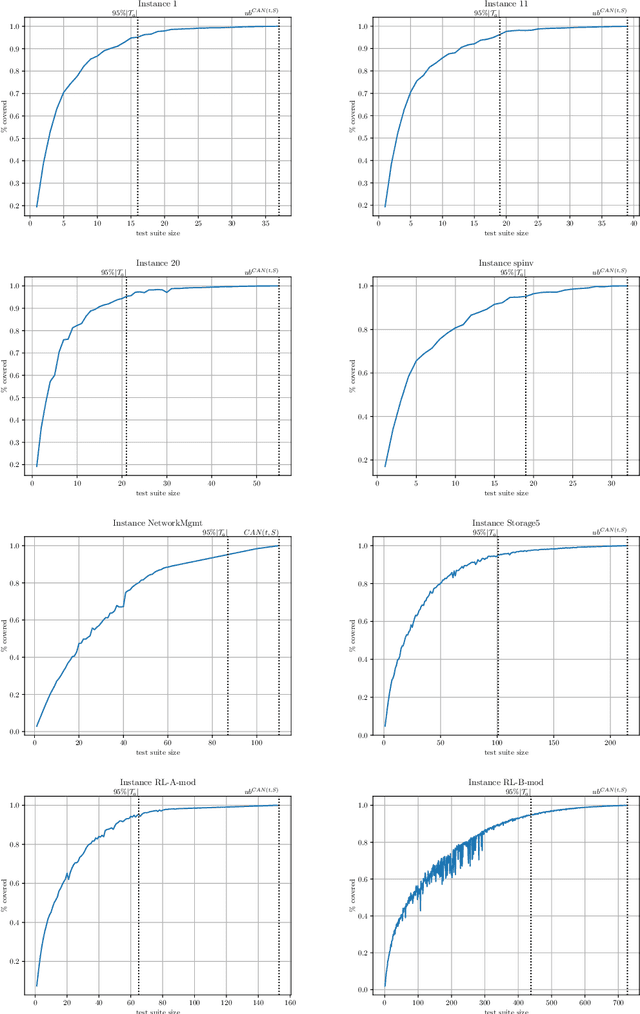
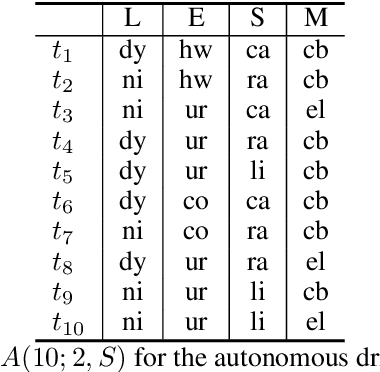
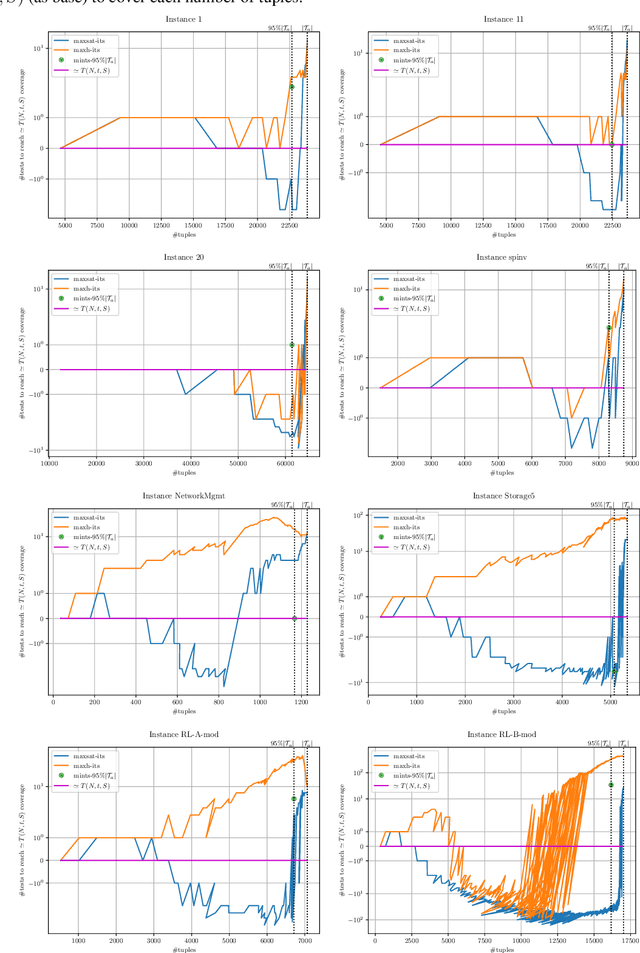
We present a Satisfiability (SAT)-based approach for building Mixed Covering Arrays with Constraints of minimum length, referred to as the Covering Array Number problem. This problem is central in Combinatorial Testing for the detection of system failures. In particular, we show how to apply Maximum Satisfiability (MaxSAT) technology by describing efficient encodings for different classes of complete and incomplete MaxSAT solvers to compute optimal and suboptimal solutions, respectively. Similarly, we show how to solve through MaxSAT technology a closely related problem, the Tuple Number problem, which we extend to incorporate constraints. For this problem, we additionally provide a new MaxSAT-based incomplete algorithm. The extensive experimental evaluation we carry out on the available Mixed Covering Arrays with Constraints benchmarks and the comparison with state-of-the-art tools confirm the good performance of our approaches.
Clause Vivification by Unit Propagation in CDCL SAT Solvers
Jul 29, 2018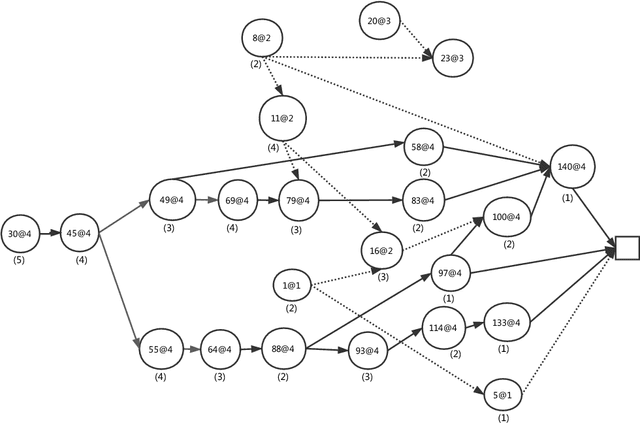
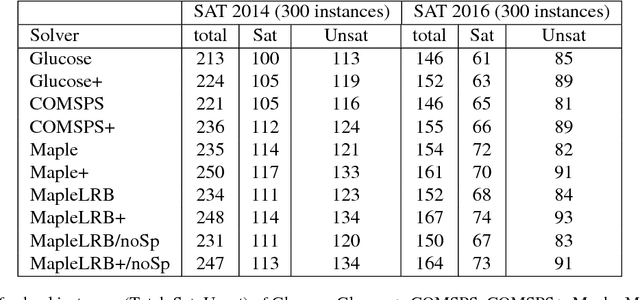
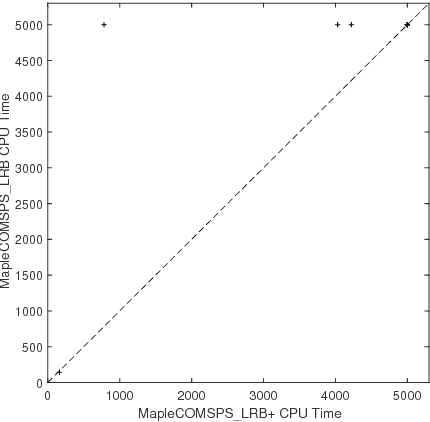
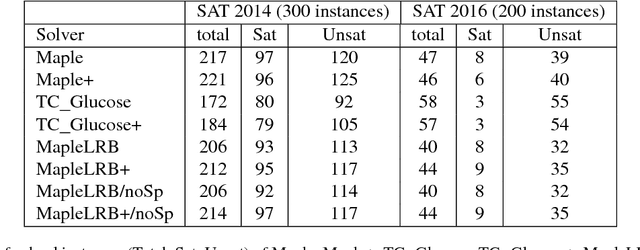
Original and learnt clauses in Conflict-Driven Clause Learning (CDCL) SAT solvers often contain redundant literals. This may have a negative impact on performance because redundant literals may deteriorate both the effectiveness of Boolean constraint propagation and the quality of subsequent learnt clauses. To overcome this drawback, we propose a clause vivification approach that eliminates redundant literals by applying unit propagation. The proposed clause vivification is activated before the SAT solver triggers some selected restarts, and only affects a subset of original and learnt clauses, which are considered to be more relevant according to metrics like the literal block distance (LBD). Moreover, we conducted an empirical investigation with instances coming from the hard combinatorial and application categories of recent SAT competitions. The results show that a remarkable number of additional instances are solved when the proposed approach is incorporated into five of the best performing CDCL SAT solvers (Glucose, TC_Glucose, COMiniSatPS, MapleCOMSPS and MapleCOMSPS_LRB). More importantly, the empirical investigation includes an in-depth analysis of the effectiveness of clause vivification. It is worth mentioning that one of the SAT solvers described here was ranked first in the main track of SAT Competition 2017 thanks to the incorporation of the proposed clause vivification. That solver was further improved in this paper and won the bronze medal in the main track of SAT Competition 2018.