 Add to Chrome
 Add to Firefox
 Add to Edge
Efficient Hessian-Free Methods for Multi-Objective Bilevel Optimization with Nonconvex Lower Level
Aug 13, 2026
Multi-objective bilevel optimization has wide applications in the AI area such as automated learning and multi-task meta-learning. Although recently some works have been begun to study the multi-objective bilevel optimization, the proposed methods rely on the (strongly) convex lower level problems. In fact, these multi-objective bilevel learning problems are generally nonconvex, and particularly their lower level problems are nonconvex. To fill this gap, we propose a class of Multi-Objective Moreau Envelope based Hessian-free Algorithms (MOMEHA) to solve the multi-objective bilevel learning problems with nonconvex lower level. Specifically, our method uses the Moreau envelope to convert the original problem into a multi-objective single-level optimization with an envelope constraint. In particular, our method retains computational advantages of being single-loop and Hessian-free in the multi-objective setting by incorporating a smooth weighted Tchebycheff scalarization. Furthermore, we propose a momentum-based variant of MOMEHA (i.e., MB-MOMEHA) method to solve the stochastic multi-objective bilevel learning problems. In theory, we provide the convergence properties of our algorithms under both deterministic and stochastic setting. Some experiments on few-shot meta-learning and neural architecture search demonstrate that our methods outperform the existing approaches in Pareto front, validating its effectiveness and robustness.

Federated Compositional Muon Optimizer for Matrix-Wise Models
Aug 13, 2026Muon, a more recently developed optimizer, is useful for matrix-wise models in AI areas. Although many works have studied Muon and its variants, these methods are still not particularly well-suited for hierarchical structured problems. To fill this gap, we propose an effective federated compositional Muon (FedCoMuon) optimizer to solve distributed matrix-wise compositional optimization problems. Specifically, our FedCoMuon optimizer builds on compositional gradient tracking and orthogonalized momentum. Moreover, we propose a variance reduced variant of FedCoMuon (FedCoMuon-VR) based on a momentum-based variance reduced technique. In theory, we analyze the convergence properties of our algorithms under the non-i.i.d. and non-convex settings. In particular, we prove that our FedCoMuon-VR obtains a lower sample complexity of $O(ε^{-3})$ for finding an $ε$-stationary solution than the existing FedMuon algorithms. Extensive numerical experiments on robust federated learning and task-distributed risk-sensitive meta learning show that our proposed methods are competitive with existing compositional baselines and achieve the best reported accuracy in several settings.
MiMuon: Mixed Muon Optimizer with Improved Generalization for Large Models
May 19, 2026Matrix-structured parameters frequently appear in many artificial intelligence models such as large language models. More recently, an efficient Muon optimizer is designed for matrix parameters of large-scale models, and shows markedly faster convergence than the vector-wise algorithms. Although some works have begun to study convergence properties (i.e., optimization error) of the Muon optimizer, its generalization properties (i.e., generalization error) is still not established. Thus, in this paper, we study generalization error of the Muon optimizer based on algorithmic stability and mathematical induction, and prove that the Muon has a generalization error of $O\big(\frac{1}{Nκ^{T}}\big)$, where $N$ is training sample size, and $T$ denotes iteration number, and $κ>0$ denotes minimum difference between singular values of gradient estimate. To enhance generalization of the Muon, we propose an effective mixed Muon (MiMuon) optimizer by cautiously using orthogonalization of gradient, which is a hybrid of Muon and momentum-based SGD optimizers. Then we prove that our MiMuon optimizer has a lower generalization error of $O\big(\frac{1}{N}\big)$ than $O\big(\frac{1}{Nκ^{T}}\big)$ of Muon optimizer, since $κ$ generally is very small. Meanwhile, we also studied the convergence properties of our MiMuon algorithm, and prove that our MiMuon algorithm has the same convergence rate of $O(\frac{1}{T^{1/4}})$ as the Muon algorithm. Some numerical experimental results on training large models including Qwen3-0.6B and YOLO26m demonstrate efficiency of the MiMuon optimizer.
CLion: Efficient Cautious Lion Optimizer with Enhanced Generalization
Apr 16, 2026Lion optimizer is a popular learning-based optimization algorithm in machine learning, which shows impressive performance in training many deep learning models. Although convergence property of the Lion optimizer has been studied, its generalization analysis is still missing. To fill this gap, we study generalization property of the Lion via algorithmic stability based on the mathematical induction. Specifically, we prove that the Lion has a generalization error of $O(\frac{1}{Nτ^T})$, where $N$ is training sample size, and $τ>0$ denotes the smallest absolute value of non-zero element in gradient estimator, and $T$ is the total iteration number. In addition, we obtain an interesting byproduct that the SignSGD algorithm has the same generalization error as the Lion. To enhance generalization of the Lion, we design a novel efficient Cautious Lion (i.e., CLion) optimizer by cautiously using sign function. Moreover, we prove that our CLion has a lower generalization error of $O(\frac{1}{N})$ than $O(\frac{1}{Nτ^T})$ of the Lion, since the parameter $τ$ generally is very small. Meanwhile, we study convergence property of our CLion optimizer, and prove that our CLion has a fast convergence rate of $O(\frac{\sqrt{d}}{T^{1/4}})$ under $\ell_1$-norm of gradient for nonconvex stochastic optimization, where $d$ denotes the model dimension. Extensive numerical experiments demonstrate effectiveness of our CLion optimizer.
HomeAdam: Adam and AdamW Algorithms Sometimes Go Home to Obtain Better Provable Generalization
Mar 03, 2026Adam and AdamW are a class of default optimizers for training deep learning models in machine learning. These adaptive algorithms converge faster but generalize worse compared to SGD. In fact, their proved generalization error $O(\frac{1}{\sqrt{N}})$ also is larger than $O(\frac{1}{N})$ of SGD, where $N$ denotes training sample size. Recently, although some variants of Adam have been proposed to improve its generalization, their improved generalizations are still unexplored in theory. To fill this gap, in the paper, we restudy generalization of Adam and AdamW via algorithmic stability, and first prove that Adam and AdamW without square-root (i.e., Adam(W)-srf) have a generalization error $O(\frac{\hatρ^{-2T}}{N})$, where $T$ denotes iteration number and $\hatρ>0$ denotes the smallest element of second-order momentum plus a small positive number. To improve generalization, we propose a class of efficient clever Adam (i.e., HomeAdam(W)) algorithms via sometimes returning momentum-based SGD. Moreover, we prove that our HomeAdam(W) have a smaller generalization error $O(\frac{1}{N})$ than $O(\frac{\hatρ^{-2T}}{N})$ of Adam(W)-srf, since $\hatρ$ is generally very small. In particular, it is also smaller than the existing $O(\frac{1}{\sqrt{N}})$ of Adam(W). Meanwhile, we prove our HomeAdam(W) have a faster convergence rate of $O(\frac{1}{T^{1/4}})$ than $O(\frac{\breveρ^{-1}}{T^{1/4}})$ of the Adam(W)-srf, where $\breveρ\leq\hatρ$ also is very small. Extensive numerical experiments demonstrate efficiency of our HomeAdam(W) algorithms.
LiMuon: Light and Fast Muon Optimizer for Large Models
Sep 19, 2025
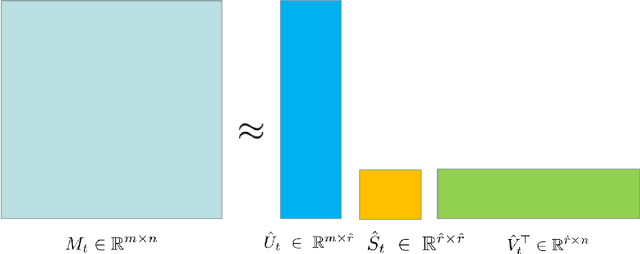
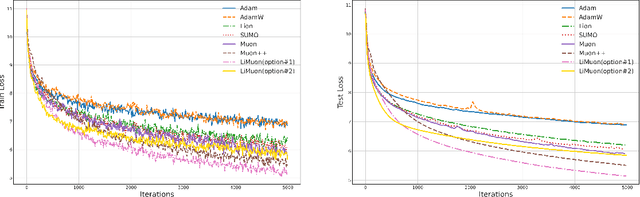
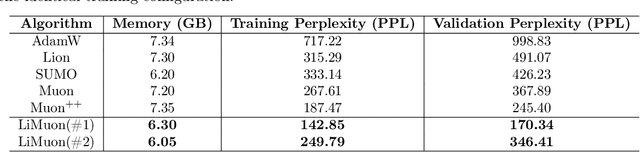
Large models recently are widely applied in artificial intelligence, so efficient training of large models has received widespread attention. More recently, a useful Muon optimizer is specifically designed for matrix-structured parameters of large models. Although some works have begun to studying Muon optimizer, the existing Muon and its variants still suffer from high sample complexity or high memory for large models. To fill this gap, we propose a light and fast Muon (LiMuon) optimizer for training large models, which builds on the momentum-based variance reduced technique and randomized Singular Value Decomposition (SVD). Our LiMuon optimizer has a lower memory than the current Muon and its variants. Moreover, we prove that our LiMuon has a lower sample complexity of $O(\epsilon^{-3})$ for finding an $\epsilon$-stationary solution of non-convex stochastic optimization under the smooth condition. Recently, the existing convergence analysis of Muon optimizer mainly relies on the strict Lipschitz smooth assumption, while some artificial intelligence tasks such as training large language models (LLMs) do not satisfy this condition. We also proved that our LiMuon optimizer has a sample complexity of $O(\epsilon^{-3})$ under the generalized smooth condition. Numerical experimental results on training DistilGPT2 and ViT models verify efficiency of our LiMuon optimizer.
Faster Adaptive Decentralized Learning Algorithms
Aug 19, 2024
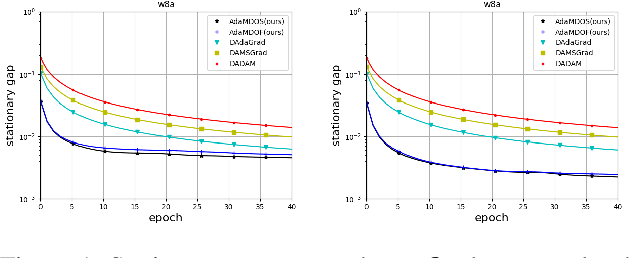
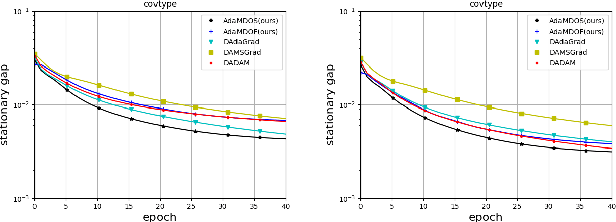
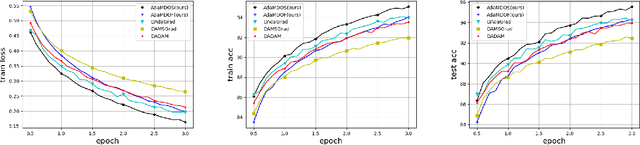
Decentralized learning recently has received increasing attention in machine learning due to its advantages in implementation simplicity and system robustness, data privacy. Meanwhile, the adaptive gradient methods show superior performances in many machine learning tasks such as training neural networks. Although some works focus on studying decentralized optimization algorithms with adaptive learning rates, these adaptive decentralized algorithms still suffer from high sample complexity. To fill these gaps, we propose a class of faster adaptive decentralized algorithms (i.e., AdaMDOS and AdaMDOF) for distributed nonconvex stochastic and finite-sum optimization, respectively. Moreover, we provide a solid convergence analysis framework for our methods. In particular, we prove that our AdaMDOS obtains a near-optimal sample complexity of $\tilde{O}(\epsilon^{-3})$ for finding an $\epsilon$-stationary solution of nonconvex stochastic optimization. Meanwhile, our AdaMDOF obtains a near-optimal sample complexity of $O(\sqrt{n}\epsilon^{-2})$ for finding an $\epsilon$-stationary solution of nonconvex finite-sum optimization, where $n$ denotes the sample size. To the best of our knowledge, our AdaMDOF algorithm is the first adaptive decentralized algorithm for nonconvex finite-sum optimization. Some experimental results demonstrate efficiency of our algorithms.
Optimal Hessian/Jacobian-Free Nonconvex-PL Bilevel Optimization
Jul 25, 2024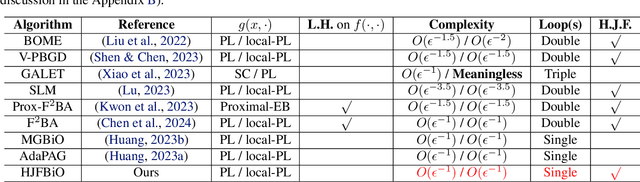
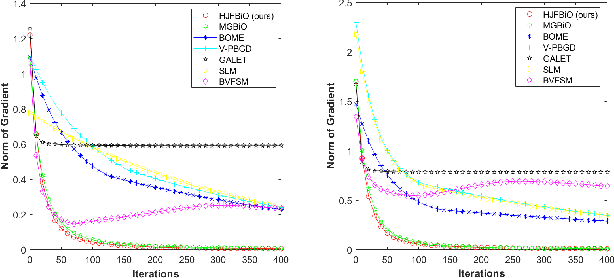
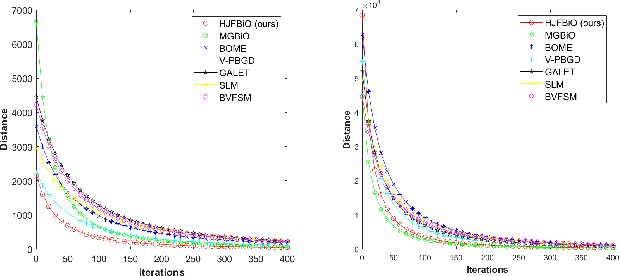
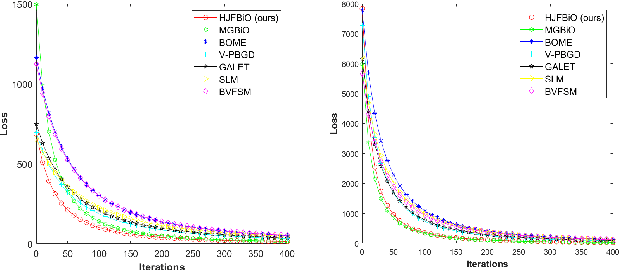
Bilevel optimization is widely applied in many machine learning tasks such as hyper-parameter learning, meta learning and reinforcement learning. Although many algorithms recently have been developed to solve the bilevel optimization problems, they generally rely on the (strongly) convex lower-level problems. More recently, some methods have been proposed to solve the nonconvex-PL bilevel optimization problems, where their upper-level problems are possibly nonconvex, and their lower-level problems are also possibly nonconvex while satisfying Polyak-{\L}ojasiewicz (PL) condition. However, these methods still have a high convergence complexity or a high computation complexity such as requiring compute expensive Hessian/Jacobian matrices and its inverses. In the paper, thus, we propose an efficient Hessian/Jacobian-free method (i.e., HJFBiO) with the optimal convergence complexity to solve the nonconvex-PL bilevel problems. Theoretically, under some mild conditions, we prove that our HJFBiO method obtains an optimal convergence rate of $O(\frac{1}{T})$, where $T$ denotes the number of iterations, and has an optimal gradient complexity of $O(\epsilon^{-1})$ in finding an $\epsilon$-stationary solution. We conduct some numerical experiments on the bilevel PL game and hyper-representation learning task to demonstrate efficiency of our proposed method.
Adaptive Mirror Descent Bilevel Optimization
Nov 18, 2023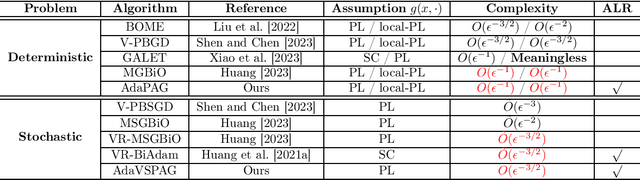
In the paper, we propose a class of efficient adaptive bilevel methods based on mirror descent for nonconvex bilevel optimization, where its upper-level problem is nonconvex possibly with nonsmooth regularization, and its lower-level problem is also nonconvex while satisfies Polyak-{\L}ojasiewicz (PL) condition. To solve these deterministic bilevel problems, we present an efficient adaptive projection-aid gradient (i.e., AdaPAG) method based on mirror descent, and prove that it obtains the best known gradient complexity of $O(\epsilon^{-1})$ for finding an $\epsilon$-stationary solution of nonconvex bilevel problems. To solve these stochastic bilevel problems, we propose an efficient adaptive stochastic projection-aid gradient (i.e., AdaVSPAG) methods based on mirror descent and variance-reduced techniques, and prove that it obtains the best known gradient complexity of $O(\epsilon^{-3/2})$ for finding an $\epsilon$-stationary solution. Since the PL condition relaxes the strongly convex, our algorithms can be used to nonconvex strongly-convex bilevel optimization. Theoretically, we provide a useful convergence analysis framework for our methods under some mild conditions, and prove that our methods have a fast convergence rate of $O(\frac{1}{T})$, where $T$ denotes the number of iterations.
Near-Optimal Decentralized Momentum Method for Nonconvex-PL Minimax Problems
Apr 21, 2023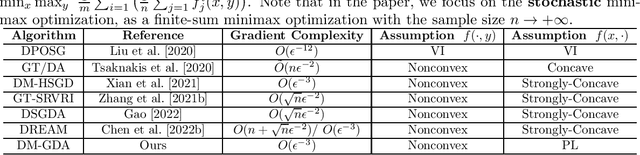
Minimax optimization plays an important role in many machine learning tasks such as generative adversarial networks (GANs) and adversarial training. Although recently a wide variety of optimization methods have been proposed to solve the minimax problems, most of them ignore the distributed setting where the data is distributed on multiple workers. Meanwhile, the existing decentralized minimax optimization methods rely on the strictly assumptions such as (strongly) concavity and variational inequality conditions. In the paper, thus, we propose an efficient decentralized momentum-based gradient descent ascent (DM-GDA) method for the distributed nonconvex-PL minimax optimization, which is nonconvex in primal variable and is nonconcave in dual variable and satisfies the Polyak-Lojasiewicz (PL) condition. In particular, our DM-GDA method simultaneously uses the momentum-based techniques to update variables and estimate the stochastic gradients. Moreover, we provide a solid convergence analysis for our DM-GDA method, and prove that it obtains a near-optimal gradient complexity of $O(\epsilon^{-3})$ for finding an $\epsilon$-stationary solution of the nonconvex-PL stochastic minimax problems, which reaches the lower bound of nonconvex stochastic optimization. To the best of our knowledge, we first study the decentralized algorithm for Nonconvex-PL stochastic minimax optimization over a network.