 Add to Chrome
 Add to Firefox
 Add to Edge
MiMuon: Mixed Muon Optimizer with Improved Generalization for Large Models
May 19, 2026
Matrix-structured parameters frequently appear in many artificial intelligence models such as large language models. More recently, an efficient Muon optimizer is designed for matrix parameters of large-scale models, and shows markedly faster convergence than the vector-wise algorithms. Although some works have begun to study convergence properties (i.e., optimization error) of the Muon optimizer, its generalization properties (i.e., generalization error) is still not established. Thus, in this paper, we study generalization error of the Muon optimizer based on algorithmic stability and mathematical induction, and prove that the Muon has a generalization error of $O\big(\frac{1}{Nκ^{T}}\big)$, where $N$ is training sample size, and $T$ denotes iteration number, and $κ>0$ denotes minimum difference between singular values of gradient estimate. To enhance generalization of the Muon, we propose an effective mixed Muon (MiMuon) optimizer by cautiously using orthogonalization of gradient, which is a hybrid of Muon and momentum-based SGD optimizers. Then we prove that our MiMuon optimizer has a lower generalization error of $O\big(\frac{1}{N}\big)$ than $O\big(\frac{1}{Nκ^{T}}\big)$ of Muon optimizer, since $κ$ generally is very small. Meanwhile, we also studied the convergence properties of our MiMuon algorithm, and prove that our MiMuon algorithm has the same convergence rate of $O(\frac{1}{T^{1/4}})$ as the Muon algorithm. Some numerical experimental results on training large models including Qwen3-0.6B and YOLO26m demonstrate efficiency of the MiMuon optimizer.

LiMuon: Light and Fast Muon Optimizer for Large Models
Sep 19, 2025
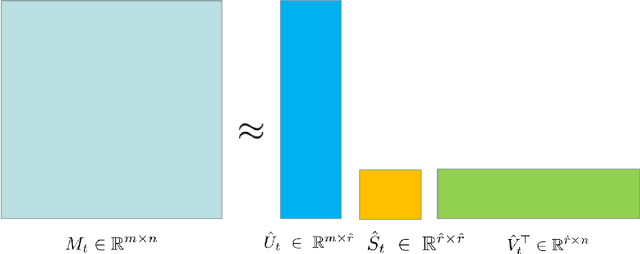
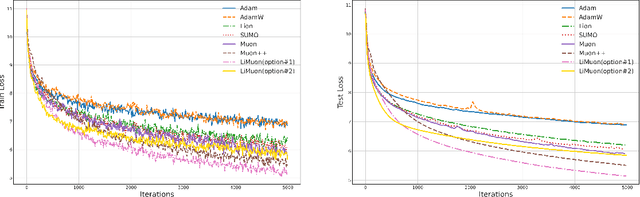
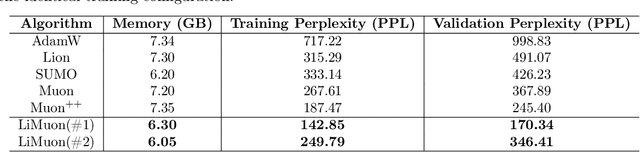
Large models recently are widely applied in artificial intelligence, so efficient training of large models has received widespread attention. More recently, a useful Muon optimizer is specifically designed for matrix-structured parameters of large models. Although some works have begun to studying Muon optimizer, the existing Muon and its variants still suffer from high sample complexity or high memory for large models. To fill this gap, we propose a light and fast Muon (LiMuon) optimizer for training large models, which builds on the momentum-based variance reduced technique and randomized Singular Value Decomposition (SVD). Our LiMuon optimizer has a lower memory than the current Muon and its variants. Moreover, we prove that our LiMuon has a lower sample complexity of $O(\epsilon^{-3})$ for finding an $\epsilon$-stationary solution of non-convex stochastic optimization under the smooth condition. Recently, the existing convergence analysis of Muon optimizer mainly relies on the strict Lipschitz smooth assumption, while some artificial intelligence tasks such as training large language models (LLMs) do not satisfy this condition. We also proved that our LiMuon optimizer has a sample complexity of $O(\epsilon^{-3})$ under the generalized smooth condition. Numerical experimental results on training DistilGPT2 and ViT models verify efficiency of our LiMuon optimizer.