 Add to Chrome
 Add to Firefox
 Add to Edge
SCALE: Scientific Concept Aggregation via LLMs and Embeddings for Fine-Grained Taxonomy Extension
Aug 07, 2026
The increasing specialization of scientific research challenges existing classification systems, which provide effective representations of broad disciplines and research topics but often fail to capture the fine-grained conceptual structure of contemporary science. Author keywords offer greater specificity, but their fragmentation, redundancy, and terminological variability limit their use as stable units of knowledge organization. We introduce SCALE (Scientific Concept Aggregation via LLMs and Embeddings), a framework that extends the OpenAlex taxonomy with a new level of scientific Concepts below Topics. Rather than treating keywords as isolated descriptors, SCALE organizes semantically related terms into coherent and interpretable conceptual units and integrates them within the existing disciplinary hierarchy. The framework combines scientific text embeddings, large language models, and graph-based community detection to construct this additional layer at scale. The resulting taxonomy enables scientific literature to be read through an intermediate conceptual level between broad research topics and individual documents. This perspective provides a more detailed representation of how scientific knowledge is structured, specialized, and connected across disciplines. By transforming heterogeneous author terminology into reusable hierarchical units, SCALE offers a foundation for fine-grained scholarly classification, scientometric analysis, research monitoring, and future ontology development.

AvatarPose: Avatar-guided 3D Pose Estimation of Close Human Interaction from Sparse Multi-view Videos
Aug 04, 2024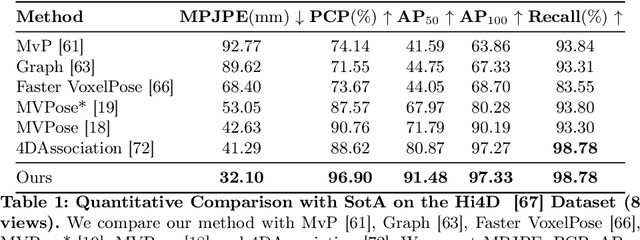
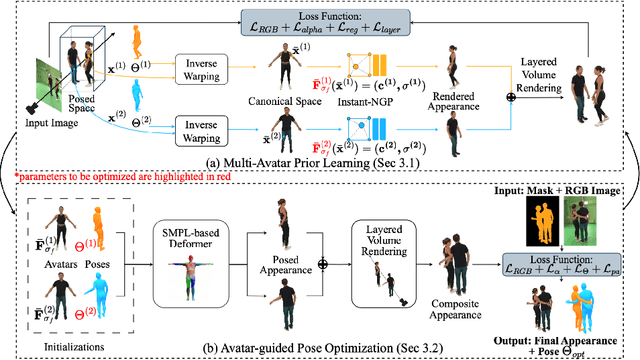

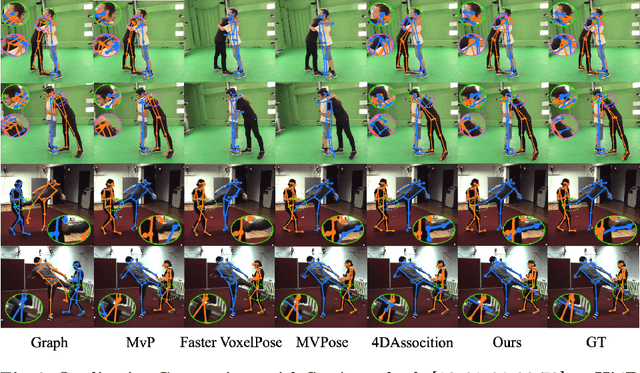
Despite progress in human motion capture, existing multi-view methods often face challenges in estimating the 3D pose and shape of multiple closely interacting people. This difficulty arises from reliance on accurate 2D joint estimations, which are hard to obtain due to occlusions and body contact when people are in close interaction. To address this, we propose a novel method leveraging the personalized implicit neural avatar of each individual as a prior, which significantly improves the robustness and precision of this challenging pose estimation task. Concretely, the avatars are efficiently reconstructed via layered volume rendering from sparse multi-view videos. The reconstructed avatar prior allows for the direct optimization of 3D poses based on color and silhouette rendering loss, bypassing the issues associated with noisy 2D detections. To handle interpenetration, we propose a collision loss on the overlapping shape regions of avatars to add penetration constraints. Moreover, both 3D poses and avatars are optimized in an alternating manner. Our experimental results demonstrate state-of-the-art performance on several public datasets.
NICE-SLAM with Adaptive Feature Grids
Jun 10, 2023


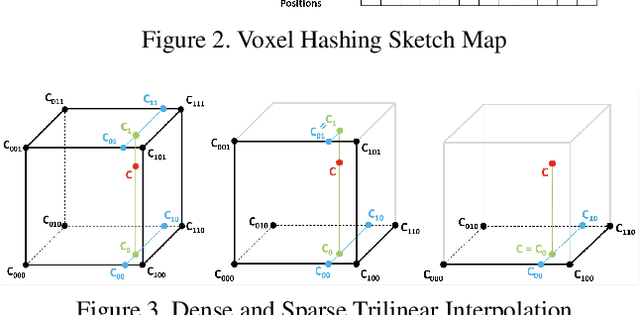
NICE-SLAM is a dense visual SLAM system that combines the advantages of neural implicit representations and hierarchical grid-based scene representation. However, the hierarchical grid features are densely stored, leading to memory explosion problems when adapting the framework to large scenes. In our project, we present sparse NICE-SLAM, a sparse SLAM system incorporating the idea of Voxel Hashing into NICE-SLAM framework. Instead of initializing feature grids in the whole space, voxel features near the surface are adaptively added and optimized. Experiments demonstrated that compared to NICE-SLAM algorithm, our approach takes much less memory and achieves comparable reconstruction quality on the same datasets. Our implementation is available at https://github.com/zhangganlin/NICE-SLAM-with-Adaptive-Feature-Grids.