 Add to Chrome
 Add to Firefox
 Add to Edge
Statistics, Not Scale: Modular Medical Dialogue with Bayesian Belief Engine
Apr 21, 2026
Large language models are increasingly deployed as autonomous diagnostic agents, yet they conflate two fundamentally different capabilities: natural-language communication and probabilistic reasoning. We argue that this conflation is an architectural flaw, not an engineering shortcoming. We introduce BMBE (Bayesian Medical Belief Engine), a modular diagnostic dialogue framework that enforces a strict separation between language and reasoning: an LLM serves only as a sensor, parsing patient utterances into structured evidence and verbalising questions, while all diagnostic inference resides in a deterministic, auditable Bayesian engine. Because patient data never enters the LLM, the architecture is private by construction; because the statistical backend is a standalone module, it can be replaced per target population without retraining. This separation yields three properties no autonomous LLM can offer: calibrated selective diagnosis with a continuously adjustable accuracy-coverage tradeoff, a statistical separation gap where even a cheap sensor paired with the engine outperforms a frontier standalone model from the same family at a fraction of the cost, and robustness to adversarial patient communication styles that cause standalone doctors to collapse. We validate across empirical and LLM-generated knowledge bases against frontier LLMs, confirming the advantage is architectural, not informational.

Can you Finetune your Binoculars? Embedding Text Watermarks into the Weights of Large Language Models
Apr 08, 2025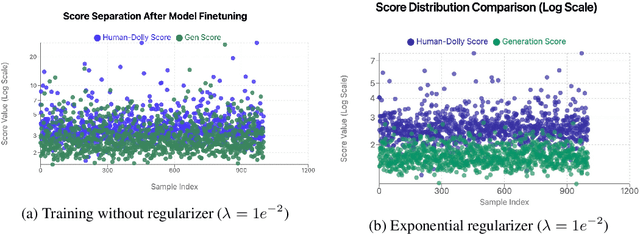
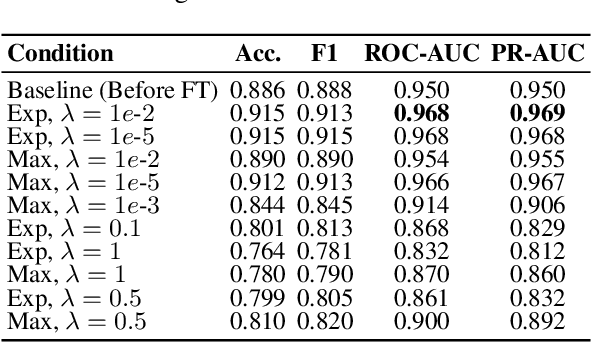
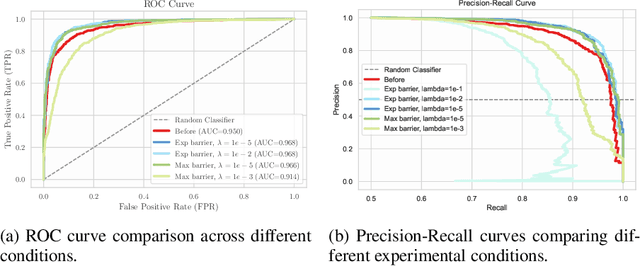
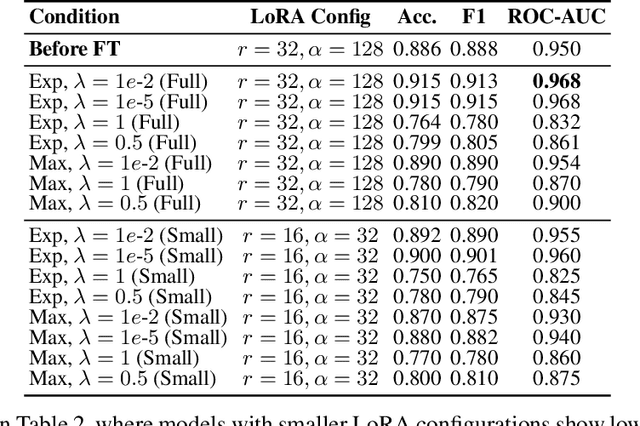
The indistinguishability of AI-generated content from human text raises challenges in transparency and accountability. While several methods exist to watermark models behind APIs, embedding watermark strategies directly into model weights that are later reflected in the outputs of the model is challenging. In this study we propose a strategy to finetune a pair of low-rank adapters of a model, one serving as the text-generating model, and the other as the detector, so that a subtle watermark is embedded into the text generated by the first model and simultaneously optimized for detectability by the second. In this way, the watermarking strategy is fully learned end-to-end. This process imposes an optimization challenge, as balancing watermark robustness, naturalness, and task performance requires trade-offs. We discuss strategies on how to optimize this min-max objective and present results showing the effect of this modification to instruction finetuning.