 Add to Chrome
 Add to Firefox
 Add to Edge
Rethinking Passive RIS: Finite Blocklength Reliability Analysis Under Thermal Noise
May 20, 2026
Short-packet communication alters the fundamental performance limits of reconfigurable intelligent surface (RIS)-assisted systems, making conventional analyses based on the infinite blocklength regime insufficient. This work investigates RIS-assisted transmission in the finite blocklength (FBL) regime while explicitly incorporating thermal noise generated by passive RIS elements, an effect commonly neglected in existing models. A unified analytical framework is developed to characterize the block-error rate (BLER), its asymptotic behavior, and the resulting goodput under both uniform and non-uniform RIS reflection coefficients. Our results show that ignoring RIS thermal noise leads to a pronounced overestimation of reliability with the mismatch increasing as the number of reflecting elements grows. Furthermore, increasing the RIS size does not always improve performance, particularly in the low transmit power regime where accumulated noise becomes dominant. Overall, the results highlight fundamental limitations of idealized RIS models and demonstrate the need for incorporating thermal noise for accurate system evaluation.

Passive RIS Is Not Silent: Revisiting Performance Limits Under Thermal Noise
Apr 20, 2026Reconfigurable intelligent surfaces (RISs) have emerged as a promising solution for enabling energy-efficient and flexible spectrum usage in wireless communication, particularly in the context of sixth-generation (6G) networks. While passive RIS architectures are widely regarded as virtually noiseless due to the lack of active components, this idealized assumption can lead to misleading performance evaluations. In this paper, we revisit this assumption and demonstrate that the thermal noise generated by passive RIS elements, though often neglected, can significantly affect system performance. We propose a tractable approximated analytical framework that incorporates RIS-induced thermal noise into the system and derive closed-form expressions for key performance metrics, such as outage probability and throughput. Simulation results validate our approximated analysis and highlight the substantial performance discrepancies that arise when RIS thermal noise is ignored. Our results offer valuable insights into the trade-offs between receiver and RIS noise, guiding the development of robust and efficient 6G communication systems.
RSMA-Aided Full-Duplex Networks Under Imperfect CSI and SIC: Performance Evaluation
Apr 20, 2026This work investigates a full-duplex (FD)-enhanced Rate-Splitting Multiple Access (RSMA) system under practical constraints, including imperfect channel state information (CSI) and successive interference cancellation (SIC). We derive closed-form expressions for key performance metrics, such as outage probability and throughput, for both uplink and downlink users. The analysis considers co-channel interference (CCI) from uplink to downlink users and models the self-interference (SI) channel as a random variable. Monte Carlo simulations validate the analytical results and highlight the impact of system imperfections on RSMA-FD performance. At low transmit power, imperfect CSI significantly affects the system, though this effect weakens as power increases. In contrast, imperfect SIC becomes more detrimental at high transmit power, causing severe degradation. Additionally, neglecting CCI and assuming perfect SI cancellation leads to substantial overestimation of performance. Lastly, we demonstrate that the SI cancellation factor must be carefully selected to suppress interference effectively. Otherwise, a poor choice limits the full potential of FD technology.
Impact of CSIR, SIC, and Hardware Impairments on the Ergodic Rate of Downlink RSMA
Apr 20, 2026This work investigates the ergodic rate performance analysis of rate-splitting multiple access (RSMA) in a downlink communication system under practical impairments. Closed-form expressions are derived for key performance metrics such as ergodic rate, energy efficiency, sum-rate, and Jains fairness index, capturing the joint effects of imperfect channel state information at the receiver (CSIR), imperfect successive interference cancellation (SIC), and hardware impairments. Numerical simulations validate the accuracy of the analytical expressions and reveal several insightful trends. At low transmit powers, imperfect CSIR is the dominant performance-limiting factor, followed by hardware impairments and imperfect SIC. However, as the transmit power increases, hardware impairments become the primary bottleneck, with the impact of imperfect CSIR gradually diminishing, and imperfect SIC becoming a more prominent bottleneck. Moreover, RSMA consistently outperforms non-orthogonal multiple access (NOMA) in terms of ergodic rate, fairness, and sum-rate, even under severe non-idealities. These findings underscore the importance of incorporating fairness as a core design objective alongside rate and energy efficiency, positioning RSMA as a robust and strong multiple access candidate for next-generation wireless networks.
A Deep-Unfolding Approach to RIS Phase Shift Optimization Via Transformer-Based Channel Prediction
Feb 25, 2025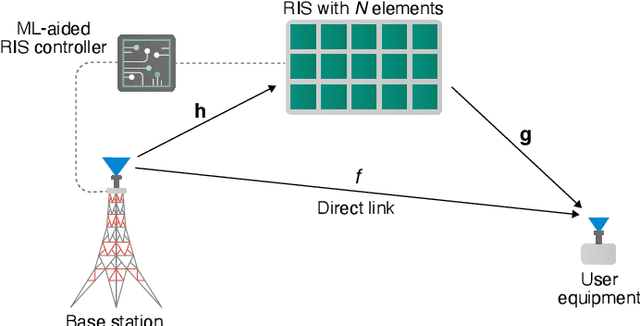
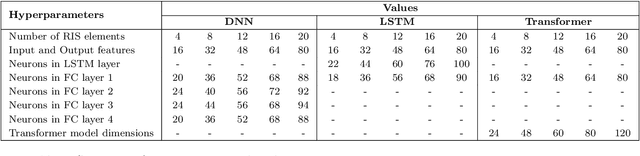
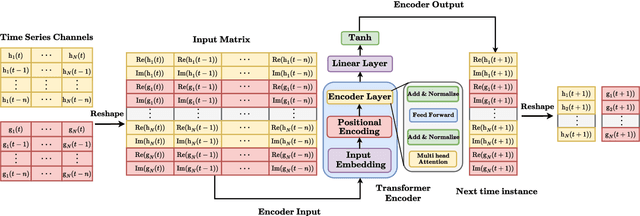
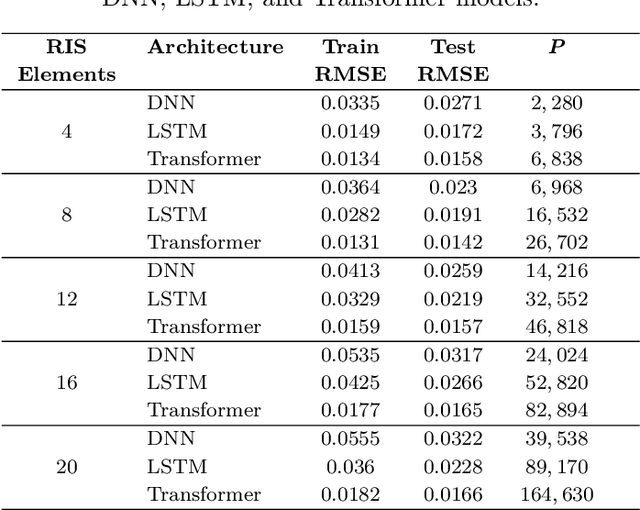
Reconfigurable intelligent surfaces (RISs) have emerged as a promising solution that can provide dynamic control over the propagation of electromagnetic waves. The RIS technology is envisioned as a key enabler of sixth-generation networks by offering the ability to adaptively manipulate signal propagation through the smart configuration of its phase shift coefficients, thereby optimizing signal strength, coverage, and capacity. However, the realization of this technology's full potential hinges on the accurate acquisition of channel state information (CSI). In this paper, we propose an efficient CSI prediction framework for a RIS-assisted communication system based on the machine learning (ML) transformer architecture. Architectural modifications are introduced to the vanilla transformer for multivariate time series forecasting to achieve high prediction accuracy. The predicted channel coefficients are then used to optimize the RIS phase shifts. Simulation results present a comprehensive analysis of key performance metrics, including data rate and outage probability. Our results confirm the effectiveness of the proposed ML approach and demonstrate its superiority over other baseline ML-based CSI prediction schemes such as conventional deep neural networks and long short-term memory architectures, albeit at the cost of slightly increased complexity.
* Accepted for Scandinavian Simulation Society(SIMS) EUROSIM 2024
Uplink Rate Splitting Multiple Access with Imperfect Channel State Information and Interference Cancellation
Jan 31, 2025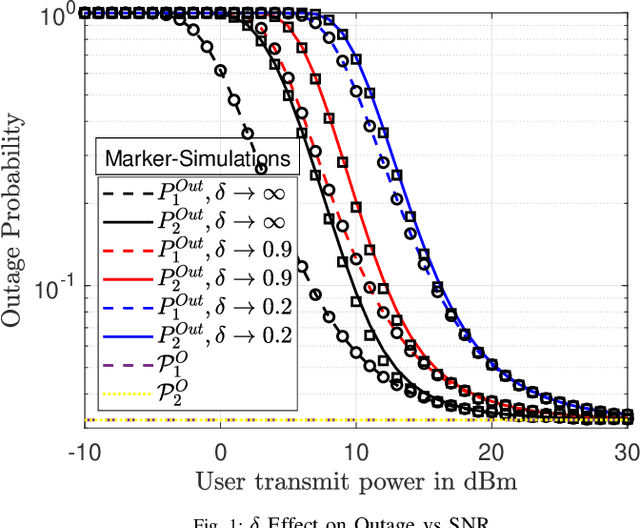
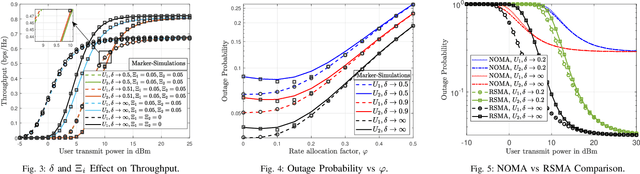

This article investigates the performance of uplink rate splitting multiple access (RSMA) in a two-user scenario, addressing an under-explored domain compared to its downlink counterpart. With the increasing demand for uplink communication in applications like the Internet-of-Things, it is essential to account for practical imperfections, such as inaccuracies in channel state information at the receiver (CSIR) and limitations in successive interference cancellation (SIC), to provide realistic assessments of system performance. Specifically, we derive closed-form expressions for the outage probability, throughput, and asymptotic outage behavior of uplink users, considering imperfect CSIR and SIC. We validate the accuracy of these derived expressions using Monte Carlo simulations. Our findings reveal that at low transmit power levels, imperfect CSIR significantly affects system performance more severely than SIC imperfections. However, as the transmit power increases, the impact of imperfect CSIR diminishes, while the influence of SIC imperfections becomes more pronounced. Moreover, we highlight the impact of the rate allocation factor on user performance. Finally, our comparison with non-orthogonal multiple access (NOMA) highlights the outage performance trade-offs between RSMA and NOMA. RSMA proves to be more effective in managing imperfect CSIR and enhances performance through strategic message splitting, resulting in more robust communication.