 Add to Chrome
 Add to Firefox
 Add to Edge
BengaliMCQ: Automatic Generation and Answer Prediction of Academic Multiple-Choice Questions in a Low-Resource Language
Aug 16, 2026
Traditional retrieval-augmented generation (RAG) frameworks process documents without attending to their hierarchical structure, leading to poor performance, especially in low-resource languages such as Bengali. To address this, we propose a structure-aware RAG framework that models Bengali textbooks as hierarchical graphs and uses a contrastively trained graph neural network to retrieve a small set of relevant passages. These passages provide focused context for a large language model, enabling topic-specific multiple-choice question (MCQ) generation and in-domain answer prediction. Experimental results demonstrate that our framework outperforms strong dense retrieval baselines across retrieval metrics, produces more relevant MCQs, and achieves superior answer prediction accuracy.

Time Present and Time Past: Benchmarking Large Language Models on Temporally Evolving Document Understanding
Aug 09, 2026Evolving documents, such as laws, tax codes, and software documentation, are amended, replaced, and sometimes reverted over time, so a question has different correct answers at different dates. In contrast to encyclopedic knowledge, where an old fact is simply overwritten, an amendment is itself an official text that states what it replaces and when it takes effect, and the earlier version stays correct for its validity period. The central challenge is therefore version resolution, that is, identifying the version in force on the queried date. Existing temporal QA datasets treat time only as an annotation, so version resolution stays untested. We present TIDE, an expert-verified benchmark of 3,050 QA pairs over 644 official customs instruments issued between 1969 and 2025 by the Government of Bangladesh, covering eight task types over deeply code-mixed documents that are heterogeneous in layout and dated in two calendars. In addition, we evaluate nine recent LLMs under a single protocol across parametric, gold-context, and retrieval access, scored by a three-judge LLM council with a hard date gate separating correct meaning from correct time. The best macro-averaged accuracy is only 68.5%. Resolving a version from an implicit date reaches 59.7%, and detecting that the supplied version does not govern the query reaches only 26.7%. Models are more likely to find correct versions than to reject incorrect ones, and they tend to follow a confident parametric answer over the supplied authoritative text. All code and data are available at https://github.com/icsetepa44/TIDE
When Does Knowledge Distillation Hurt? Reliability-Aware Distillation for Low-Resource Language Summarization
Jul 22, 2026Knowledge distillation (KD) is a standard approach for compressing sequence-to-sequence models, but its per-sample effects are rarely examined. On the BanSum Bangla summarization benchmark, we find that standard KD improves ROUGE-L by only +0.0003 over a cross-entropy baseline, and that approximately 51.3% of training samples are estimated to actively harm student validation loss under standard KD. We propose two complementary reliability-aware distillation methods. CHAD (Counterfactual Harm-Aware Distillation) measures per-sample KD usefulness via gradient alignment with the validation loss direction and trains a lightweight gate that generalizes this counterfactual judgment to the full training set. EWAD+CPDP combines token-level entropy-weighted adaptive distillation with a capacity-proportional geometric constraint from a second, vocabulary-incompatible teacher. On BanSum, both methods substantially outperform standard KD: CHAD by +0.0173 ROUGE-L and EWAD+CPDP by +0.0219 ROUGE-L, where standard KD itself improves ROUGE-L by only +0.0003; despite using only 60M parameters, both outperform a fine-tuned Qwen 2.5-3B model (50x larger). We further evaluate the stronger method, EWAD+CPDP, across 15 typologically diverse XL-Sum languages organised into three sets, beating the CE-only baseline on 10/15 languages; gains are most reliable where the two teachers contribute complementary signal, and weakest where they have saturated or jointly weak target-language coverage. We release code and trained models to support reproducibility and further research on selective distillation.
Contaminated Collaboration: Measuring Gender Bias Transfer in LLM-Assisted Student Writing
Jun 14, 2026Gender bias in LLMs has been studied extensively in model outputs, with biased prompts shown to amplify stereotyped generations. Whether such bias propagates into text produced by humans who use these systems, however, remains underexplored. We investigate whether gender bias in an LLM writing assistant transfers into career plan essays written by students. We first verify that a gender-biased prompt induces gender-differentiated language in LLM-generated essays, while a neutral prompt does not. We then recruited participants (N = 123) in a controlled environment to write career plan essays for paired biographical profiles differing only in gender under three conditions: no AI assistance, neutral LLM assistance, or gender-biased LLM assistance. Students in the biased condition produced essays with a significantly larger agentic gap and more gender-stereotypic occupation suggestions than those in the control and neutral conditions. Our results also reveal that this bias transfer is asymmetric: agency is suppressed in female-target essays while male-target writing remains largely unaffected. Our findings highlight the risk of bias propagation in AI-assisted writing, calling for fairness-aware design in educational AI tools.
Enhancing Mental Health Counseling Support in Bangladesh using Culturally-Grounded Knowledge
Apr 16, 2026Large language models (LLMs) show promise in generating supportive responses for mental health and counseling applications. However, their responses often lack cultural sensitivity, contextual grounding, and clinically appropriate guidance. This work addresses the gap of how to systematically incorporate domain-specific, clinically validated knowledge into LLMs to improve counseling quality. We utilize and compare two approaches, retrieval-augmented generation (RAG) and a knowledge graph (KG)-based method, designed to support para-counselors. Our KG is constructed manually and clinically validated, capturing causal relationships between stressors, interventions, and outcomes, with contributions from multidisciplinary people. We evaluated multiple LLMs in both settings using BERTScore F1 and SBERT cosine similarity, as well as human evaluation across five metrics, which is designed to directly measure the effectiveness of counseling beyond similarity at the surface level. The results show that KG-based approaches consistently improve contextual relevance, clinical appropriateness, and practical usability compared to RAG alone, demonstrating that structured, expert-validated knowledge plays a critical role in addressing LLMs limitations in counseling tasks.
Benchmarking Bengali Dialectal Bias: A Multi-Stage Framework Integrating RAG-Based Translation and Human-Augmented RLAIF
Mar 22, 2026Large language models (LLMs) frequently exhibit performance biases against regional dialects of low-resource languages. However, frameworks to quantify these disparities remain scarce. We propose a two-phase framework to evaluate dialectal bias in LLM question-answering across nine Bengali dialects. First, we translate and gold-label standard Bengali questions into dialectal variants adopting a retrieval-augmented generation (RAG) pipeline to prepare 4,000 question sets. Since traditional translation quality evaluation metrics fail on unstandardized dialects, we evaluate fidelity using an LLM-as-a-judge, which human correlation confirms outperforms legacy metrics. Second, we benchmark 19 LLMs across these gold-labeled sets, running 68,395 RLAIF evaluations validated through multi-judge agreement and human fallback. Our findings reveal severe performance drops linked to linguistic divergence. For instance, responses to the highly divergent Chittagong dialect score 5.44/10, compared to 7.68/10 for Tangail. Furthermore, increased model scale does not consistently mitigate this bias. We contribute a validated translation quality evaluation method, a rigorous benchmark dataset, and a Critical Bias Sensitivity (CBS) metric for safety-critical applications.
Representation-Aware Unlearning via Activation Signatures: From Suppression to Knowledge-Signature Erasure
Jan 15, 2026Selective knowledge erasure from LLMs is critical for GDPR compliance and model safety, yet current unlearning methods conflate behavioral suppression with true knowledge removal, allowing latent capabilities to persist beneath surface-level refusals. In this work, we address this challenge by introducing Knowledge Immunization Framework (KIF), a representation-aware architecture that distinguishes genuine erasure from obfuscation by targeting internal activation signatures rather than surface outputs. Our approach combines dynamic suppression of subject-specific representations with parameter-efficient adaptation, enabling durable unlearning without full model retraining. KIF achieves near-oracle erasure (FQ approx 0.99 vs. 1.00) while preserving utility at oracle levels (MU = 0.62), effectively breaking the stability-erasure tradeoff that has constrained all prior work. We evaluate both standard foundation models (Llama and Mistral) and reasoning-prior models (Qwen and DeepSeek) across 3B to 14B parameters. Our observation shows that standard models exhibit scale-independent true erasure (<3% utility drift), while reasoning-prior models reveal fundamental architectural divergence. Our comprehensive dual-metric evaluation protocol, combining surface-level leakage with latent trace persistence, operationalizes the obfuscation - erasure distinction and enables the first systematic diagnosis of mechanism-level forgetting behavior across model families and scales.
A Comparative Analysis of Retrieval-Augmented Generation Techniques for Bengali Standard-to-Dialect Machine Translation Using LLMs
Dec 16, 2025Translating from a standard language to its regional dialects is a significant NLP challenge due to scarce data and linguistic variation, a problem prominent in the Bengali language. This paper proposes and compares two novel RAG pipelines for standard-to-dialectal Bengali translation. The first, a Transcript-Based Pipeline, uses large dialect sentence contexts from audio transcripts. The second, a more effective Standardized Sentence-Pairs Pipeline, utilizes structured local\_dialect:standard\_bengali sentence pairs. We evaluated both pipelines across six Bengali dialects and multiple LLMs using BLEU, ChrF, WER, and BERTScore. Our findings show that the sentence-pair pipeline consistently outperforms the transcript-based one, reducing Word Error Rate (WER) from 76\% to 55\% for the Chittagong dialect. Critically, this RAG approach enables smaller models (e.g., Llama-3.1-8B) to outperform much larger models (e.g., GPT-OSS-120B), demonstrating that a well-designed retrieval strategy can be more crucial than model size. This work contributes an effective, fine-tuning-free solution for low-resource dialect translation, offering a practical blueprint for preserving linguistic diversity.
Bridging Human and Model Perspectives: A Comparative Analysis of Political Bias Detection in News Media Using Large Language Models
Nov 18, 2025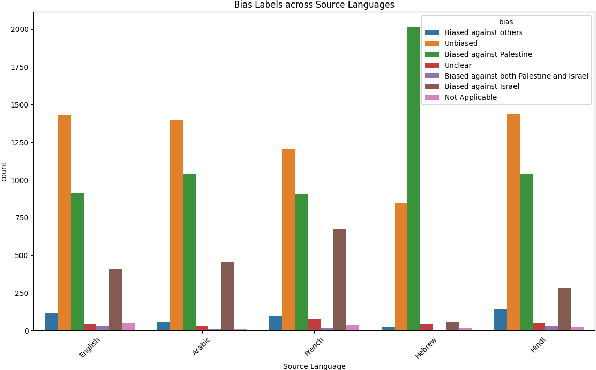
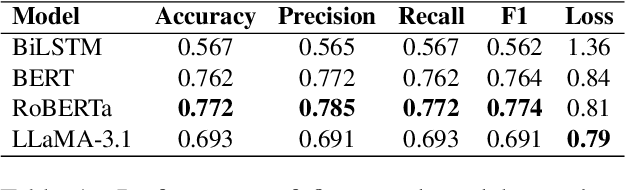
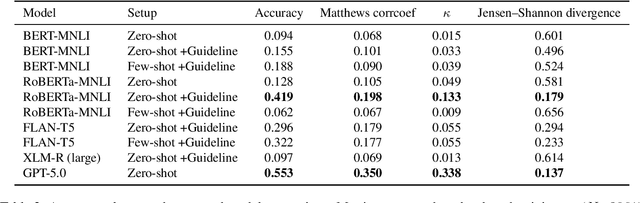
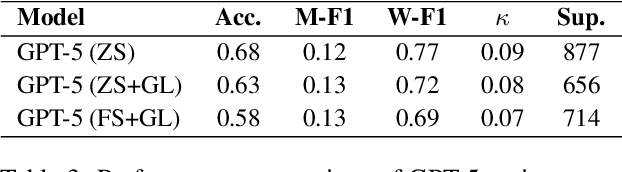
Detecting political bias in news media is a complex task that requires interpreting subtle linguistic and contextual cues. Although recent advances in Natural Language Processing (NLP) have enabled automatic bias classification, the extent to which large language models (LLMs) align with human judgment still remains relatively underexplored and not yet well understood. This study aims to present a comparative framework for evaluating the detection of political bias across human annotations and multiple LLMs, including GPT, BERT, RoBERTa, and FLAN. We construct a manually annotated dataset of news articles and assess annotation consistency, bias polarity, and inter-model agreement to quantify divergence between human and model perceptions of bias. Experimental results show that among traditional transformer-based models, RoBERTa achieves the highest alignment with human labels, whereas generative models such as GPT demonstrate the strongest overall agreement with human annotations in a zero-shot setting. Among all transformer-based baselines, our fine-tuned RoBERTa model acquired the highest accuracy and the strongest alignment with human-annotated labels. Our findings highlight systematic differences in how humans and LLMs perceive political slant, underscoring the need for hybrid evaluation frameworks that combine human interpretability with model scalability in automated media bias detection.
BNLI: A Linguistically-Refined Bengali Dataset for Natural Language Inference
Nov 11, 2025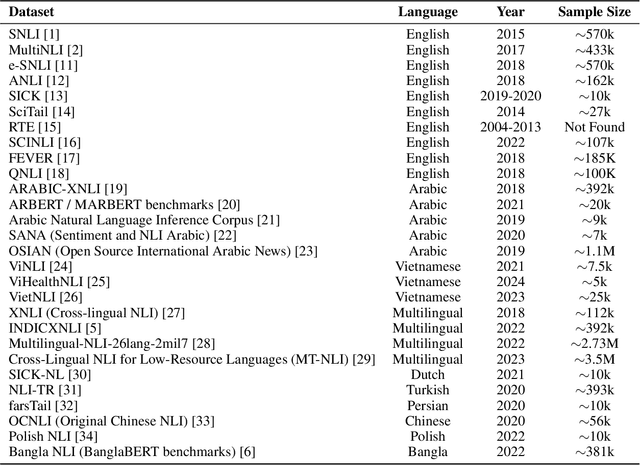
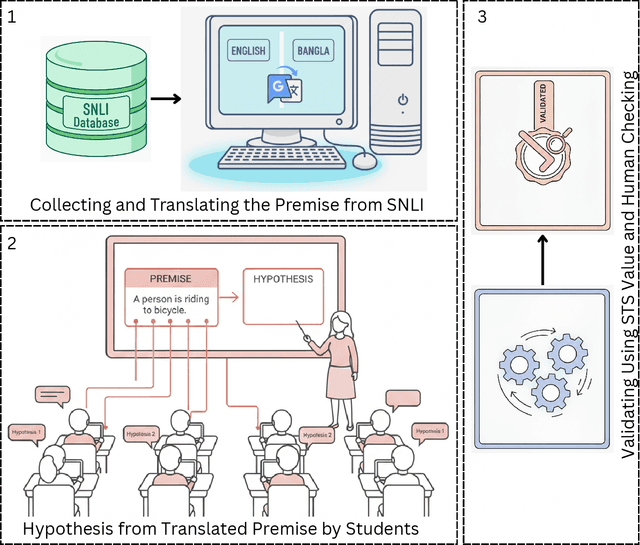
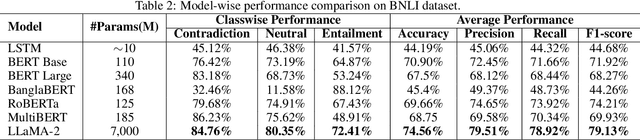
Despite the growing progress in Natural Language Inference (NLI) research, resources for the Bengali language remain extremely limited. Existing Bengali NLI datasets exhibit several inconsistencies, including annotation errors, ambiguous sentence pairs, and inadequate linguistic diversity, which hinder effective model training and evaluation. To address these limitations, we introduce BNLI, a refined and linguistically curated Bengali NLI dataset designed to support robust language understanding and inference modeling. The dataset was constructed through a rigorous annotation pipeline emphasizing semantic clarity and balance across entailment, contradiction, and neutrality classes. We benchmarked BNLI using a suite of state-of-the-art transformer-based architectures, including multilingual and Bengali-specific models, to assess their ability to capture complex semantic relations in Bengali text. The experimental findings highlight the improved reliability and interpretability achieved with BNLI, establishing it as a strong foundation for advancing research in Bengali and other low-resource language inference tasks.