 Add to Chrome
 Add to Firefox
 Add to Edge
When Looking Is Not Enough: Visual Attention Structure Reveals Hallucination in MLLMs
May 12, 2026
Multimodal large language models (MLLMs) have become a key interface for visual reasoning and grounded question answering, yet they remain vulnerable to visual hallucinations, where generated responses contradict image content or mention nonexistent objects. A central challenge is that hallucination is not always caused by a simple lack of visual attention: the model may still assign substantial attention mass to image tokens while internally drifting toward an incorrect answer. In this paper, we show that the high-frequency structure of visual attention, measured by layer-wise Laplacian energy, reveals both the layer where hallucinated preferences emerge and the layer where the ground-truth answer transiently recovers. Building on this finding, we propose LaSCD (Laplacian-Spectral Contrastive Decoding), a training-free decoding strategy that selects informative layers via Laplacian energy and remaps next-token logits in closed form. Experiments on hallucination and general multimodal benchmarks show that LaSCD consistently reduces hallucination while preserving general capabilities, highlighting its potential as a faithful decoding paradigm. The code is available at https://github.com/macovaseas/LaSCD.

ProCache: Constraint-Aware Feature Caching with Selective Computation for Diffusion Transformer Acceleration
Dec 19, 2025Diffusion Transformers (DiTs) have achieved state-of-the-art performance in generative modeling, yet their high computational cost hinders real-time deployment. While feature caching offers a promising training-free acceleration solution by exploiting temporal redundancy, existing methods suffer from two key limitations: (1) uniform caching intervals fail to align with the non-uniform temporal dynamics of DiT, and (2) naive feature reuse with excessively large caching intervals can lead to severe error accumulation. In this work, we analyze the evolution of DiT features during denoising and reveal that both feature changes and error propagation are highly time- and depth-varying. Motivated by this, we propose ProCache, a training-free dynamic feature caching framework that addresses these issues via two core components: (i) a constraint-aware caching pattern search module that generates non-uniform activation schedules through offline constrained sampling, tailored to the model's temporal characteristics; and (ii) a selective computation module that selectively computes within deep blocks and high-importance tokens for cached segments to mitigate error accumulation with minimal overhead. Extensive experiments on PixArt-alpha and DiT demonstrate that ProCache achieves up to 1.96x and 2.90x acceleration with negligible quality degradation, significantly outperforming prior caching-based methods.
SWIFT: Mapping Sub-series with Wavelet Decomposition Improves Time Series Forecasting
Jan 27, 2025In recent work on time-series prediction, Transformers and even large language models have garnered significant attention due to their strong capabilities in sequence modeling. However, in practical deployments, time-series prediction often requires operation in resource-constrained environments, such as edge devices, which are unable to handle the computational overhead of large models. To address such scenarios, some lightweight models have been proposed, but they exhibit poor performance on non-stationary sequences. In this paper, we propose $\textit{SWIFT}$, a lightweight model that is not only powerful, but also efficient in deployment and inference for Long-term Time Series Forecasting (LTSF). Our model is based on three key points: (i) Utilizing wavelet transform to perform lossless downsampling of time series. (ii) Achieving cross-band information fusion with a learnable filter. (iii) Using only one shared linear layer or one shallow MLP for sub-series' mapping. We conduct comprehensive experiments, and the results show that $\textit{SWIFT}$ achieves state-of-the-art (SOTA) performance on multiple datasets, offering a promising method for edge computing and deployment in this task. Moreover, it is noteworthy that the number of parameters in $\textit{SWIFT-Linear}$ is only 25\% of what it would be with a single-layer linear model for time-domain prediction. Our code is available at https://github.com/LancelotXWX/SWIFT.
Ister: Inverted Seasonal-Trend Decomposition Transformer for Explainable Multivariate Time Series Forecasting
Dec 25, 2024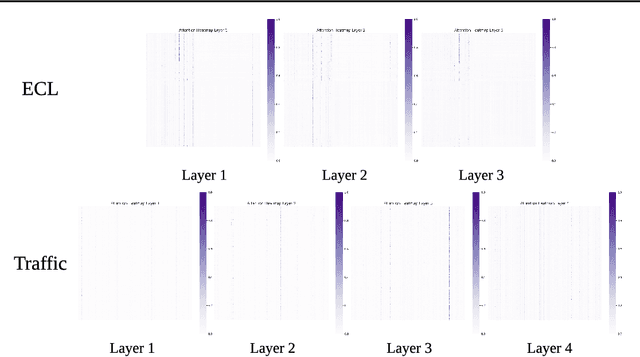
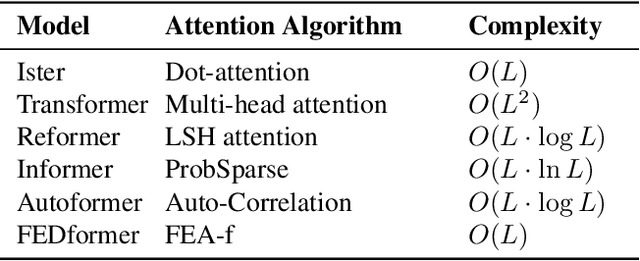

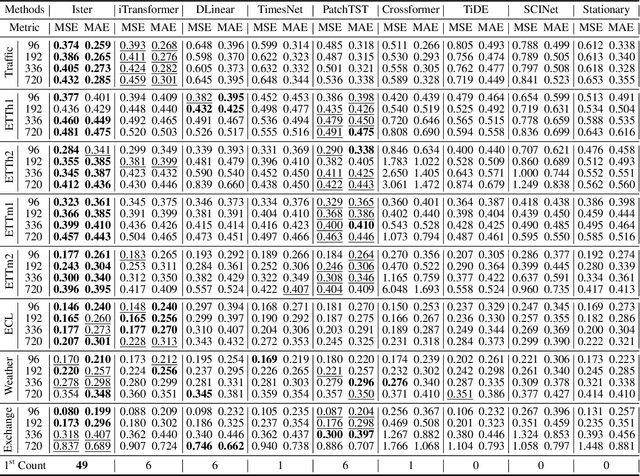
In long-term time series forecasting, Transformer-based models have achieved great success, due to its ability to capture long-range dependencies. However, existing transformer-based methods face challenges in accurately identifying which variables play a pivotal role in the prediction process and tend to overemphasize noisy channels, thereby limiting the interpretability and practical effectiveness of the models. Besides, it faces scalability issues due to quadratic computational complexity of self-attention. In this paper, we propose a new model named Inverted Seasonal-Trend Decomposition Transformer (Ister), which addresses these challenges in long-term multivariate time series forecasting by designing an improved Transformer-based structure. Ister firstly decomposes original time series into seasonal and trend components. Then we propose a new Dot-attention mechanism to process the seasonal component, which improves both accuracy, computation complexity and interpretability. Upon completion of the training phase, it allows users to intuitively visualize the significance of each feature in the overall prediction. We conduct comprehensive experiments, and the results show that Ister achieves state-of-the-art (SOTA) performance on multiple datasets, surpassing existing models in long-term prediction tasks.