 Add to Chrome
 Add to Firefox
 Add to Edge
FeasibleCap: Real-Time Embodiment Constraint Guidance for In-the-Wild Robot Demonstration Collection
Mar 08, 2026
Gripper-in-hand data collection decouples demonstration acquisition from robot hardware, but whether a trajectory is executable on the target robot remains unknown until a separate replay-and-validate stage. Failed demonstrations therefore inflate the effective cost per usable trajectory through repeated collection, diagnosis, and validation. Existing collection-time feedback systems mitigate this issue but rely on head-worn AR/VR displays, robot-in-the-loop hardware, or learned dynamics models; real-time executability feedback has not yet been integrated into the gripper-in-hand data collection paradigm. We present \textbf{FeasibleCap}, a gripper-in-hand data collection system that brings real-time executability guidance into robot-free capture. At each frame, FeasibleCap checks reachability, joint-rate limits, and collisions against a target robot model and closes the loop through on-device visual overlays and haptic cues, allowing demonstrators to correct motions during collection without learned models, headsets, or robot hardware. On pick-and-place and tossing tasks, FeasibleCap improves replay success and reduces the fraction of infeasible frames, with the largest gains on tossing. Simulation experiments further indicate that enforcing executability constraints during collection does not sacrifice cross-embodiment transfer across robot platforms. Hardware designs and software are available at https://github.com/aod321/FeasibleCap.

RAPID: Reconfigurable, Adaptive Platform for Iterative Design
Feb 06, 2026Developing robotic manipulation policies is iterative and hypothesis-driven: researchers test tactile sensing, gripper geometries, and sensor placements through real-world data collection and training. Yet even minor end-effector changes often require mechanical refitting and system re-integration, slowing iteration. We present RAPID, a full-stack reconfigurable platform designed to reduce this friction. RAPID is built around a tool-free, modular hardware architecture that unifies handheld data collection and robot deployment, and a matching software stack that maintains real-time awareness of the underlying hardware configuration through a driver-level Physical Mask derived from USB events. This modular hardware architecture reduces reconfiguration to seconds and makes systematic multi-modal ablation studies practical, allowing researchers to sweep diverse gripper and sensing configurations without repeated system bring-up. The Physical Mask exposes modality presence as an explicit runtime signal, enabling auto-configuration and graceful degradation under sensor hot-plug events, so policies can continue executing when sensors are physically added or removed. System-centric experiments show that RAPID reduces the setup time for multi-modal configurations by two orders of magnitude compared to traditional workflows and preserves policy execution under runtime sensor hot-unplug events. The hardware designs, drivers, and software stack are open-sourced at https://rapid-kit.github.io/ .
AToM-Bot: Embodied Fulfillment of Unspoken Human Needs with Affective Theory of Mind
Jun 12, 2024
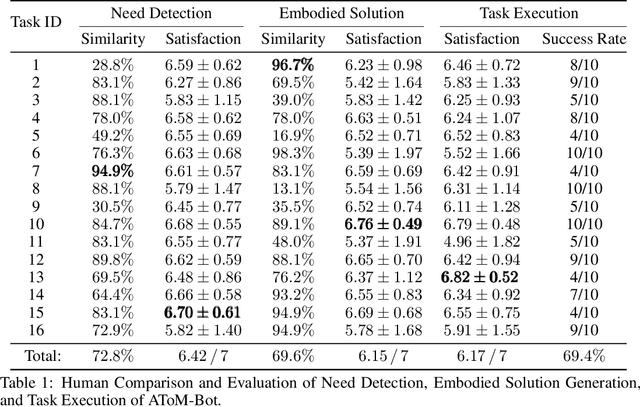
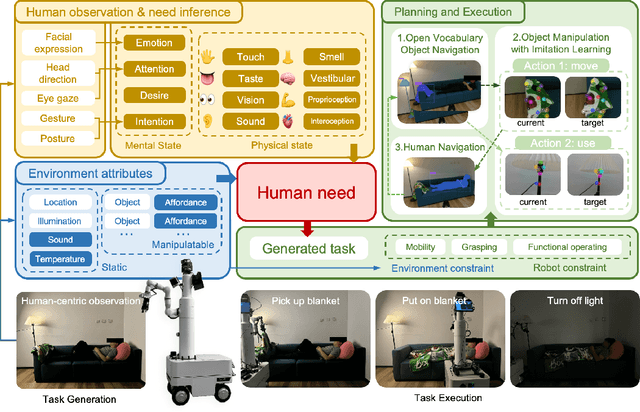

We propose AToM-Bot, a novel task generation and execution framework for proactive robot-human interaction, which leverages the human mental and physical state inference capabilities of the Vision Language Model (VLM) prompted by the Affective Theory of Mind (AToM). Without requiring explicit commands by humans, AToM-Bot proactively generates and follows feasible tasks to improve general human well-being. When around humans, AToM-Bot first detects current human needs based on inferred human states and observations of the surrounding environment. It then generates tasks to fulfill these needs, taking into account its embodied constraints. We designed 16 daily life scenarios spanning 4 common scenes and tasked the same visual stimulus to 59 human subjects and our robot. We used the similarity between human open-ended answers and robot output, and the human satisfaction scores to metric robot performance. AToM-Bot received high human evaluations in need detection (6.42/7, 91.7%), embodied solution (6.15/7, 87.8%) and task execution (6.17/7, 88.1%). We show that AToM-Bot excels in generating and executing feasible plans to fulfill unspoken human needs. Videos and code are available at https://affective-tom-bot.github.io.