 Add to Chrome
 Add to Firefox
 Add to Edge
Machine intelligence supports the full chain of 2D dendrite synthesis
Mar 17, 2026
Exemplified by the chemical vapor deposition growth of two-dimensional dendrites, which has potential applications in catalysis and presents a parameter-intensive, data-scarce and reaction process-complex model problem, we devise a machine intelligence-empowered framework for the full chain support of material synthesis, encompassing rapid process optimization, accurate customized synthesis, and comprehensive mechanism deciphering.First, active learning is integrated into the experimental workflow, identifying an optimal recipe for the growth of highly-branched, electrocatalytically-active ReSe2 dendrites through 60 experiments (4 iterations), which account for less than 1.3% of the numerous possible parameter combinations.Then, a prediction accuracy-guided data augmentation strategy is developed combined with a tree-based machine learning (ML) algorithm, unveiling a non-linear correlation between 5 process variables and fractal dimension (DF) of ReSe2 dendrites with only 9 experiment additions, which guides the synthesis of various user-defined DF. Finally, we construct a data-knowledge dual-driven mechanism model by integration of cross-scale characterizations, interpretable ML models, and domain knowledge in thermodynamics and kinetics, unraveling synergistic contributions of multiple process parameters to the product morphology. This work demonstrates the ML potential to transform the research paradigm and is adaptable to broader material synthesis.

Exploring structure diversity in atomic resolution microscopy with graph neural networks
Oct 23, 2024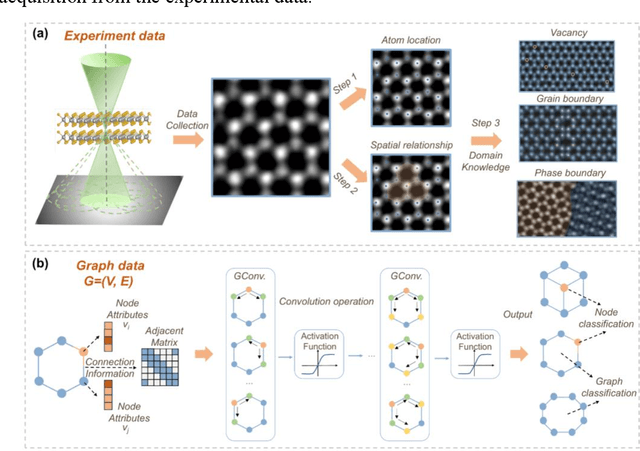
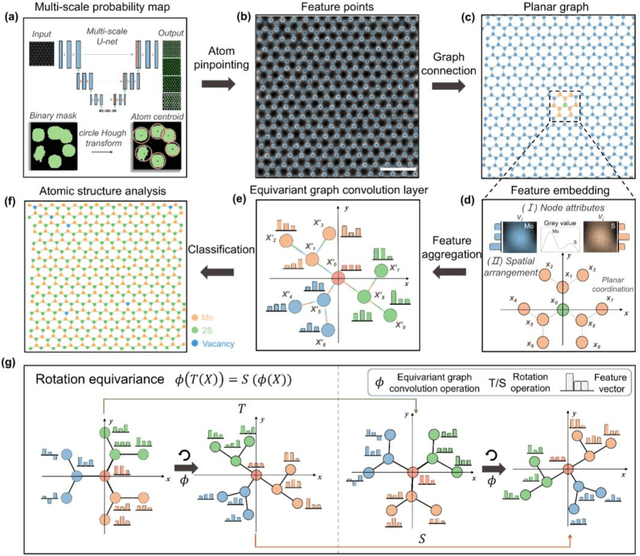
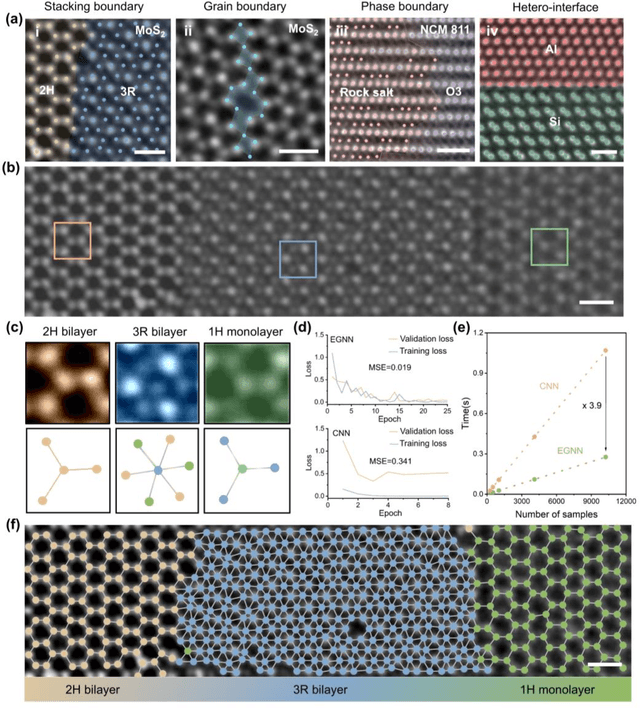
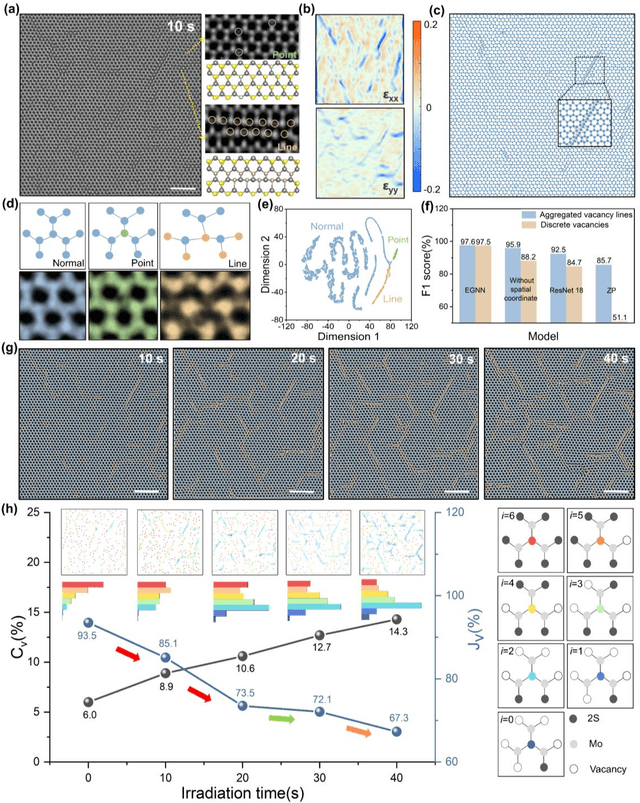
The emergence of deep learning (DL) has provided great opportunities for the high-throughput analysis of atomic-resolution micrographs. However, the DL models trained by image patches in fixed size generally lack efficiency and flexibility when processing micrographs containing diversified atomic configurations. Herein, inspired by the similarity between the atomic structures and graphs, we describe a few-shot learning framework based on an equivariant graph neural network (EGNN) to analyze a library of atomic structures (e.g., vacancies, phases, grain boundaries, doping, etc.), showing significantly promoted robustness and three orders of magnitude reduced computing parameters compared to the image-driven DL models, which is especially evident for those aggregated vacancy lines with flexible lattice distortion. Besides, the intuitiveness of graphs enables quantitative and straightforward extraction of the atomic-scale structural features in batches, thus statistically unveiling the self-assembly dynamics of vacancy lines under electron beam irradiation. A versatile model toolkit is established by integrating EGNN sub-models for single structure recognition to process images involving varied configurations in the form of a task chain, leading to the discovery of novel doping configurations with superior electrocatalytic properties for hydrogen evolution reactions. This work provides a powerful tool to explore structure diversity in a fast, accurate, and intelligent manner.