 Add to Chrome
 Add to Firefox
 Add to Edge
SO-Mamba: State-Ownership Mamba for Unrolled MRI Reconstruction
May 21, 2026
Accelerated MRI reconstruction requires recovering missing details while preserving anatomically coherent structures across large spatial regions. State-space models such as Mamba provide efficient long-range modeling, making them attractive learned regularizers for unrolled reconstruction. However, in a data-consistency-coupled unrolled solver, different stages operate on different reconstruction iterates, where the resident carrier should preserve coherent reconstruction content across stages while stage-dependent non-resident evidence is tied to the current update. Treating these roles uniformly can place persistent resident-carrier evidence and update-dependent non-resident evidence into the same recurrent content route. We therefore propose SO-Mamba, a state-ownership Mamba regularizer that assigns reconstruction evidence within each Mamba stage to recurrent residency, state-interface access, and non-state output correction. SO-Mamba implements this ownership rule with a State-Ownership Router (SOR), which constructs a resident carrier for recurrent content and routes non-resident evidence to affine modulation of the B/C state interfaces and an output correction outlet. The resident carrier supplies the Mamba content route, while the non-resident evidence stream adapts the state interfaces and contributes through the output outlet without entering the recurrent content route. We further introduce a two-level outer-band leakage diagnostic that separates hidden-state storage from readout expression by measuring outer-band energy in the selective-scan state trajectory and the post-scan Mamba readout. Experiments on five public MRI reconstruction benchmarks spanning diverse anatomies, sampling patterns, and coil configurations show that SO-Mamba consistently improves over CNN-, Transformer-, and Mamba-based baselines with competitive computational efficiency.

Deep Simultaneous Optimisation of Sampling and Reconstruction for Multi-contrast MRI
Mar 31, 2021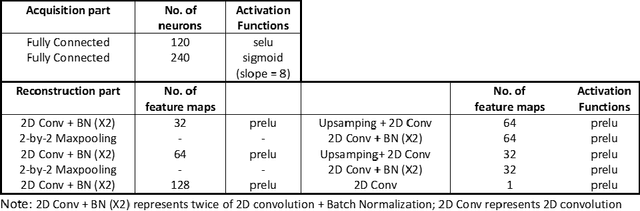
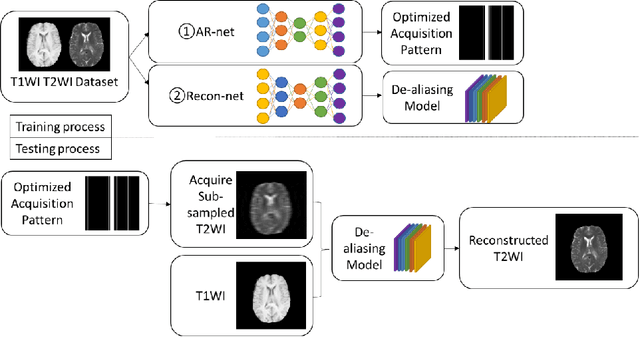
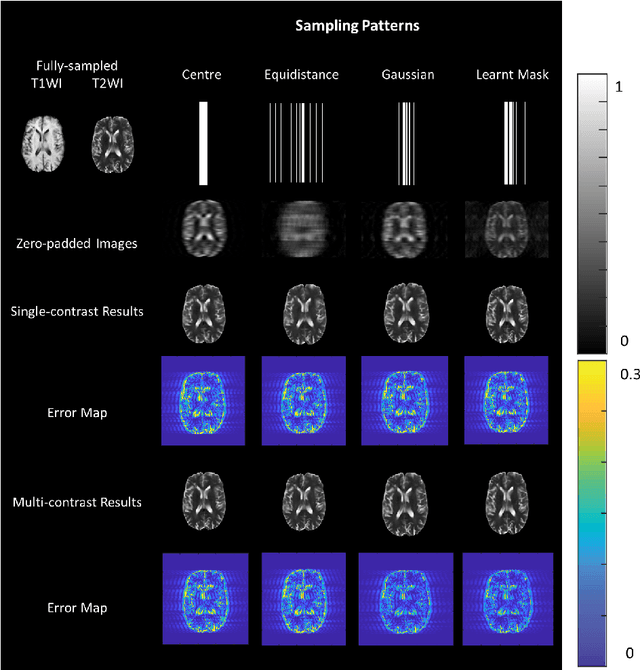
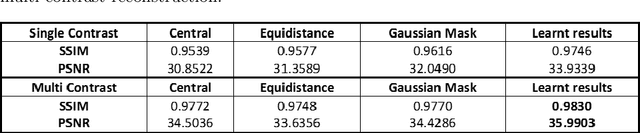
MRI images of the same subject in different contrasts contain shared information, such as the anatomical structure. Utilizing the redundant information amongst the contrasts to sub-sample and faithfully reconstruct multi-contrast images could greatly accelerate the imaging speed, improve image quality and shorten scanning protocols. We propose an algorithm that generates the optimised sampling pattern and reconstruction scheme of one contrast (e.g. T2-weighted image) when images with different contrast (e.g. T1-weighted image) have been acquired. The proposed algorithm achieves increased PSNR and SSIM with the resulting optimal sampling pattern compared to other acquisition patterns and single contrast methods.