 Add to Chrome
 Add to Firefox
 Add to Edge
CertBind from Multimodal Connectivity to Certifiable Retrieval Decisions
Aug 06, 2026
Lightweight connectors make frozen multimodal encoders composable at the representation level. Deployment exposes a second problem at the level of task decisions. A connected route can expand cross-modal reach while changing an established native retrieval capability. We introduce CertBind, a multiscale theory of certifiable composition for frozen multimodal connector graphs. At the node scale, native anchors establish the exact task identification boundary under the stated chart model. At the edge scale, contract-aware conformal ranks provide graph-wide family-wise error control. At the path scale, an overlap-aware budget and clean calibration yield a finite-sample recovery radius under declared conditions. At the query scale, this radius yields a covered top-k candidate set that becomes a point certificate when its size equals k. CertBind therefore retains supported routes as Direct, sends only flagged routes to recovery, returns Certified for decisive recovery, and returns Abstain for unresolved queries. The evaluated C-MCR shared route reduced native CLIP R@1 from 0.524 to 0.290. The production fallback recovered 0.963 +- 0.002 of clean retrieval, while the passing branch recorded a no-harm value of 1.000. CertBind extends multimodal composability from connected representations to certifiable task decisions.

Improved Sensitivity of Base Layer on the Performance of Rigid Pavement
Jan 20, 2021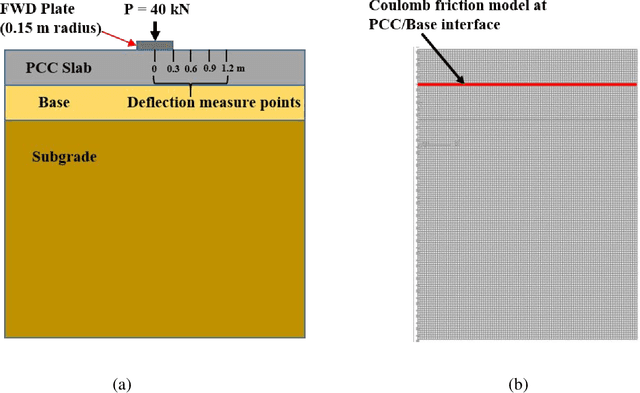
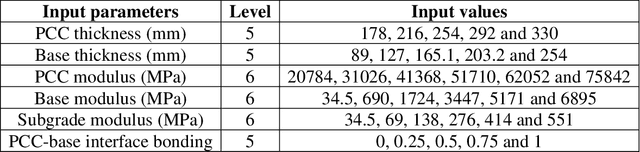
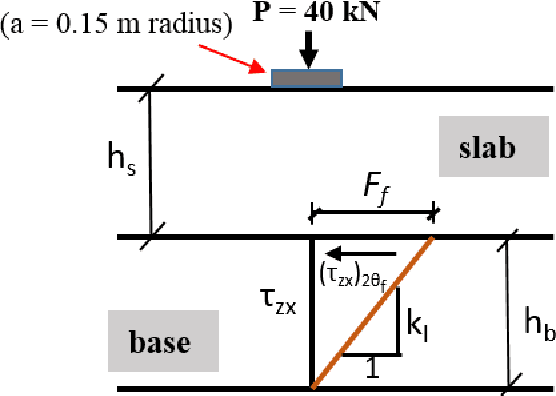
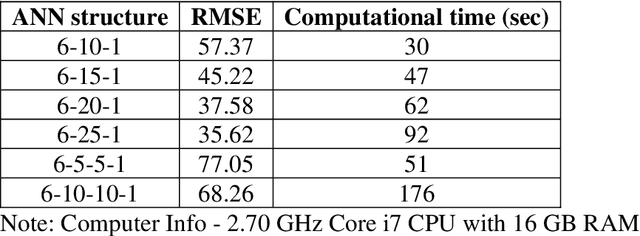
The performance of rigid pavement is greatly affected by the properties of base/subbase as well as subgrade layer. However, the performance predicted by the AASHTOWare Pavement ME design shows low sensitivity to the properties of base and subgrade layers. To improve the sensitivity and better reflect the influence of unbound layers a new set of improved models i.e., resilient modulus (MR) and modulus of subgrade reaction (k-value) are adopted in this study. An Artificial Neural Network (ANN) model is developed to predict the modified k-value based on finite element (FE) analysis. The training and validation datasets in the ANN model consist of 27000 simulation cases with different combinations of pavement layer thickness, layer modulus and slab-base interface bond ratio. To examine the sensitivity of modified MR and k-values on pavement response, eight pavement sections data are collected from the Long-Term Pavement performance (LTPP) database and modeled by using the FE software ISLAB2000. The computational results indicate that the modified MR values have higher sensitivity to water content in base layer on critical stress and deflection response of rigid pavements compared to the results using the Pavement ME design model. It is also observed that the k-values using ANN model has the capability of predicting critical pavement response at any partially bonded conditions whereas the Pavement ME design model can only calculate at two extreme bonding conditions (i.e., fully bonding and no bonding).