 Add to Chrome
 Add to Firefox
 Add to Edge
OSS-CRS: Liberating AIxCC Cyber Reasoning Systems for Real-World Open-Source Security
Mar 09, 2026
DARPA's AI Cyber Challenge (AIxCC) showed that cyber reasoning systems (CRSs) can go beyond vulnerability discovery to autonomously confirm and patch bugs: seven teams built such systems and open-sourced them after the competition. Yet all seven open-sourced CRSs remain largely unusable outside their original teams, each bound to the competition cloud infrastructure that no longer exists. We present OSS-CRS, an open, locally deployable framework for running and combining CRS techniques against real-world open-source projects, with budget-aware resource management. We ported the first-place system (Atlantis) and discovered 10 previously unknown bugs (three of high severity) across 8 OSS-Fuzz projects. OSS-CRS is publicly available.

SoK: DARPA's AI Cyber Challenge (AIxCC): Competition Design, Architectures, and Lessons Learned
Feb 07, 2026DARPA's AI Cyber Challenge (AIxCC, 2023--2025) is the largest competition to date for building fully autonomous cyber reasoning systems (CRSs) that leverage recent advances in AI -- particularly large language models (LLMs) -- to discover and remediate vulnerabilities in real-world open-source software. This paper presents the first systematic analysis of AIxCC. Drawing on design documents, source code, execution traces, and discussions with organizers and competing teams, we examine the competition's structure and key design decisions, characterize the architectural approaches of finalist CRSs, and analyze competition results beyond the final scoreboard. Our analysis reveals the factors that truly drove CRS performance, identifies genuine technical advances achieved by teams, and exposes limitations that remain open for future research. We conclude with lessons for organizing future competitions and broader insights toward deploying autonomous CRSs in practice.
ATLANTIS: AI-driven Threat Localization, Analysis, and Triage Intelligence System
Sep 18, 2025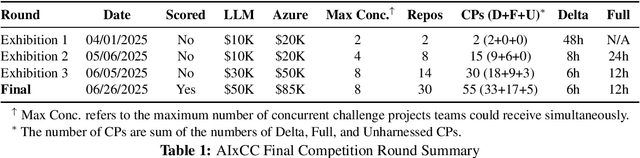
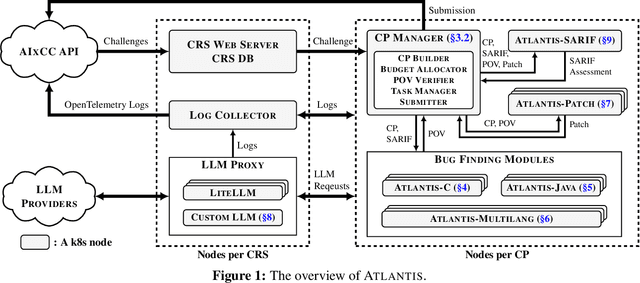
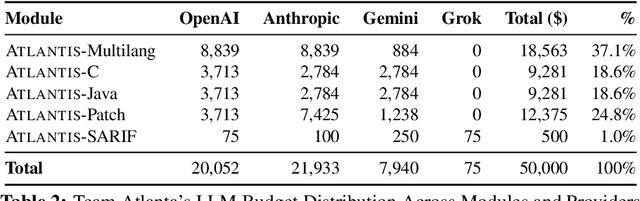
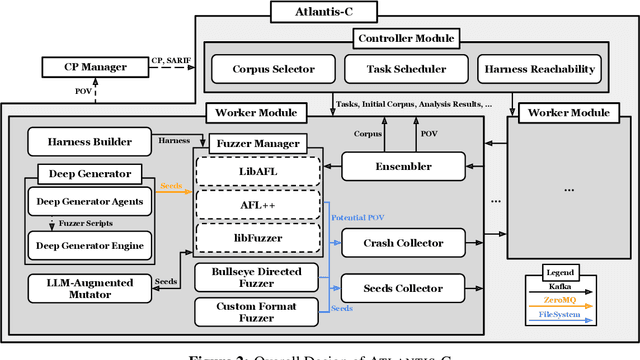
We present ATLANTIS, the cyber reasoning system developed by Team Atlanta that won 1st place in the Final Competition of DARPA's AI Cyber Challenge (AIxCC) at DEF CON 33 (August 2025). AIxCC (2023-2025) challenged teams to build autonomous cyber reasoning systems capable of discovering and patching vulnerabilities at the speed and scale of modern software. ATLANTIS integrates large language models (LLMs) with program analysis -- combining symbolic execution, directed fuzzing, and static analysis -- to address limitations in automated vulnerability discovery and program repair. Developed by researchers at Georgia Institute of Technology, Samsung Research, KAIST, and POSTECH, the system addresses core challenges: scaling across diverse codebases from C to Java, achieving high precision while maintaining broad coverage, and producing semantically correct patches that preserve intended behavior. We detail the design philosophy, architectural decisions, and implementation strategies behind ATLANTIS, share lessons learned from pushing the boundaries of automated security when program analysis meets modern AI, and release artifacts to support reproducibility and future research.