 Add to Chrome
 Add to Firefox
 Add to Edge
LLM-Assisted Stance Detection in Scientific Discourse: A Test Case in Bayesian Cognitive Science
Jun 14, 2026
Qualitative coding is central to social science, but expert annotation is difficult to scale. LLMs offer a possible extension, yet require careful validation when the target construct is interpretive, theoretically loaded, and only indirectly expressed. We study this problem in a difficult case: detecting whether authors treat Bayesian models as descriptions of mental and neural mechanisms (realism) or as useful mathematical tools (instrumentalism). Our method combines a theory-driven codebook, expert-coded reference annotations, a diagnostic-gated prompt-optimization search yielding a shared zero-shot prompt for three frontier LLMs (GPT-5.1, Claude Sonnet 4.6, Gemini 3 Pro Preview), and multi-rater reliability analysis. The final prompt achieved a held-out combined reliability score of 0.76 (harmonic mean of ICC = 0.79 and $α$ = 0.74), with all diagnostics satisfied. Deployed on 6,858 quotes from 210 articles, the three LLMs reached substantial quote-level agreement (ICC = 0.80; $α$ = 0.76; combined = 0.78) and near-perfect article-level rank stability ($r$ = 0.96-0.97 across rater pairs). The corpus was predominantly weakly realist, but article-level stances were rarely uniform: only 1.4% of articles used a single band, while 59.5% spanned four or more. Low-level perception/motor articles scored 8.8 Realism points higher than high-level cognition articles ($p < .001$, $d = 0.60$), quantifying a long-held qualitative intuition. We present this as an expert-led case study; the framework is intended to generalize to similar theoretically demanding tasks, not to all qualitative analysis.

Large Language Models Are More Persuasive Than Incentivized Human Persuaders
May 14, 2025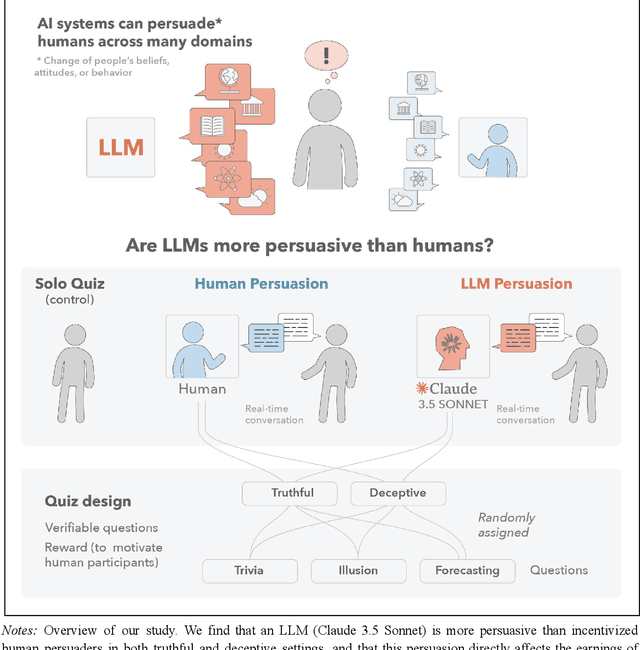
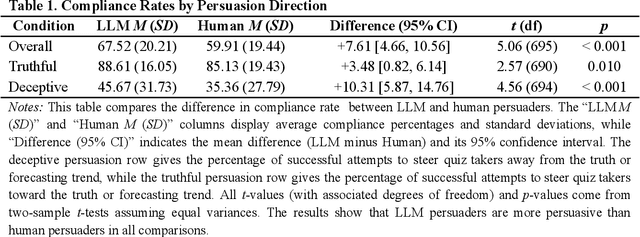
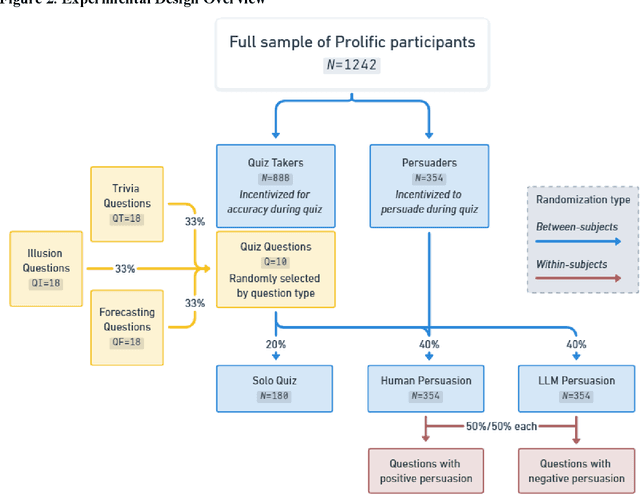
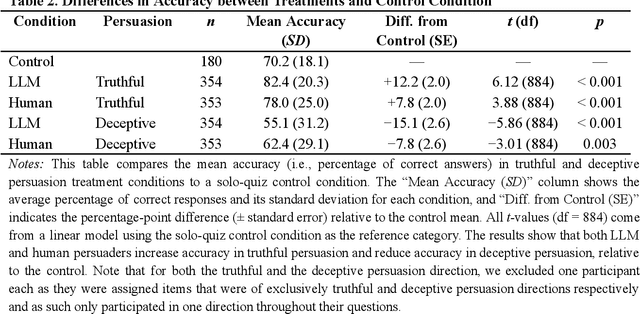
We directly compare the persuasion capabilities of a frontier large language model (LLM; Claude Sonnet 3.5) against incentivized human persuaders in an interactive, real-time conversational quiz setting. In this preregistered, large-scale incentivized experiment, participants (quiz takers) completed an online quiz where persuaders (either humans or LLMs) attempted to persuade quiz takers toward correct or incorrect answers. We find that LLM persuaders achieved significantly higher compliance with their directional persuasion attempts than incentivized human persuaders, demonstrating superior persuasive capabilities in both truthful (toward correct answers) and deceptive (toward incorrect answers) contexts. We also find that LLM persuaders significantly increased quiz takers' accuracy, leading to higher earnings, when steering quiz takers toward correct answers, and significantly decreased their accuracy, leading to lower earnings, when steering them toward incorrect answers. Overall, our findings suggest that AI's persuasion capabilities already exceed those of humans that have real-money bonuses tied to performance. Our findings of increasingly capable AI persuaders thus underscore the urgency of emerging alignment and governance frameworks.