 Add to Chrome
 Add to Firefox
 Add to Edge
Quantization-Robust LLM Unlearning via Low-Rank Adaptation
Feb 13, 2026
Large Language Model (LLM) unlearning aims to remove targeted knowledge from a trained model, but practical deployments often require post-training quantization (PTQ) for efficient inference. However, aggressive low-bit PTQ can mask or erase unlearning updates, causing quantized models to revert to pre-unlearning behavior. We show that standard full-parameter fine-tuning often induce parameter changes that are too small to survive 4-bit quantization. We propose quantization-robust unlearning via low-rank adaptation (LoRA): we freeze the base model and concentrate unlearning into trainable adapters so that the effective update is preserved after quantization. On Llama-2-7B evaluated with MUSE dataset (BOOKS and NEWS), LoRA improves 4-bit utility by up to 7.93 points (NPO+GDR on BOOKS: 50.17 to 58.10) and yields higher 4-bit utility on NEWS for GA+GDR (40.06 to 44.82, increase of 4.76). LoRA also substantially reduces privacy leakage under 4-bit PTQ, e.g., for GA+KLR on BOOKS, PrivLeak moves from -25.68 to -5.86 (closer to ideal 0), while maintaining strong forgetting (VerMem and KnowMem near 0). Thus, using LoRA for Machine Unlearning is beneficial for scenarios where quantization is necessary for model deployment.

Proximal Control of UAVs with Federated Learning for Human-Robot Collaborative Domains
Dec 03, 2024

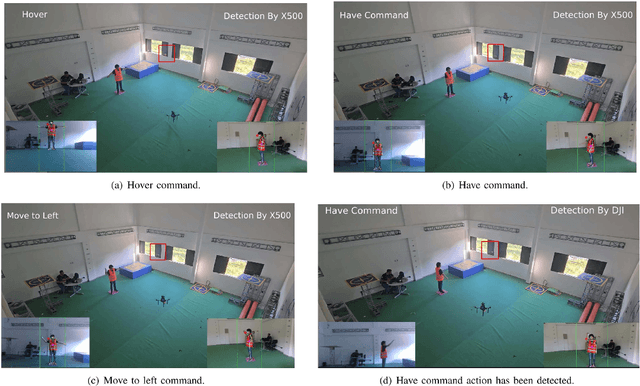

The human-robot interaction (HRI) is a growing area of research. In HRI, complex command (action) classification is still an open problem that usually prevents the real applicability of such a technique. The literature presents some works that use neural networks to detect these actions. However, occlusion is still a major issue in HRI, especially when using uncrewed aerial vehicles (UAVs), since, during the robot's movement, the human operator is often out of the robot's field of view. Furthermore, in multi-robot scenarios, distributed training is also an open problem. In this sense, this work proposes an action recognition and control approach based on Long Short-Term Memory (LSTM) Deep Neural Networks with two layers in association with three densely connected layers and Federated Learning (FL) embedded in multiple drones. The FL enabled our approach to be trained in a distributed fashion, i.e., access to data without the need for cloud or other repositories, which facilitates the multi-robot system's learning. Furthermore, our multi-robot approach results also prevented occlusion situations, with experiments with real robots achieving an accuracy greater than 96%.