 Add to Chrome
 Add to Firefox
 Add to Edge
Quantization-Robust LLM Unlearning via Low-Rank Adaptation
Feb 13, 2026
Large Language Model (LLM) unlearning aims to remove targeted knowledge from a trained model, but practical deployments often require post-training quantization (PTQ) for efficient inference. However, aggressive low-bit PTQ can mask or erase unlearning updates, causing quantized models to revert to pre-unlearning behavior. We show that standard full-parameter fine-tuning often induce parameter changes that are too small to survive 4-bit quantization. We propose quantization-robust unlearning via low-rank adaptation (LoRA): we freeze the base model and concentrate unlearning into trainable adapters so that the effective update is preserved after quantization. On Llama-2-7B evaluated with MUSE dataset (BOOKS and NEWS), LoRA improves 4-bit utility by up to 7.93 points (NPO+GDR on BOOKS: 50.17 to 58.10) and yields higher 4-bit utility on NEWS for GA+GDR (40.06 to 44.82, increase of 4.76). LoRA also substantially reduces privacy leakage under 4-bit PTQ, e.g., for GA+KLR on BOOKS, PrivLeak moves from -25.68 to -5.86 (closer to ideal 0), while maintaining strong forgetting (VerMem and KnowMem near 0). Thus, using LoRA for Machine Unlearning is beneficial for scenarios where quantization is necessary for model deployment.

An approach based on class activation maps for investigating the effects of data augmentation on neural networks for image classification
May 19, 2025Neural networks have become increasingly popular in the last few years as an effective tool for the task of image classification due to the impressive performance they have achieved on this task. In image classification tasks, it is common to use data augmentation strategies to increase the robustness of trained networks to changes in the input images and to avoid overfitting. Although data augmentation is a widely adopted technique, the literature lacks a body of research analyzing the effects data augmentation methods have on the patterns learned by neural network models working on complex datasets. The primary objective of this work is to propose a methodology and set of metrics that may allow a quantitative approach to analyzing the effects of data augmentation in convolutional networks applied to image classification. An important tool used in the proposed approach lies in the concept of class activation maps for said models, which allow us to identify and measure the importance these models assign to each individual pixel in an image when executing the classification task. From these maps, we may then extract metrics over the similarities and differences between maps generated by these models trained on a given dataset with different data augmentation strategies. Experiments made using this methodology suggest that the effects of these data augmentation techniques not only can be analyzed in this way but also allow us to identify different impact profiles over the trained models.
Siamese Networks for Cat Re-Identification: Exploring Neural Models for Cat Instance Recognition
Jan 03, 2025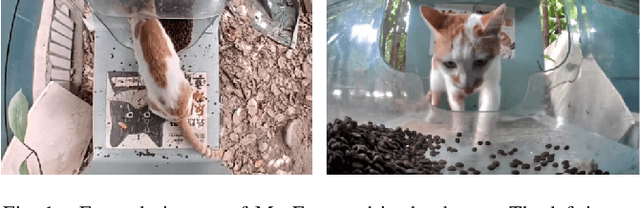

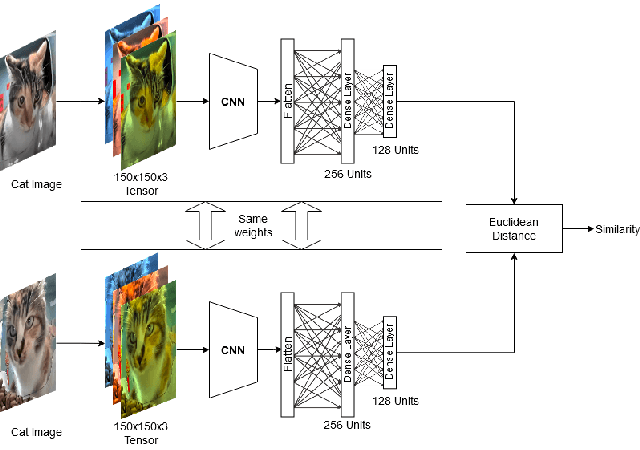
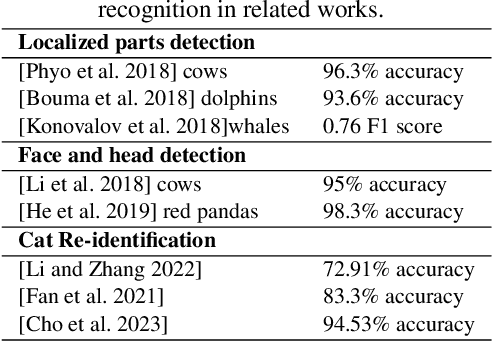
Street cats in urban areas often rely on human intervention for survival, leading to challenges in population control and welfare management. In April 2023, Hello Inc., a Chinese urban mobility company, launched the Hello Street Cat initiative to address these issues. The project deployed over 21,000 smart feeding stations across 14 cities in China, integrating livestreaming cameras and treat dispensers activated through user donations. It also promotes the Trap-Neuter-Return (TNR) method, supported by a community-driven platform, HelloStreetCatWiki, where volunteers catalog and identify cats. However, manual identification is inefficient and unsustainable, creating a need for automated solutions. This study explores Deep Learning-based models for re-identifying street cats in the Hello Street Cat initiative. A dataset of 2,796 images of 69 cats was used to train Siamese Networks with EfficientNetB0, MobileNet and VGG16 as base models, evaluated under contrastive and triplet loss functions. VGG16 paired with contrastive loss emerged as the most effective configuration, achieving up to 97% accuracy and an F1 score of 0.9344 during testing. The approach leverages image augmentation and dataset refinement to overcome challenges posed by limited data and diverse visual variations. These findings underscore the potential of automated cat re-identification to streamline population monitoring and welfare efforts. By reducing reliance on manual processes, the method offers a scalable and reliable solution for communitydriven initiatives. Future research will focus on expanding datasets and developing real-time implementations to enhance practicality in large-scale deployments.