 Add to Chrome
 Add to Firefox
 Add to Edge
Spatial-Temporal Expert Learning for Video-based Person Re-identification
Jul 01, 2026
Video-based person re-identification (Re-ID) aims to retrieve the same identity in the query video clips from the gallery video clips. To solve this problem, exploiting fine-grained features is of great importance, especially when discriminating identities that are similar in appearance. In this paper, we propose to enhance the ability to explore fine-grained information with a novel input-aware extendable expert module. Instead of updating the network parameters with every sample in the dataset, we aim to train the experts within specific subsets that only contain similar samples and promote their ability to exploit fine-grained information within these similar samples. To achieve this goal, we incorporate two mechanisms in this module: input-aware expert selection mechanism and spatial-temporal selection mechanism. The first mechanism dynamically activates a set of experts on subsets of similar samples, pushing the experts to exploit subtle differences between these similar samples, while the second one further increases their sensitivity to the fine-grained differences in spatial and temporal aspects and allows the experts to dynamically utilize them for different input samples. In addition, to facilitate the expert module, we design an extendable scheme that allows the module to flexibly add new experts when necessary. As a result, our method achieves outstanding performance on two large-scale datasets.

Humans need not label more humans: Occlusion Copy & Paste for Occluded Human Instance Segmentation
Oct 07, 2022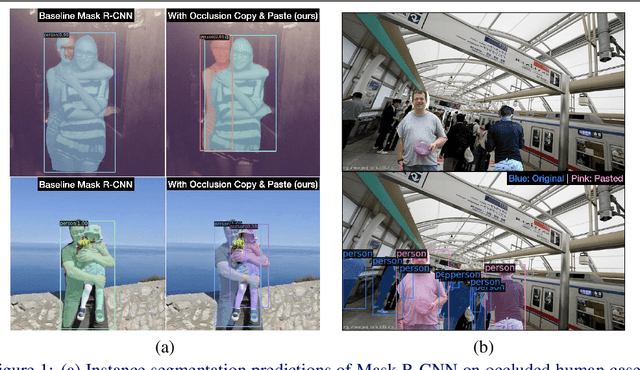
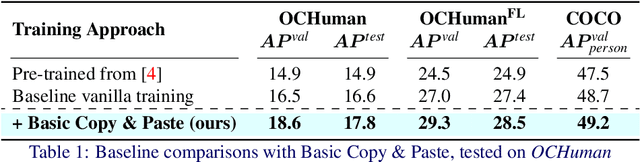
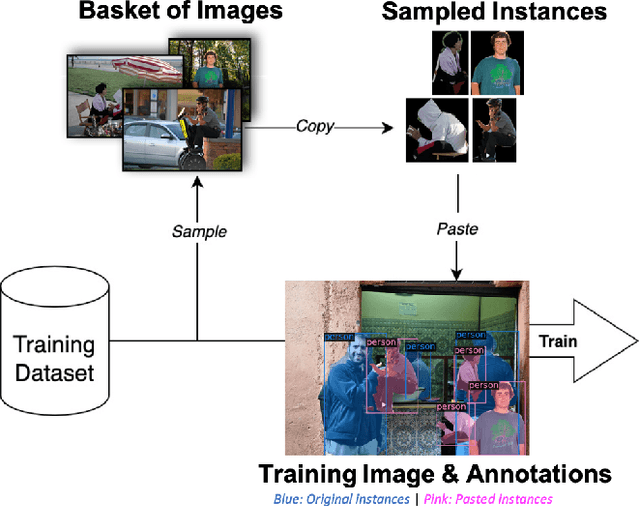
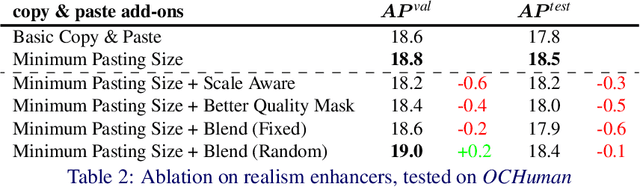
Modern object detection and instance segmentation networks stumble when picking out humans in crowded or highly occluded scenes. Yet, these are often scenarios where we require our detectors to work well. Many works have approached this problem with model-centric improvements. While they have been shown to work to some extent, these supervised methods still need sufficient relevant examples (i.e. occluded humans) during training for the improvements to be maximised. In our work, we propose a simple yet effective data-centric approach, Occlusion Copy & Paste, to introduce occluded examples to models during training - we tailor the general copy & paste augmentation approach to tackle the difficult problem of same-class occlusion. It improves instance segmentation performance on occluded scenarios for "free" just by leveraging on existing large-scale datasets, without additional data or manual labelling needed. In a principled study, we show whether various proposed add-ons to the copy & paste augmentation indeed contribute to better performance. Our Occlusion Copy & Paste augmentation is easily interoperable with any models: by simply applying it to a recent generic instance segmentation model without explicit model architectural design to tackle occlusion, we achieve state-of-the-art instance segmentation performance on the very challenging OCHuman dataset. Source code is available at https://github.com/levan92/occlusion-copy-paste.