 Add to Chrome
 Add to Firefox
 Add to Edge
Mi:dm 2.0 Korea-centric Bilingual Language Models
Jan 14, 2026
We introduce Mi:dm 2.0, a bilingual large language model (LLM) specifically engineered to advance Korea-centric AI. This model goes beyond Korean text processing by integrating the values, reasoning patterns, and commonsense knowledge inherent to Korean society, enabling nuanced understanding of cultural contexts, emotional subtleties, and real-world scenarios to generate reliable and culturally appropriate responses. To address limitations of existing LLMs, often caused by insufficient or low-quality Korean data and lack of cultural alignment, Mi:dm 2.0 emphasizes robust data quality through a comprehensive pipeline that includes proprietary data cleansing, high-quality synthetic data generation, strategic data mixing with curriculum learning, and a custom Korean-optimized tokenizer to improve efficiency and coverage. To realize this vision, we offer two complementary configurations: Mi:dm 2.0 Base (11.5B parameters), built with a depth-up scaling strategy for general-purpose use, and Mi:dm 2.0 Mini (2.3B parameters), optimized for resource-constrained environments and specialized tasks. Mi:dm 2.0 achieves state-of-the-art performance on Korean-specific benchmarks, with top-tier zero-shot results on KMMLU and strong internal evaluation results across language, humanities, and social science tasks. The Mi:dm 2.0 lineup is released under the MIT license to support extensive research and commercial use. By offering accessible and high-performance Korea-centric LLMs, KT aims to accelerate AI adoption across Korean industries, public services, and education, strengthen the Korean AI developer community, and lay the groundwork for the broader vision of K-intelligence. Our models are available at https://huggingface.co/K-intelligence. For technical inquiries, please contact midm-llm@kt.com.

RILQ: Rank-Insensitive LoRA-based Quantization Error Compensation for Boosting 2-bit Large Language Model Accuracy
Dec 02, 2024Low-rank adaptation (LoRA) has become the dominant method for parameter-efficient LLM fine-tuning, with LoRA-based quantization error compensation (LQEC) emerging as a powerful tool for recovering accuracy in compressed LLMs. However, LQEC has underperformed in sub-4-bit scenarios, with no prior investigation into understanding this limitation. We propose RILQ (Rank-Insensitive LoRA-based Quantization Error Compensation) to understand fundamental limitation and boost 2-bit LLM accuracy. Based on rank analysis revealing model-wise activation discrepancy loss's rank-insensitive nature, RILQ employs this loss to adjust adapters cooperatively across layers, enabling robust error compensation with low-rank adapters. Evaluations on LLaMA-2 and LLaMA-3 demonstrate RILQ's consistent improvements in 2-bit quantized inference across various state-of-the-art quantizers and enhanced accuracy in task-specific fine-tuning. RILQ maintains computational efficiency comparable to existing LoRA methods, enabling adapter-merged weight-quantized LLM inference with significantly enhanced accuracy, making it a promising approach for boosting 2-bit LLM performance.
NASH: A Simple Unified Framework of Structured Pruning for Accelerating Encoder-Decoder Language Models
Oct 16, 2023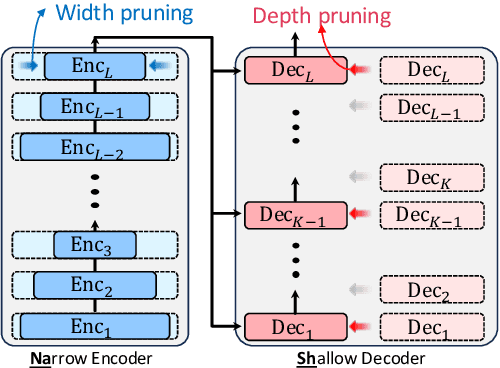
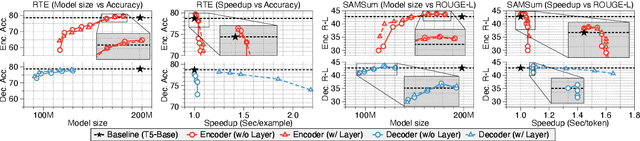
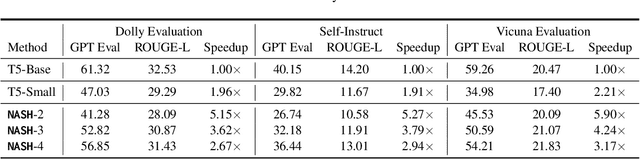
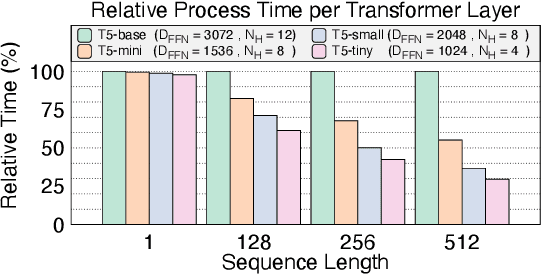
Structured pruning methods have proven effective in reducing the model size and accelerating inference speed in various network architectures such as Transformers. Despite the versatility of encoder-decoder models in numerous NLP tasks, the structured pruning methods on such models are relatively less explored compared to encoder-only models. In this study, we investigate the behavior of the structured pruning of the encoder-decoder models in the decoupled pruning perspective of the encoder and decoder component, respectively. Our findings highlight two insights: (1) the number of decoder layers is the dominant factor of inference speed, and (2) low sparsity in the pruned encoder network enhances generation quality. Motivated by these findings, we propose a simple and effective framework, NASH, that narrows the encoder and shortens the decoder networks of encoder-decoder models. Extensive experiments on diverse generation and inference tasks validate the effectiveness of our method in both speedup and output quality.
Revisiting Intermediate Layer Distillation for Compressing Language Models: An Overfitting Perspective
Feb 03, 2023


Knowledge distillation (KD) is a highly promising method for mitigating the computational problems of pre-trained language models (PLMs). Among various KD approaches, Intermediate Layer Distillation (ILD) has been a de facto standard KD method with its performance efficacy in the NLP field. In this paper, we find that existing ILD methods are prone to overfitting to training datasets, although these methods transfer more information than the original KD. Next, we present the simple observations to mitigate the overfitting of ILD: distilling only the last Transformer layer and conducting ILD on supplementary tasks. Based on our two findings, we propose a simple yet effective consistency-regularized ILD (CR-ILD), which prevents the student model from overfitting the training dataset. Substantial experiments on distilling BERT on the GLUE benchmark and several synthetic datasets demonstrate that our proposed ILD method outperforms other KD techniques. Our code is available at https://github.com/jongwooko/CR-ILD.