 Add to Chrome
 Add to Firefox
 Add to Edge
Mi:dm 2.0 Korea-centric Bilingual Language Models
Jan 14, 2026
We introduce Mi:dm 2.0, a bilingual large language model (LLM) specifically engineered to advance Korea-centric AI. This model goes beyond Korean text processing by integrating the values, reasoning patterns, and commonsense knowledge inherent to Korean society, enabling nuanced understanding of cultural contexts, emotional subtleties, and real-world scenarios to generate reliable and culturally appropriate responses. To address limitations of existing LLMs, often caused by insufficient or low-quality Korean data and lack of cultural alignment, Mi:dm 2.0 emphasizes robust data quality through a comprehensive pipeline that includes proprietary data cleansing, high-quality synthetic data generation, strategic data mixing with curriculum learning, and a custom Korean-optimized tokenizer to improve efficiency and coverage. To realize this vision, we offer two complementary configurations: Mi:dm 2.0 Base (11.5B parameters), built with a depth-up scaling strategy for general-purpose use, and Mi:dm 2.0 Mini (2.3B parameters), optimized for resource-constrained environments and specialized tasks. Mi:dm 2.0 achieves state-of-the-art performance on Korean-specific benchmarks, with top-tier zero-shot results on KMMLU and strong internal evaluation results across language, humanities, and social science tasks. The Mi:dm 2.0 lineup is released under the MIT license to support extensive research and commercial use. By offering accessible and high-performance Korea-centric LLMs, KT aims to accelerate AI adoption across Korean industries, public services, and education, strengthen the Korean AI developer community, and lay the groundwork for the broader vision of K-intelligence. Our models are available at https://huggingface.co/K-intelligence. For technical inquiries, please contact midm-llm@kt.com.

You Truly Understand What I Need: Intellectual and Friendly Dialogue Agents grounding Knowledge and Persona
Jan 06, 2023
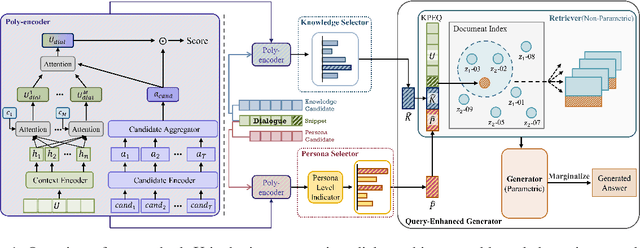


To build a conversational agent that interacts fluently with humans, previous studies blend knowledge or personal profile into the pre-trained language model. However, the model that considers knowledge and persona at the same time is still limited, leading to hallucination and a passive way of using personas. We propose an effective dialogue agent that grounds external knowledge and persona simultaneously. The agent selects the proper knowledge and persona to use for generating the answers with our candidate scoring implemented with a poly-encoder. Then, our model generates the utterance with lesser hallucination and more engagingness utilizing retrieval augmented generation with knowledge-persona enhanced query. We conduct experiments on the persona-knowledge chat and achieve state-of-the-art performance in grounding and generation tasks on the automatic metrics. Moreover, we validate the answers from the models regarding hallucination and engagingness through human evaluation and qualitative results. We show our retriever's effectiveness in extracting relevant documents compared to the other previous retrievers, along with the comparison of multiple candidate scoring methods. Code is available at https://github.com/dlawjddn803/INFO