 Add to Chrome
 Add to Firefox
 Add to Edge
Pancakes: Consistent Multi-Protocol Image Segmentation Across Biomedical Domains
Dec 15, 2025
A single biomedical image can be meaningfully segmented in multiple ways, depending on the desired application. For instance, a brain MRI can be segmented according to tissue types, vascular territories, broad anatomical regions, fine-grained anatomy, or pathology, etc. Existing automatic segmentation models typically either (1) support only a single protocol, the one they were trained on, or (2) require labor-intensive manual prompting to specify the desired segmentation. We introduce Pancakes, a framework that, given a new image from a previously unseen domain, automatically generates multi-label segmentation maps for multiple plausible protocols, while maintaining semantic consistency across related images. Pancakes introduces a new problem formulation that is not currently attainable by existing foundation models. In a series of experiments on seven held-out datasets, we demonstrate that our model can significantly outperform existing foundation models in producing several plausible whole-image segmentations, that are semantically coherent across images.

Neurovascular Segmentation in sOCT with Deep Learning and Synthetic Training Data
Jul 01, 2024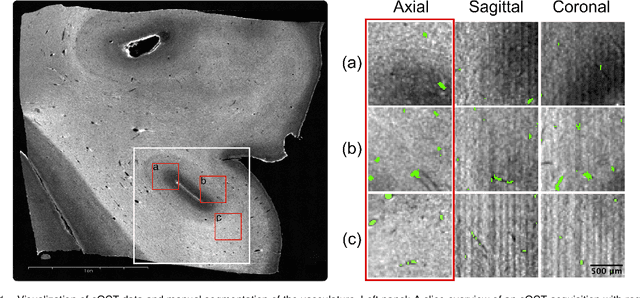
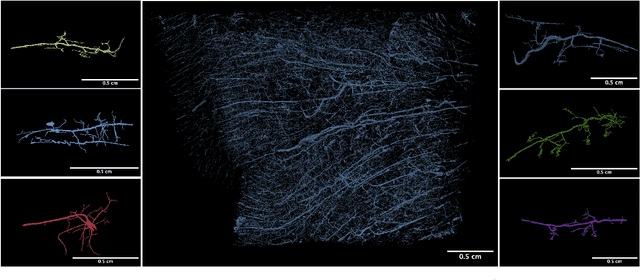
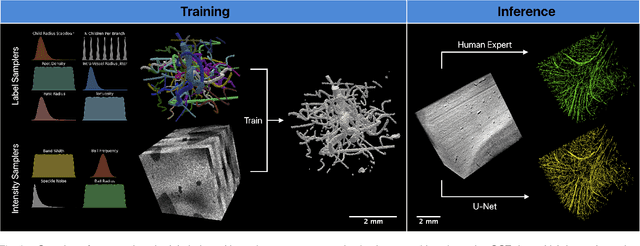
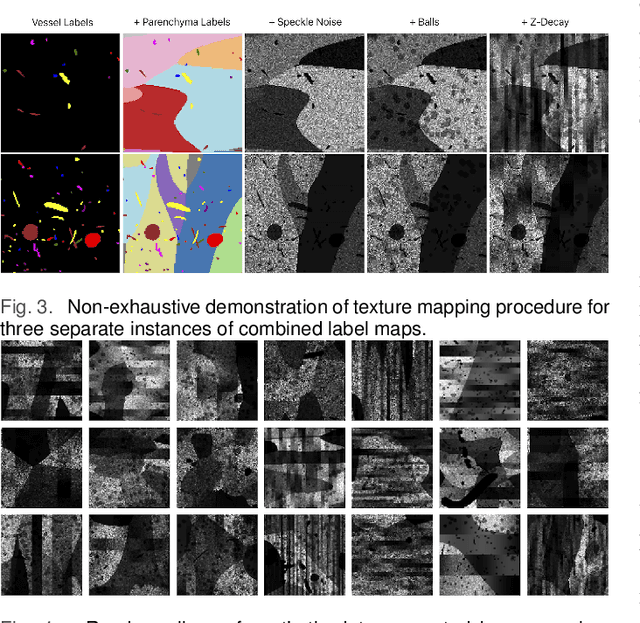
Microvascular anatomy is known to be involved in various neurological disorders. However, understanding these disorders is hindered by the lack of imaging modalities capable of capturing the comprehensive three-dimensional vascular network structure at microscopic resolution. With a lateral resolution of $<=$20 {\textmu}m and ability to reconstruct large tissue blocks up to tens of cubic centimeters, serial-section optical coherence tomography (sOCT) is well suited for this task. This method uses intrinsic optical properties to visualize the vessels and therefore does not possess a specific contrast, which complicates the extraction of accurate vascular models. The performance of traditional vessel segmentation methods is heavily degraded in the presence of substantial noise and imaging artifacts and is sensitive to domain shifts, while convolutional neural networks (CNNs) require extensive labeled data and are also sensitive the precise intensity characteristics of the data that they are trained on. Building on the emerging field of synthesis-based training, this study demonstrates a synthesis engine for neurovascular segmentation in sOCT images. Characterized by minimal priors and high variance sampling, our highly generalizable method tested on five distinct sOCT acquisitions eliminates the need for manual annotations while attaining human-level precision. Our approach comprises two phases: label synthesis and label-to-image transformation. We demonstrate the efficacy of the former by comparing it to several more realistic sets of training labels, and the latter by an ablation study of synthetic noise and artifact models.
A label-free and data-free training strategy for vasculature segmentation in serial sectioning OCT data
May 22, 2024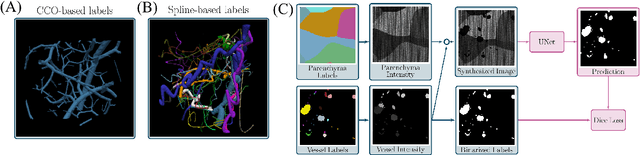
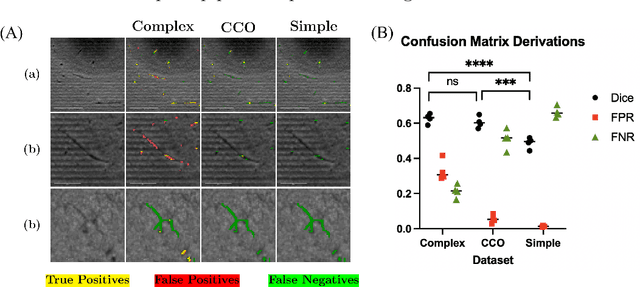
Serial sectioning Optical Coherence Tomography (sOCT) is a high-throughput, label free microscopic imaging technique that is becoming increasingly popular to study post-mortem neurovasculature. Quantitative analysis of the vasculature requires highly accurate segmentation; however, sOCT has low signal-to-noise-ratio and displays a wide range of contrasts and artifacts that depend on acquisition parameters. Furthermore, labeled data is scarce and extremely time consuming to generate. Here, we leverage synthetic datasets of vessels to train a deep learning segmentation model. We construct the vessels with semi-realistic splines that simulate the vascular geometry and compare our model with realistic vascular labels generated by constrained constructive optimization. Both approaches yield similar Dice scores, although with very different false positive and false negative rates. This method addresses the complexity inherent in OCT images and paves the way for more accurate and efficient analysis of neurovascular structures.