 Add to Chrome
 Add to Firefox
 Add to Edge
Weak Dominant Balance for Robust Identification of Dynamically Consistent Fluid Flow Structure
Jun 27, 2026
Extracting interpretable, localized physical mechanisms from complex spatiotemporal data is a foundational challenge across physics, biology, and engineering, but has remained out of reach on real measurements. The central obstacle is obtaining high-quality gradients of data via numerical differentiation, which amplifies noise, diverges for high-order equations, and falters on irregular geometries, limiting the scope of existing approaches to clean simulations of low-order systems. Here, we present weak dominant balance, a derivative-free framework that projects governing equations into a weak (integral) formulation, offloading differentiation onto smooth analytical test functions and leaving the data untouched. The method sustains accurate regime identification under severe noise where existing approaches categorically fail, delivers the first data-driven decomposition of a third-order partial differential equation applied to turbulent duct flow, and produces matching decompositions across direct numerical simulation and particle-image velocimetry measurements of a wavy channel flow, uncovering a previously uncharacterized dynamical regime. Weak dominant balance brings mechanism-level analysis out of simulation and onto measured data, and opens complex physical systems to direct, equation-grounded interpretation.

HydroGym: A Reinforcement Learning Platform for Fluid Dynamics
Dec 19, 2025Modeling and controlling fluid flows is critical for several fields of science and engineering, including transportation, energy, and medicine. Effective flow control can lead to, e.g., lift increase, drag reduction, mixing enhancement, and noise reduction. However, controlling a fluid faces several significant challenges, including high-dimensional, nonlinear, and multiscale interactions in space and time. Reinforcement learning (RL) has recently shown great success in complex domains, such as robotics and protein folding, but its application to flow control is hindered by a lack of standardized benchmark platforms and the computational demands of fluid simulations. To address these challenges, we introduce HydroGym, a solver-independent RL platform for flow control research. HydroGym integrates sophisticated flow control benchmarks, scalable runtime infrastructure, and state-of-the-art RL algorithms. Our platform includes 42 validated environments spanning from canonical laminar flows to complex three-dimensional turbulent scenarios, validated over a wide range of Reynolds numbers. We provide non-differentiable solvers for traditional RL and differentiable solvers that dramatically improve sample efficiency through gradient-enhanced optimization. Comprehensive evaluation reveals that RL agents consistently discover robust control principles across configurations, such as boundary layer manipulation, acoustic feedback disruption, and wake reorganization. Transfer learning studies demonstrate that controllers learned at one Reynolds number or geometry adapt efficiently to new conditions, requiring approximately 50% fewer training episodes. The HydroGym platform is highly extensible and scalable, providing a framework for researchers in fluid dynamics, machine learning, and control to add environments, surrogate models, and control algorithms to advance science and technology.
A deep learning approach to wall-shear stress quantification: From numerical training to zero-shot experimental application
Sep 05, 2024The accurate quantification of wall-shear stress dynamics is of substantial importance for various applications in fundamental and applied research, spanning areas from human health to aircraft design and optimization. Despite significant progress in experimental measurement techniques and post-processing algorithms, temporally resolved wall-shear stress dynamics with adequate spatial resolution and within a suitable spatial domain remain an elusive goal. To address this gap, we introduce a deep learning architecture that ingests wall-parallel velocity fields from the logarithmic layer of turbulent wall-bounded flows and outputs the corresponding 2D wall-shear stress fields with identical spatial resolution and domain size. From a physical perspective, our framework acts as a surrogate model encapsulating the various mechanisms through which highly energetic outer-layer flow structures influence the governing wall-shear stress dynamics. The network is trained in a supervised fashion on a unified dataset comprising direct numerical simulations of statistically 1D turbulent channel and spatially developing turbulent boundary layer flows at friction Reynolds numbers ranging from 390 to 1,500. We demonstrate a zero-shot applicability to experimental velocity fields obtained from Particle-Image Velocimetry measurements and verify the physical accuracy of the wall-shear stress estimates with synchronized wall-shear stress measurements using the Micro-Pillar Shear-Stress Sensor for Reynolds numbers up to 2,000. In summary, the presented framework lays the groundwork for extracting inaccessible experimental wall-shear stress information from readily available velocity measurements and thus, facilitates advancements in a variety of experimental applications.
Uncovering wall-shear stress dynamics from neural-network enhanced fluid flow measurements
Oct 18, 2023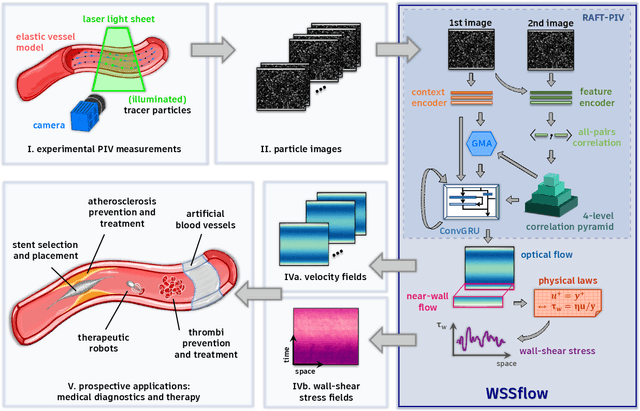
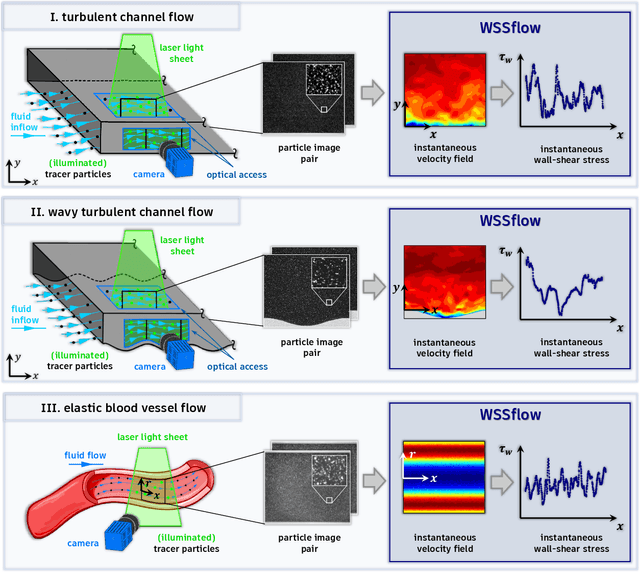
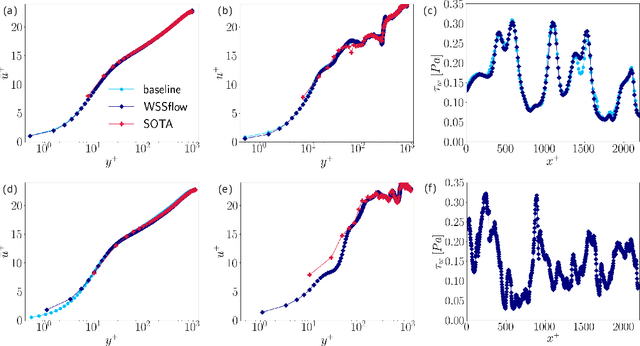
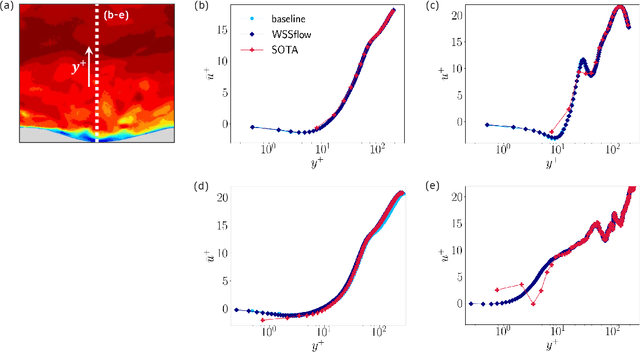
Friction drag from a turbulent fluid moving past or inside an object plays a crucial role in domains as diverse as transportation, public utility infrastructure, energy technology, and human health. As a direct measure of the shear-induced friction forces, an accurate prediction of the wall-shear stress can contribute to sustainability, conservation of resources, and carbon neutrality in civil aviation as well as enhanced medical treatment of vascular diseases and cancer. Despite such importance for our modern society, we still lack adequate experimental methods to capture the instantaneous wall-shear stress dynamics. In this contribution, we present a holistic approach that derives velocity and wall-shear stress fields with impressive spatial and temporal resolution from flow measurements using a deep optical flow estimator with physical knowledge. The validity and physical correctness of the derived flow quantities is demonstrated with synthetic and real-world experimental data covering a range of relevant fluid flows.