 Add to Chrome
 Add to Firefox
 Add to Edge
R3PM-Net: Real-time, Robust, Real-world Point Matching Network
Apr 06, 2026
Accurate Point Cloud Registration (PCR) is an important task in 3D data processing, involving the estimation of a rigid transformation between two point clouds. While deep-learning methods have addressed key limitations of traditional non-learning approaches, such as sensitivity to noise, outliers, occlusion, and initialization, they are developed and evaluated on clean, dense, synthetic datasets (limiting their generalizability to real-world industrial scenarios). This paper introduces R3PM-Net, a lightweight, global-aware, object-level point matching network designed to bridge this gap by prioritizing both generalizability and real-time efficiency. To support this transition, two datasets, Sioux-Cranfield and Sioux-Scans, are proposed. They provide an evaluation ground for registering imperfect photogrammetric and event-camera scans to digital CAD models, and have been made publicly available. Extensive experiments demonstrate that R3PM-Net achieves competitive accuracy with unmatched speed. On ModelNet40, it reaches a perfect fitness score of $1$ and inlier RMSE of $0.029$ cm in only $0.007$s, approximately 7 times faster than the state-of-the-art method RegTR. This performance carries over to the Sioux-Cranfield dataset, maintaining a fitness of $1$ and inlier RMSE of $0.030$ cm with similarly low latency. Furthermore, on the highly challenging Sioux-Scans dataset, R3PM-Net successfully resolves edge cases in under 50 ms. These results confirm that R3PM-Net offers a robust, high-speed solution for critical industrial applications, where precision and real-time performance are indispensable. The code and datasets are available at https://github.com/YasiiKB/R3PM-Net.

uTRAND: Unsupervised Anomaly Detection in Traffic Trajectories
Apr 19, 2024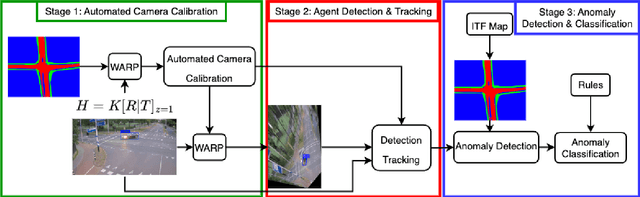
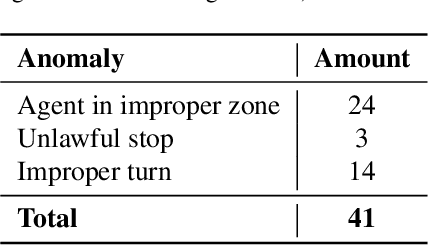
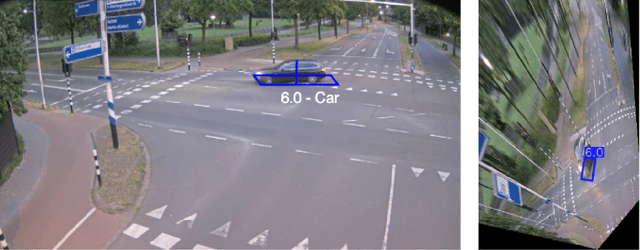
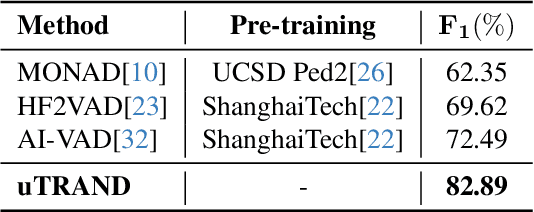
Deep learning-based approaches have achieved significant improvements on public video anomaly datasets, but often do not perform well in real-world applications. This paper addresses two issues: the lack of labeled data and the difficulty of explaining the predictions of a neural network. To this end, we present a framework called uTRAND, that shifts the problem of anomalous trajectory prediction from the pixel space to a semantic-topological domain. The framework detects and tracks all types of traffic agents in bird's-eye-view videos of traffic cameras mounted at an intersection. By conceptualizing the intersection as a patch-based graph, it is shown that the framework learns and models the normal behaviour of traffic agents without costly manual labeling. Furthermore, uTRAND allows to formulate simple rules to classify anomalous trajectories in a way suited for human interpretation. We show that uTRAND outperforms other state-of-the-art approaches on a dataset of anomalous trajectories collected in a real-world setting, while producing explainable detection results.
Homography Estimation in Complex Topological Scenes
Aug 02, 2023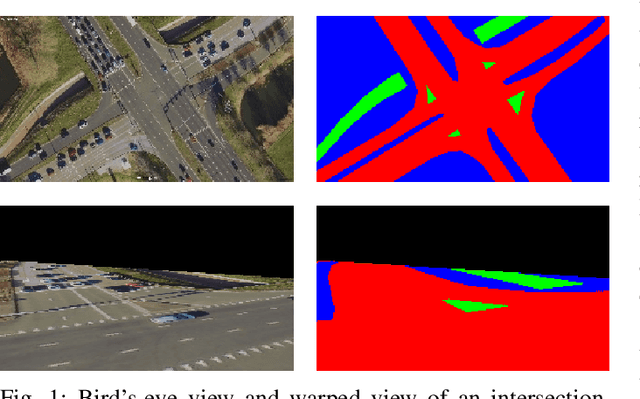
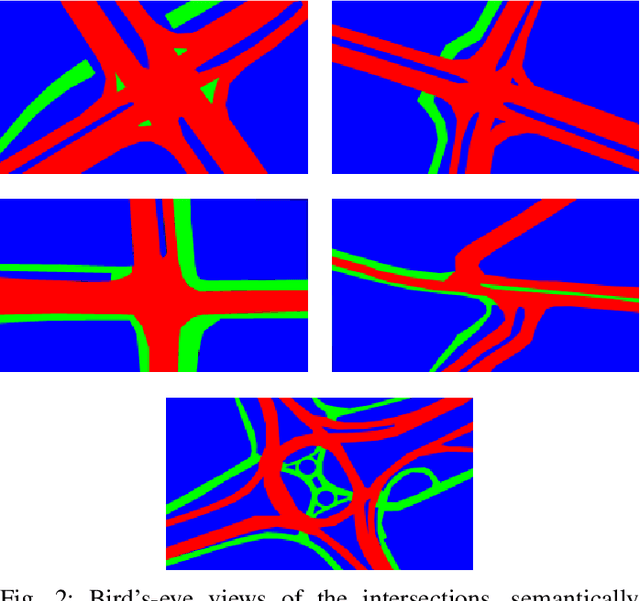
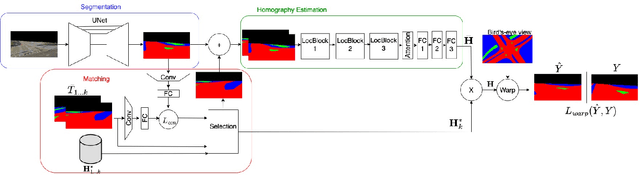
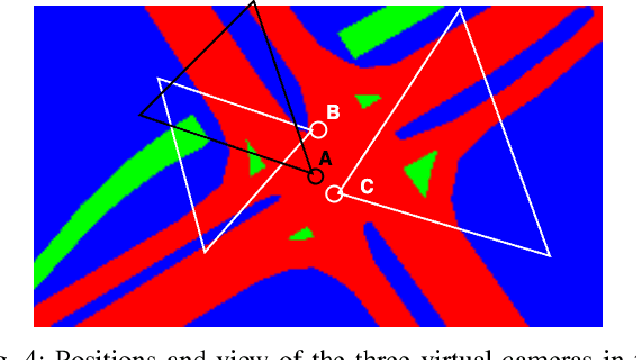
Surveillance videos and images are used for a broad set of applications, ranging from traffic analysis to crime detection. Extrinsic camera calibration data is important for most analysis applications. However, security cameras are susceptible to environmental conditions and small camera movements, resulting in a need for an automated re-calibration method that can account for these varying conditions. In this paper, we present an automated camera-calibration process leveraging a dictionary-based approach that does not require prior knowledge on any camera settings. The method consists of a custom implementation of a Spatial Transformer Network (STN) and a novel topological loss function. Experiments reveal that the proposed method improves the IoU metric by up to 12% w.r.t. a state-of-the-art model across five synthetic datasets and the World Cup 2014 dataset.