 Add to Chrome
 Add to Firefox
 Add to Edge
HASTE: Hardware-Aware Dynamic Sparse Training for Large Output Spaces
May 31, 2026
Extreme multi-label classification (XMC) involves learning models over large output spaces with millions of labels, making the output layer a memory-compute bottleneck. While sparsity-based methods reduce arithmetic complexity, they often fail to yield proportional speedups due to irregular memory access, poor hardware utilization, or reliance on auxiliary architectural components in long-tailed regimes. We introduce group-shared fixed fan-in sparsity, a semi-structured output-layer design in which semantically related labels share a sparse input pattern while retaining independent weights. This grouping introduces a task-aligned inductive bias -- encouraging related labels to share feature subsets -- while reducing index memory overhead, increasing feature reuse across labels, and enabling efficient GPU execution via custom CUDA kernels that leverage modern accelerator primitives. As an alternative to auxiliary objectives, we exploit the long-tailed structure of XMC by decomposing the output layer into a small dense head over frequent labels and a group-shared sparse tail over the remainder, providing an informative gradient pathway while preserving the memory benefits of sparsity. Through kernel-level microbenchmarking, we show that group-shared fixed fan-in translates arithmetic reductions into practical wall-clock gains, achieving up to $4.4\times$ speedup in the forward pass and up to $25\times$ speedup in backward passes over standard fixed fan-in sparsity, while operating within a few percent of a FLOPs-matched dense bottleneck. Across large-scale XMC benchmarks, our approach matches or improves precision@k over prior sparse baselines, while narrowing the performance gap to dense.

Grid Games: The Power of Multiple Grids for Quantizing Large Language Models
May 12, 2026A major recent advance in quantization is given by microscaled 4-bit formats such as NVFP4 and MXFP4, quantizing values into small groups sharing a scale, assuming a fixed floating-point grid. In this paper, we study the following natural extension: assume that, for each group of values, we are free to select the "better" among two or more 4-bit grids marked by one or more bits in the scale value. We formalize the power-of-two-grids (PO2) problem, and provide theoretical results showing that practical small-group formats such as MXFP or NVFP can benefit significantly from PO2 grids, while the advantage vanishes for very large groups. On the practical side, we instantiate several grid families, including 1) PO2(NF4), which pairs the standard NF4 normal grid with a learned grid, 2) MPO2, a grid pair that is fully learned over real weights and activations, 3) PO2(Split87), an explicit-zero asymmetric grid and 4) SFP4, a TensorCore-implementable triple which pairs NVFP4 with two shifted variants. Results for post-training quantization of standard open models and pre-training of Llama-like models show that adaptive grids consistently improve accuracy vs single-grid FP4 under both weight-only and weight+activation. Source code is available at https://github.com/IST-DASLab/GridGames.
DASH: Faster Shampoo via Batched Block Preconditioning and Efficient Inverse-Root Solvers
Feb 02, 2026Shampoo is one of the leading approximate second-order optimizers: a variant of it has won the MLCommons AlgoPerf competition, and it has been shown to produce models with lower activation outliers that are easier to compress. Yet, applying Shampoo currently comes at the cost of significant computational slowdown, due to its expensive internal operations. In this paper, we take a significant step to address this shortcoming by proposing \method (for \textbf{D}istributed \textbf{A}ccelerated \textbf{SH}ampoo), a faster implementation of Distributed Shampoo based on two main new techniques: First, we show that preconditioner blocks can be stacked into 3D tensors to significantly improve GPU utilization; second, we introduce the Newton-DB iteration and the Chebyshev polynomial approximations as novel and faster approaches for computing the inverse matrix roots required by Shampoo. Along with these algorithmic contributions, we provide a first in-depth analysis of how matrix scaling critically affects Shampoo convergence. On the practical side, our GPU-aware implementation achieves up to $4.83\times$ faster optimizer steps compared to the well-optimized Distributed Shampoo, while Newton-DB attains the lowest validation perplexity per iteration among all tested methods. Our code is available at https://github.com/IST-DASLab/DASH.
Quartet II: Accurate LLM Pre-Training in NVFP4 by Improved Unbiased Gradient Estimation
Jan 30, 2026The NVFP4 lower-precision format, supported in hardware by NVIDIA Blackwell GPUs, promises to allow, for the first time, end-to-end fully-quantized pre-training of massive models such as LLMs. Yet, existing quantized training methods still sacrifice some of the representation capacity of this format in favor of more accurate unbiased quantized gradient estimation by stochastic rounding (SR), losing noticeable accuracy relative to standard FP16 and FP8 training. In this paper, improve the state of the art for quantized training in NVFP4 via a novel unbiased quantization routine for micro-scaled formats, called MS-EDEN, that has more than 2x lower quantization error than SR. We integrate it into a novel fully-NVFP4 quantization scheme for linear layers, called Quartet II. We show analytically that Quartet II achieves consistently better gradient estimation across all major matrix multiplications, both on the forward and on the backward passes. In addition, our proposal synergizes well with recent training improvements aimed specifically at NVFP4. We further validate Quartet II on end-to-end LLM training with up to 1.9B parameters on 38B tokens. We provide kernels for execution on NVIDIA Blackwell GPUs with up to 4.2x speedup over BF16. Our code is available at https://github.com/IST-DASLab/Quartet-II .
LLMQ: Efficient Lower-Precision Pretraining for Consumer GPUs
Dec 17, 2025We present LLMQ, an end-to-end CUDA/C++ implementation for medium-sized language-model training, e.g. 3B to 32B parameters, on affordable, commodity GPUs. These devices are characterized by low memory availability and slow communication compared to datacentre-grade GPUs. Consequently, we showcase a range of optimizations that target these bottlenecks, including activation checkpointing, offloading, and copy-engine based collectives. LLMQ is able to train or fine-tune a 7B model on a single 16GB mid-range gaming card, or a 32B model on a workstation equipped with 4 RTX 4090s. This is achieved while executing a standard 8-bit training pipeline, without additional algorithmic approximations, and maintaining FLOP utilization of around 50%. The efficiency of LLMQ rivals that of production-scale systems on much more expensive cloud-grade GPUs.
SVD-Free Low-Rank Adaptive Gradient Optimization for Large Language Models
May 23, 2025Low-rank optimization has emerged as a promising direction in training large language models (LLMs) to reduce the memory usage of adaptive optimizers by constraining learning to a lower-dimensional space. Prior work typically projects gradients of linear layers using approaches based on Singular Value Decomposition (SVD). However, applying SVD-based procedures individually to each layer in large models is computationally expensive and incurs additional memory costs due to storing the projection matrices. In this work, we propose a computationally efficient and conceptually simple two-step procedure to approximate SVD-based gradient projections into lower-dimensional spaces. First, we construct a complete orthogonal basis using predefined orthogonal matrices of the Discrete Cosine Transform (DCT). Second, we adaptively select basis columns based on their alignment with the gradient of each layer. Each projection matrix in our method is obtained via a single matrix multiplication followed by a lightweight sorting step to identify the most relevant basis vectors. Due to the predefined nature of the orthogonal bases, they are computed once at the start of training. During training, we store only the indices of the selected columns, avoiding the need to store full projection matrices for each layer. Our numerical experiments on both pre-training and fine-tuning tasks demonstrate the effectiveness of our dual strategy in approximating optimal low-rank projections, matching the performance of costly SVD-based methods while achieving faster runtime and reduced memory usage.
Labels in Extremes: How Well Calibrated are Extreme Multi-label Classifiers?
Nov 06, 2024

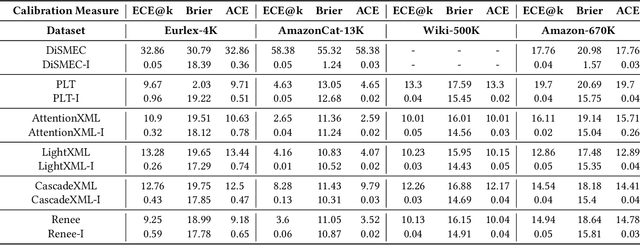

Extreme multilabel classification (XMLC) problems occur in settings such as related product recommendation, large-scale document tagging, or ad prediction, and are characterized by a label space that can span millions of possible labels. There are two implicit tasks that the classifier performs: \emph{Evaluating} each potential label for its expected worth, and then \emph{selecting} the best candidates. For the latter task, only the relative order of scores matters, and this is what is captured by the standard evaluation procedure in the XMLC literature. However, in many practical applications, it is important to have a good estimate of the actual probability of a label being relevant, e.g., to decide whether to pay the fee to be allowed to display the corresponding ad. To judge whether an extreme classifier is indeed suited to this task, one can look, for example, to whether it returns \emph{calibrated} probabilities, which has hitherto not been done in this field. Therefore, this paper aims to establish the current status quo of calibration in XMLC by providing a systematic evaluation, comprising nine models from four different model families across seven benchmark datasets. As naive application of Expected Calibration Error (ECE) leads to meaningless results in long-tailed XMC datasets, we instead introduce the notion of \emph{calibration@k} (e.g., ECE@k), which focusses on the top-$k$ probability mass, offering a more appropriate measure for evaluating probability calibration in XMLC scenarios. While we find that different models can exhibit widely varying reliability plots, we also show that post-training calibration via a computationally efficient isotonic regression method enhances model calibration without sacrificing prediction accuracy. Thus, the practitioner can choose the model family based on accuracy considerations, and leave calibration to isotonic regression.
Navigating Extremes: Dynamic Sparsity in Large Output Space
Nov 05, 2024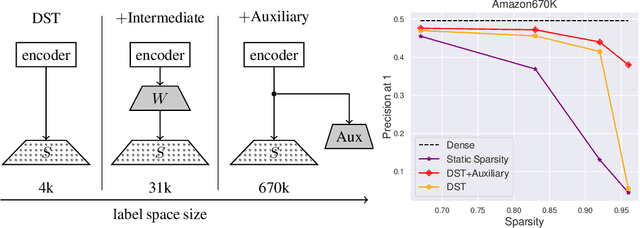
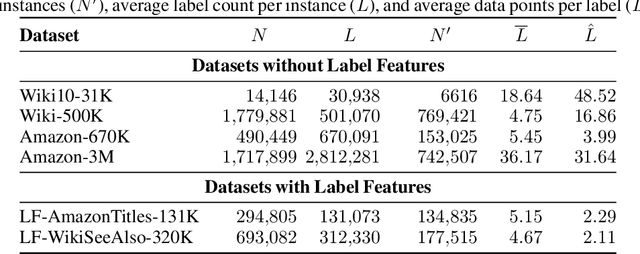
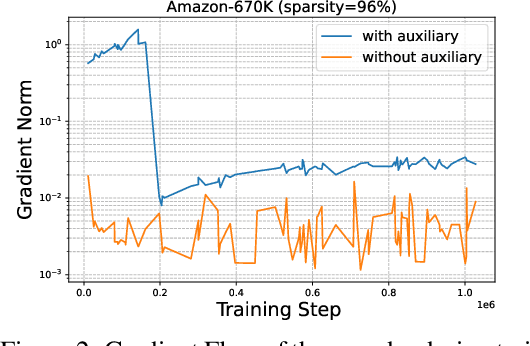
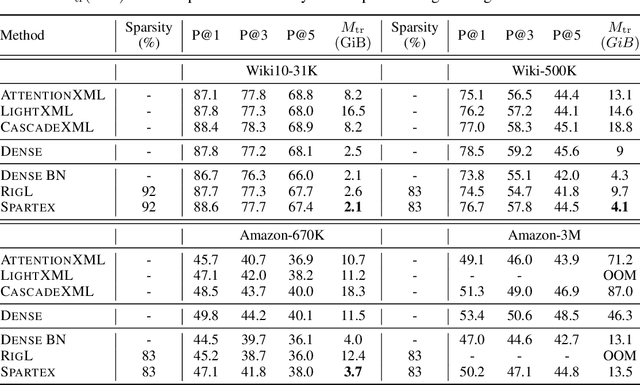
In recent years, Dynamic Sparse Training (DST) has emerged as an alternative to post-training pruning for generating efficient models. In principle, DST allows for a more memory efficient training process, as it maintains sparsity throughout the entire training run. However, current DST implementations fail to capitalize on this in practice. Because sparse matrix multiplication is much less efficient than dense matrix multiplication on GPUs, most implementations simulate sparsity by masking weights. In this paper, we leverage recent advances in semi-structured sparse training to apply DST in the domain of classification with large output spaces, where memory-efficiency is paramount. With a label space of possibly millions of candidates, the classification layer alone will consume several gigabytes of memory. Switching from a dense to a fixed fan-in sparse layer updated with sparse evolutionary training (SET); however, severely hampers training convergence, especially at the largest label spaces. We find that poor gradient flow from the sparse classifier to the dense text encoder make it difficult to learn good input representations. By employing an intermediate layer or adding an auxiliary training objective, we recover most of the generalisation performance of the dense model. Overall, we demonstrate the applicability and practical benefits of DST in a challenging domain -- characterized by a highly skewed label distribution that differs substantially from typical DST benchmark datasets -- which enables end-to-end training with millions of labels on commodity hardware.
A General Online Algorithm for Optimizing Complex Performance Metrics
Jun 20, 2024
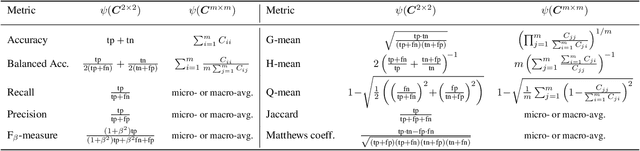
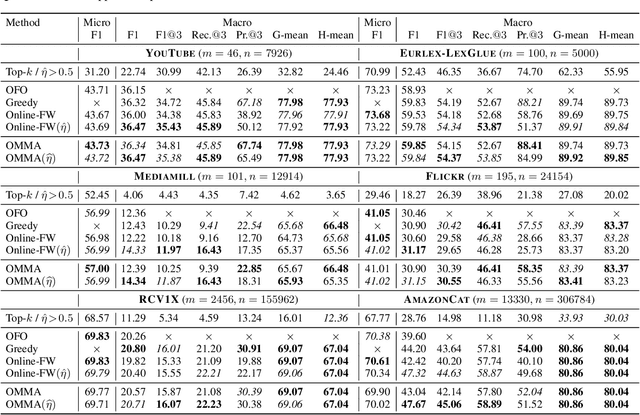

We consider sequential maximization of performance metrics that are general functions of a confusion matrix of a classifier (such as precision, F-measure, or G-mean). Such metrics are, in general, non-decomposable over individual instances, making their optimization very challenging. While they have been extensively studied under different frameworks in the batch setting, their analysis in the online learning regime is very limited, with only a few distinguished exceptions. In this paper, we introduce and analyze a general online algorithm that can be used in a straightforward way with a variety of complex performance metrics in binary, multi-class, and multi-label classification problems. The algorithm's update and prediction rules are appealingly simple and computationally efficient without the need to store any past data. We show the algorithm attains $\mathcal{O}(\frac{\ln n}{n})$ regret for concave and smooth metrics and verify the efficiency of the proposed algorithm in empirical studies.
Learning label-label correlations in Extreme Multi-label Classification via Label Features
May 03, 2024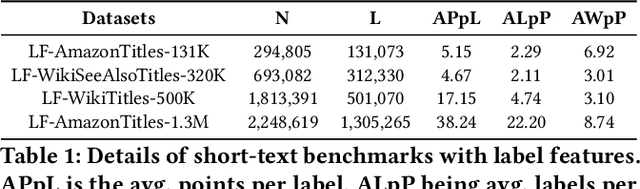
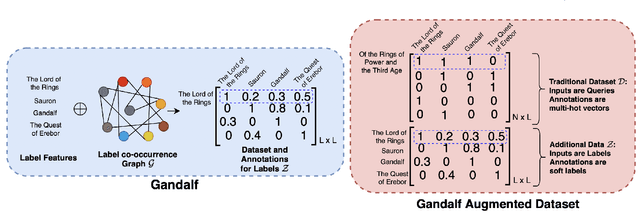
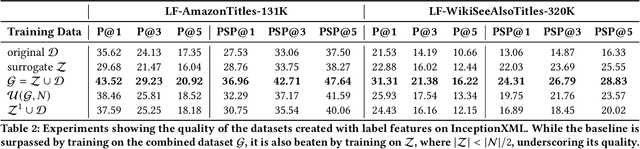
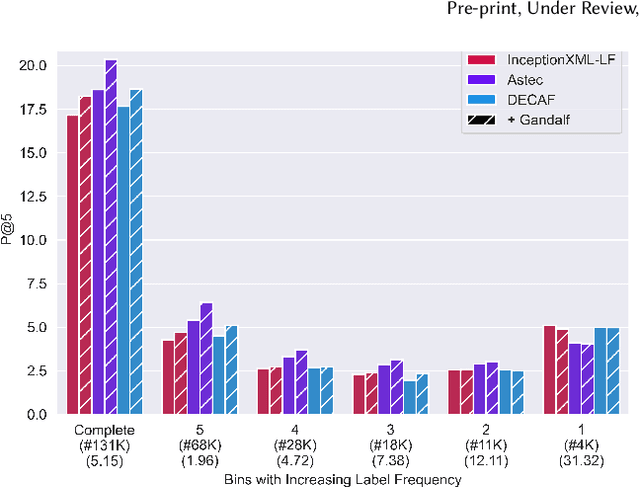
Extreme Multi-label Text Classification (XMC) involves learning a classifier that can assign an input with a subset of most relevant labels from millions of label choices. Recent works in this domain have increasingly focused on a symmetric problem setting where both input instances and label features are short-text in nature. Short-text XMC with label features has found numerous applications in areas such as query-to-ad-phrase matching in search ads, title-based product recommendation, prediction of related searches. In this paper, we propose Gandalf, a novel approach which makes use of a label co-occurrence graph to leverage label features as additional data points to supplement the training distribution. By exploiting the characteristics of the short-text XMC problem, it leverages the label features to construct valid training instances, and uses the label graph for generating the corresponding soft-label targets, hence effectively capturing the label-label correlations. Surprisingly, models trained on these new training instances, although being less than half of the original dataset, can outperform models trained on the original dataset, particularly on the PSP@k metric for tail labels. With this insight, we aim to train existing XMC algorithms on both, the original and new training instances, leading to an average 5% relative improvements for 6 state-of-the-art algorithms across 4 benchmark datasets consisting of up to 1.3M labels. Gandalf can be applied in a plug-and-play manner to various methods and thus forwards the state-of-the-art in the domain, without incurring any additional computational overheads.