 Add to Chrome
 Add to Firefox
 Add to Edge
Dictionary learning for Kernel EDMD
Apr 28, 2026
Studying nonlinear dynamical systems through their state space behavior can be challenging, and one possible alternative is to analyze them via their associated Koopman operator. This turns the nonlinear problem into a linear, infinite-dimensional one. To approximate the operator in finite dimensions, extended dynamic mode decomposition (EDMD) is a commonly used algorithm. It requires a finite list of functionals and a set of snapshots from the system to compute an approximation of the operator and its corresponding spectrum. Instead of choosing the list of functionals directly, it can be implicitly defined via kernels, a method known as kernel extended dynamic mode decomposition (kEDMD). However, one still needs to define the kernel and choose its parameter values. In this paper, we aim to streamline this process by extending dictionary learning for EDMD to kernel learning in kEDMD. By simplifying kEDMD we show how to perform gradient-based optimization over the learnable kernel parameters, and demonstrate that this method leads to useful kernels for the original kEDMD. The focus of our work is a method that takes a weighted list of kernels with randomly initialized values as input and outputs a list of kernels and parameter values suitable for approximating the Koopman operator of the underlying system. We demonstrate that unimportant kernels can be removed from the list by analyzing the weights in the weighted sum. We evaluate the method across several experiments, including the Duffing oscillator and the Kuramoto-Sivashinsky PDE, showcasing the method's different strengths.

Gradient-free training of recurrent neural networks
Oct 30, 2024Recurrent neural networks are a successful neural architecture for many time-dependent problems, including time series analysis, forecasting, and modeling of dynamical systems. Training such networks with backpropagation through time is a notoriously difficult problem because their loss gradients tend to explode or vanish. In this contribution, we introduce a computational approach to construct all weights and biases of a recurrent neural network without using gradient-based methods. The approach is based on a combination of random feature networks and Koopman operator theory for dynamical systems. The hidden parameters of a single recurrent block are sampled at random, while the outer weights are constructed using extended dynamic mode decomposition. This approach alleviates all problems with backpropagation commonly related to recurrent networks. The connection to Koopman operator theory also allows us to start using results in this area to analyze recurrent neural networks. In computational experiments on time series, forecasting for chaotic dynamical systems, and control problems, as well as on weather data, we observe that the training time and forecasting accuracy of the recurrent neural networks we construct are improved when compared to commonly used gradient-based methods.
Sampling weights of deep neural networks
Jun 29, 2023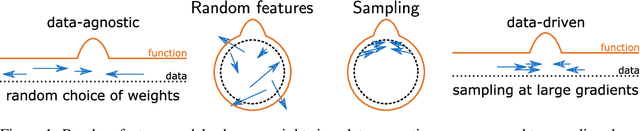
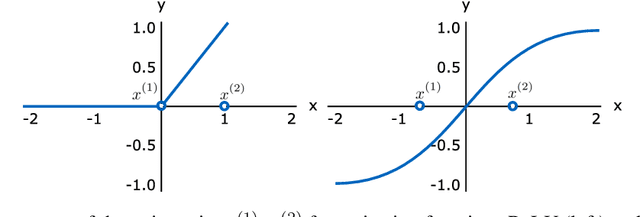
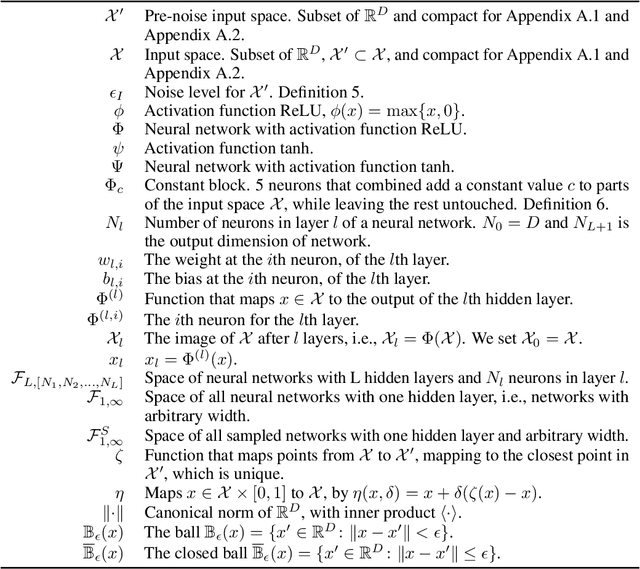
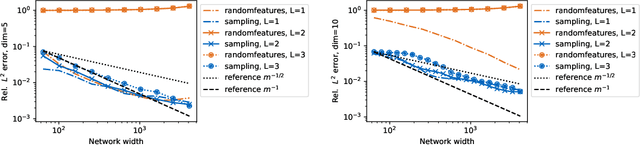
We introduce a probability distribution, combined with an efficient sampling algorithm, for weights and biases of fully-connected neural networks. In a supervised learning context, no iterative optimization or gradient computations of internal network parameters are needed to obtain a trained network. The sampling is based on the idea of random feature models. However, instead of a data-agnostic distribution, e.g., a normal distribution, we use both the input and the output training data of the supervised learning problem to sample both shallow and deep networks. We prove that the sampled networks we construct are universal approximators. We also show that our sampling scheme is invariant to rigid body transformations and scaling of the input data. This implies many popular pre-processing techniques are no longer required. For Barron functions, we show that the $L^2$-approximation error of sampled shallow networks decreases with the square root of the number of neurons. In numerical experiments, we demonstrate that sampled networks achieve comparable accuracy as iteratively trained ones, but can be constructed orders of magnitude faster. Our test cases involve a classification benchmark from OpenML, sampling of neural operators to represent maps in function spaces, and transfer learning using well-known architectures.