 Add to Chrome
 Add to Firefox
 Add to Edge
Exploiting Search in Symbolic Numeric Planning with Patterns
Jun 15, 2026
In this paper, we present a procedure for numeric planning based on Symbolic Pattern Planning (SPP). Given a numeric planning problem $Π$, a pattern $\prec$ is a sequence of actions used to define a formula encoding the subsequences of $\prec$ executable from a starting state $S$. Cardellini, Giunchiglia, and Maratea (2024a) follow the Planning as Satisfiability approach by defining, at each step $n \ge 0$, a formula $Π^\prec_n$ in which $(i)$ the pattern $\prec$ is computed only for $n=0$ in the initial state $I$ of $Π$, and then exploited at each step $n$, $(ii)$ the starting state $S$ is set to $I$, and $(iii)$ the set $G$ of goals is required to hold in the last state that can be reached by one of the subsequences of $\prec$ concatenated $n$ times. The procedure begins with $n=0$, terminates as soon as $Π^\prec_n$ is satisfiable, and otherwise proceeds by incrementing $n$. In this paper, possibly at each step, $(i)$ we symbolically search for an intermediate state $P$ reachable from $I$, closer to a goal state, $(ii)$ dynamically recompute the pattern $\prec_h$ -- to be used in the next step -- in $P$, $(iii)$ refine the pattern $\prec_g$ used to reach $P$, and $(iv)$ start the new search from the state $S$ which can be either the initial state $I$ or the last computed intermediate state $P$, exploiting the computed patterns $\prec_g$ and $\prec_h$ to define the pattern $\prec$ to be used in the search. In particular, at each step, we define a formula $Π^{\prec}_{S,P}$ encoding the existence of a state $P'$ closer than $P$ to a goal state, with $P'$ reachable from the starting state $S$ when using the pattern $\prec$. We present different techniques for producing such formulas, each corresponding to a different strategy for exploring the search space. We prove their correctness and completeness, the latter under certain conditions.

Symbolic Pattern Temporal Numeric Planning with Intermediate Conditions and Effects
Feb 10, 2026Recently, a Symbolic Pattern Planning (SPP) approach was proposed for numeric planning where a pattern (i.e., a finite sequence of actions) suggests a causal order between actions. The pattern is then encoded in a SMT formula whose models correspond to valid plans. If the suggestion by the pattern is inaccurate and no valid plan can be found, the pattern is extended until it contains the causal order of actions in a valid plan, making the approach complete. In this paper, we extend the SPP approach to the temporal planning with Intermediate Conditions and Effects (ICEs) fragment, where $(i)$ actions are durative (and thus can overlap over time) and have conditions/effects which can be checked/applied at any time during an action's execution, and $(ii)$ one can specify plan's conditions/effects that must be checked/applied at specific times during the plan execution. Experimental results show that our SPP planner Patty $(i)$ outperforms all other planners in the literature in the majority of temporal domains without ICEs, $(ii)$ obtains comparable results with the SoTA search planner for ICS in literature domains with ICEs, and $(iii)$ outperforms the same planner in a novel domain based on a real-world application.
Temporal Numeric Planning with Patterns
Dec 12, 2024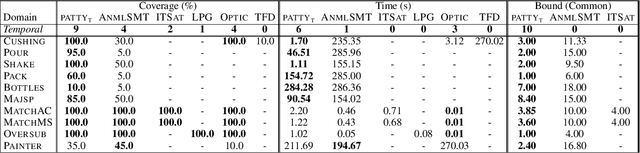
We consider temporal numeric planning problems $\Pi$ expressed in PDDL2.1 level 3, and show how to produce SMT formulas $(i)$ whose models correspond to valid plans of $\Pi$, and $(ii)$ that extend the recently proposed planning with patterns approach from the numeric to the temporal case. We prove the correctness and completeness of the approach and show that it performs very well on 10 domains with required concurrency.
Symbolic Numeric Planning with Patterns
Dec 15, 2023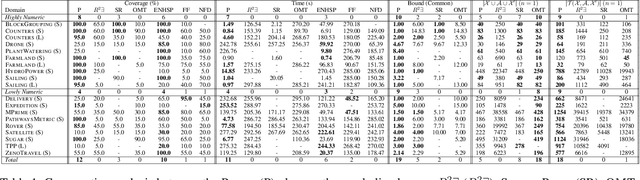
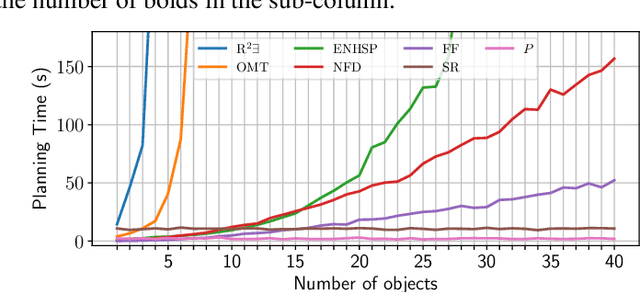
In this paper, we propose a novel approach for solving linear numeric planning problems, called Symbolic Pattern Planning. Given a planning problem $\Pi$, a bound $n$ and a pattern -- defined as an arbitrary sequence of actions -- we encode the problem of finding a plan for $\Pi$ with bound $n$ as a formula with fewer variables and/or clauses than the state-of-the-art rolled-up and relaxed-relaxed-$\exists$ encodings. More importantly, we prove that for any given bound, it is never the case that the latter two encodings allow finding a valid plan while ours does not. On the experimental side, we consider 6 other planning systems -- including the ones which participated in this year's International Planning Competition (IPC) -- and we show that our planner Patty has remarkably good comparative performances on this year's IPC problems.
Causal Laws and Multi-Valued Fluents
Jul 15, 2023This paper continues the line of work on representing properties of actions in nonmonotonic formalisms that stresses the distinction between being "true" and being "caused", as in the system of causal logic introduced by McCain and Turner and in the action language C proposed by Giunchiglia and Lifschitz. The only fluents directly representable in language C+ are truth-valued fluents, which is often inconvenient. We show that both causal logic and language C can be extended to allow values from arbitrary nonempty sets. Our extension of language C, called C+, also makes it possible to describe actions in terms of their attributes, which is important from the perspective of elaboration tolerance. We describe an embedding of C+ in causal theories with multi-valued constants, relate C+ to Pednault's action language ADL, and show how multi-valued constants can be eliminated in favor of Boolean constants.