 Add to Chrome
 Add to Firefox
 Add to Edge
MindTrellis: Co-Creating Knowledge Structures with AI through Interactive Visual Exploration
Apr 25, 2026
Knowledge workers face increasing challenges in synthesizing information from multiple documents into structured conceptual understanding. This process is inherently iterative: users explore content, identify relationships between concepts, and continuously reorganize their mental models. However, current approaches offer limited support. LLM-based systems let users query information but not shape how knowledge is organized; manual tools like mind maps support structure creation but lack intelligent assistance. This leaves an open opportunity: supporting collaborative construction where users and AI jointly develop an evolving knowledge representation. We present MindTrellis, an interactive visual system where users and AI collaboratively build a dynamic knowledge graph. Users can query the graph to retrieve document-grounded information, and contribute by introducing new concepts, modifying relationships, and reorganizing the hierarchy to reflect their developing understanding. In a user study where 12 participants created slide decks, MindTrellis outperformed retrieval-only baselines in knowledge organization and cognitive load, as measured by expert ratings of content coverage and structural quality.

I'm Not Reading All of That: Understanding Software Engineers' Level of Cognitive Engagement with Agentic Coding Assistants
Mar 15, 2026Over-reliance on AI systems can undermine users' critical thinking and promote complacency, a risk intensified by the emergence of agentic AI systems that operate with minimal human involvement. In software engineering, agentic coding assistants are rapidly becoming embedded in everyday development workflows. Since software engineers create systems deployed across diverse and high-stakes real-world contexts, these assistants must function not merely as autonomous task performers but as Tools for Thought that actively support human reasoning and sensemaking. We conducted a formative study examining software engineers' cognitive engagement and sensemaking processes when working with an agentic coding assistant. Our findings reveal that cognitive engagement consistently declines as tasks progress, and that current agentic coding assistants' designs provide limited affordances for reflection, verification, and meaning-making. Based on these findings, e identify concrete design opportunities leveraging richer interaction modalities and cognitive-forcing mechanisms to sustain engagement and promote deeper thinking in AI-assisted programming.
Collaboration with Conversational AI Assistants for UX Evaluation: Questions and How to Ask them (Voice vs. Text)
Mar 07, 2023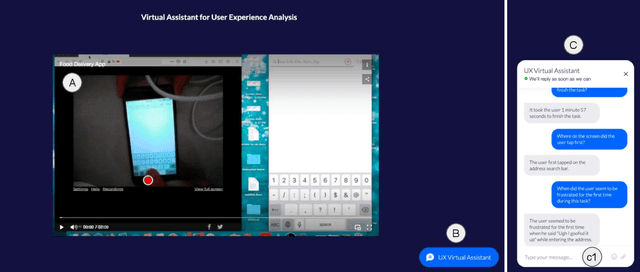
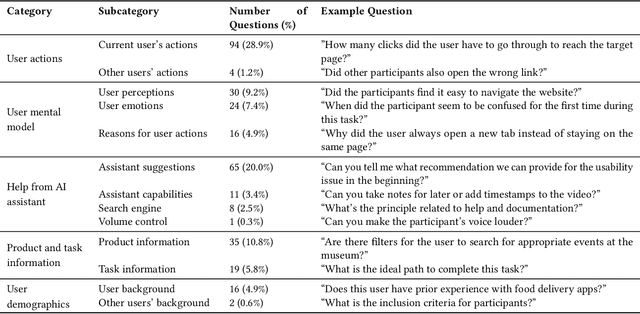
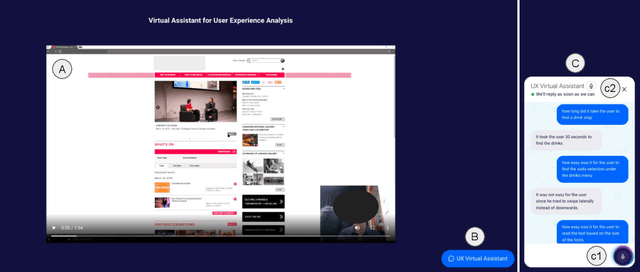
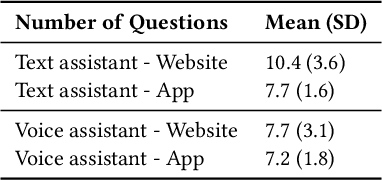
AI is promising in assisting UX evaluators with analyzing usability tests, but its judgments are typically presented as non-interactive visualizations. Evaluators may have questions about test recordings, but have no way of asking them. Interactive conversational assistants provide a Q&A dynamic that may improve analysis efficiency and evaluator autonomy. To understand the full range of analysis-related questions, we conducted a Wizard-of-Oz design probe study with 20 participants who interacted with simulated AI assistants via text or voice. We found that participants asked for five categories of information: user actions, user mental model, help from the AI assistant, product and task information, and user demographics. Those who used the text assistant asked more questions, but the question lengths were similar. The text assistant was perceived as significantly more efficient, but both were rated equally in satisfaction and trust. We also provide design considerations for future conversational AI assistants for UX evaluation.