 Add to Chrome
 Add to Firefox
 Add to Edge
On the Controllability-Fidelity Frontier in Diffusion Editing
Jun 05, 2026
Diffusion-based generative models enable powerful image editing capabilities, but achieving precise control while maintaining fidelity and safety remains challenging. We present a comprehensive theoretical and empirical study of controllable diffusion-based image editing, analyzing the trade-offs between adherence to user intent, preservation of non-target content, and output quality. Our work spans text- and mask-guided edits, point/drag manipulation, and inversion-based pipelines. We derive mathematical formulations of editing objectives and analyze dynamics of noise injection, score guidance, and inversion error. We provide theoretical bounds on reconstruction error, stability under repeated edits, and locality of changes. We propose algorithmic frameworks (with pseudocode) for mask-localized and instruction-guided editing, and present extensive experiments comparing state-of-the-art methods (e.g.\ TF-ICON \cite{lu2023tficone}, DragFlow \cite{zhou2025dragflow}, InstructPix2Pix \cite{brooks2023instructpix2pix}, UltraEdit \cite{zhao2024ultraedit}) on multiple tasks and metrics (FID, identity similarity, CLIP alignment, artifact scores, etc). Our results reveal key failure modes, such as identity drift, prompt sensitivity, and compositional errors. We also discuss ethical considerations in image editing, including misuse risks, bias, consent, and concept erasure techniques (e.g.\ MACE \cite{lu2024mace}, ANT \cite{li2025ant}, EraseAnything \cite{gao2024eraseanything}) as safeguards. We conclude with best practices and future directions for responsible, high-fidelity diffusion-based editing.

Editing Away the Evidence: Diffusion-Based Image Manipulation and the Failure Modes of Robust Watermarking
Mar 13, 2026Robust invisible watermarks are widely used to support copyright protection, content provenance, and accountability by embedding hidden signals designed to survive common post-processing operations. However, diffusion-based image editing introduces a fundamentally different class of transformations: it injects noise and reconstructs images through a powerful generative prior, often altering semantic content while preserving photorealism. In this paper, we provide a unified theoretical and empirical analysis showing that non-adversarial diffusion editing can unintentionally degrade or remove robust watermarks. We model diffusion editing as a stochastic transformation that progressively contracts off-manifold perturbations, causing the low-amplitude signals used by many watermarking schemes to decay. Our analysis derives bounds on watermark signal-to-noise ratio and mutual information along diffusion trajectories, yielding conditions under which reliable recovery becomes information-theoretically impossible. We further evaluate representative watermarking systems under a range of diffusion-based editing scenarios and strengths. The results indicate that even routine semantic edits can significantly reduce watermark recoverability. Finally, we discuss the implications for content provenance and outline principles for designing watermarking approaches that remain robust under generative image editing.
When Denoising Becomes Unsigning: Theoretical and Empirical Analysis of Watermark Fragility Under Diffusion-Based Image Editing
Mar 05, 2026Robust invisible watermarking systems aim to embed imperceptible payloads that remain decodable after common post-processing such as JPEG compression, cropping, and additive noise. In parallel, diffusion-based image editing has rapidly matured into a default transformation layer for modern content pipelines, enabling instruction-based editing, object insertion and composition, and interactive geometric manipulation. This paper studies a subtle but increasingly consequential interaction between these trends: diffusion-based editing procedures may unintentionally compromise, and in extreme cases practically bypass, robust watermarking mechanisms that were explicitly engineered to survive conventional distortions. We develop a unified view of diffusion editors that (i) inject substantial Gaussian noise in a latent space and (ii) project back to the natural image manifold via learned denoising dynamics. Under this view, watermark payloads behave as low-energy, high-frequency signals that are systematically attenuated by the forward diffusion step and then treated as nuisance variation by the reverse generative process. We formalize this degradation using information-theoretic tools, proving that for broad classes of pixel-level watermark encoders/decoders the mutual information between the watermark payload and the edited output decays toward zero as the editing strength increases, yielding decoding error close to random guessing. We complement the theory with a realistic hypothetical experimental protocol and tables spanning representative watermarking methods and representative diffusion editors. Finally, we discuss ethical implications, responsible disclosure norms, and concrete design guidelines for watermarking schemes that remain meaningful in the era of generative transformations.
Diffusion-Based Image Editing: An Unforeseen Adversary to Robust Invisible Watermarks
Nov 05, 2025

Robust invisible watermarking aims to embed hidden messages into images such that they survive various manipulations while remaining imperceptible. However, powerful diffusion-based image generation and editing models now enable realistic content-preserving transformations that can inadvertently remove or distort embedded watermarks. In this paper, we present a theoretical and empirical analysis demonstrating that diffusion-based image editing can effectively break state-of-the-art robust watermarks designed to withstand conventional distortions. We analyze how the iterative noising and denoising process of diffusion models degrades embedded watermark signals, and provide formal proofs that under certain conditions a diffusion model's regenerated image retains virtually no detectable watermark information. Building on this insight, we propose a diffusion-driven attack that uses generative image regeneration to erase watermarks from a given image. Furthermore, we introduce an enhanced \emph{guided diffusion} attack that explicitly targets the watermark during generation by integrating the watermark decoder into the sampling loop. We evaluate our approaches on multiple recent deep learning watermarking schemes (e.g., StegaStamp, TrustMark, and VINE) and demonstrate that diffusion-based editing can reduce watermark decoding accuracy to near-zero levels while preserving high visual fidelity of the images. Our findings reveal a fundamental vulnerability in current robust watermarking techniques against generative model-based edits, underscoring the need for new watermarking strategies in the era of generative AI.
FADE: Adversarial Concept Erasure in Flow Models
Jul 16, 2025
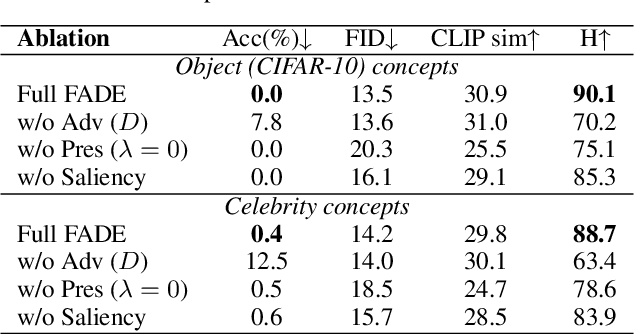
Diffusion models have demonstrated remarkable image generation capabilities, but also pose risks in privacy and fairness by memorizing sensitive concepts or perpetuating biases. We propose a novel \textbf{concept erasure} method for text-to-image diffusion models, designed to remove specified concepts (e.g., a private individual or a harmful stereotype) from the model's generative repertoire. Our method, termed \textbf{FADE} (Fair Adversarial Diffusion Erasure), combines a trajectory-aware fine-tuning strategy with an adversarial objective to ensure the concept is reliably removed while preserving overall model fidelity. Theoretically, we prove a formal guarantee that our approach minimizes the mutual information between the erased concept and the model's outputs, ensuring privacy and fairness. Empirically, we evaluate FADE on Stable Diffusion and FLUX, using benchmarks from prior work (e.g., object, celebrity, explicit content, and style erasure tasks from MACE). FADE achieves state-of-the-art concept removal performance, surpassing recent baselines like ESD, UCE, MACE, and ANT in terms of removal efficacy and image quality. Notably, FADE improves the harmonic mean of concept removal and fidelity by 5--10\% over the best prior method. We also conduct an ablation study to validate each component of FADE, confirming that our adversarial and trajectory-preserving objectives each contribute to its superior performance. Our work sets a new standard for safe and fair generative modeling by unlearning specified concepts without retraining from scratch.