 Add to Chrome
 Add to Firefox
 Add to Edge
Sashimi-Bot: Autonomous Tri-manual Advanced Manipulation and Cutting of Deformable Objects
Nov 14, 2025
Advanced robotic manipulation of deformable, volumetric objects remains one of the greatest challenges due to their pliancy, frailness, variability, and uncertainties during interaction. Motivated by these challenges, this article introduces Sashimi-Bot, an autonomous multi-robotic system for advanced manipulation and cutting, specifically the preparation of sashimi. The objects that we manipulate, salmon loins, are natural in origin and vary in size and shape, they are limp and deformable with poorly characterized elastoplastic parameters, while also being slippery and hard to hold. The three robots straighten the loin; grasp and hold the knife; cut with the knife in a slicing motion while cooperatively stabilizing the loin during cutting; and pick up the thin slices from the cutting board or knife blade. Our system combines deep reinforcement learning with in-hand tool shape manipulation, in-hand tool cutting, and feedback of visual and tactile information to achieve robustness to the variabilities inherent in this task. This work represents a milestone in robotic manipulation of deformable, volumetric objects that may inspire and enable a wide range of other real-world applications.

Robotic Handling of Compliant Food Objects by Robust Learning from Demonstration
Sep 22, 2023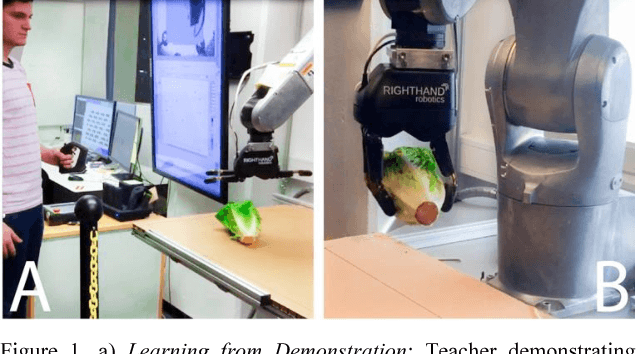
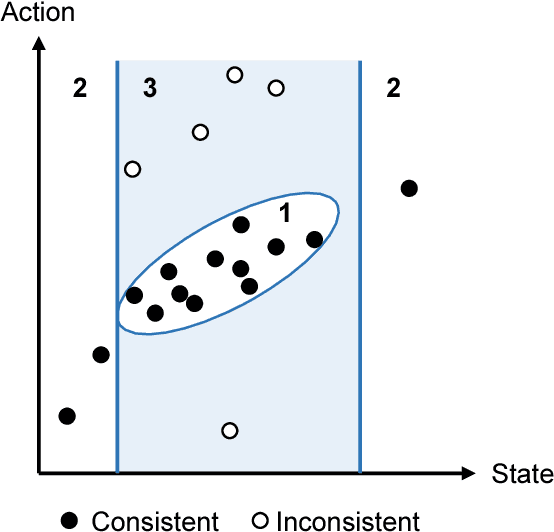
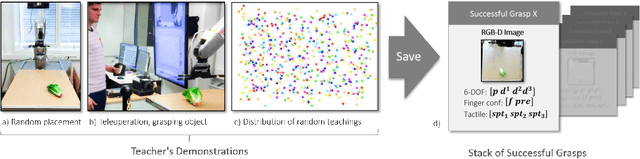
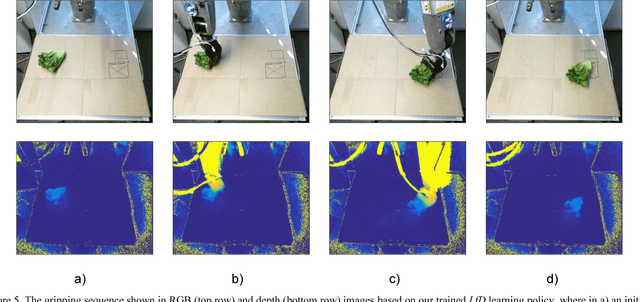
The robotic handling of compliant and deformable food raw materials, characterized by high biological variation, complex geometrical 3D shapes, and mechanical structures and texture, is currently in huge demand in the ocean space, agricultural, and food industries. Many tasks in these industries are performed manually by human operators who, due to the laborious and tedious nature of their tasks, exhibit high variability in execution, with variable outcomes. The introduction of robotic automation for most complex processing tasks has been challenging due to current robot learning policies. A more consistent learning policy involving skilled operators is desired. In this paper, we address the problem of robot learning when presented with inconsistent demonstrations. To this end, we propose a robust learning policy based on Learning from Demonstration (LfD) for robotic grasping of food compliant objects. The approach uses a merging of RGB-D images and tactile data in order to estimate the necessary pose of the gripper, gripper finger configuration and forces exerted on the object in order to achieve effective robot handling. During LfD training, the gripper pose, finger configurations and tactile values for the fingers, as well as RGB-D images are saved. We present an LfD learning policy that automatically removes inconsistent demonstrations, and estimates the teacher's intended policy. The performance of our approach is validated and demonstrated for fragile and compliant food objects with complex 3D shapes. The proposed approach has a vast range of potential applications in the aforementioned industry sectors.