 Add to Chrome
 Add to Firefox
 Add to Edge
SiPhy: Single-Image Physical Property Reasoning
Jul 24, 2026
Inferring physical properties such as mass, stiffness, and elasticity from a single image is essential for simulation and embodied AI, yet most existing approaches rely on multi-view reconstruction or physics-based supervision. We introduce SiPhy, a unified framework for single-image physical property reasoning that aligns 3D-aware visual cues, depth with language-based material knowledge. From one RGB image, SiPhy samples pseudo-voxel points, extracts CLIP features, and grounds them to material candidates proposed by a VLM. A part-based contrastive aggregator enforces region consistency, while a heaviness-aware refinement improves thickness and volume estimation for dense objects. Across ABO-500, MVImgNet-100, and PhysXNet-100, SiPhy achieves state-of-the-art single-image performance, surpassing multi-view reconstruction methods by improving mass MnRE by up to 93% (vs. PUGS), reducing density MAE by 35.5% (vs. NeRF2Physics), and lowering Young's modulus error by 23.5%. We further validate SiPhy on real hand-object interaction datasets, demonstrating its potential as a data annotation engine for physical understanding from single-view imagery.

PAD-Hand: Physics-Aware Diffusion for Hand Motion Recovery
Mar 27, 2026Significant advancements made in reconstructing hands from images have delivered accurate single-frame estimates, yet they often lack physics consistency and provide no notion of how confidently the motion satisfies physics. In this paper, we propose a novel physics-aware conditional diffusion framework that refines noisy pose sequences into physically plausible hand motion while estimating the physics variance in motion estimates. Building on a MeshCNN-Transformer backbone, we formulate Euler-Lagrange dynamics for articulated hands. Unlike prior works that enforce zero residuals, we treat the resulting dynamic residuals as virtual observables to more effectively integrate physics. Through a last-layer Laplace approximation, our method produces per-joint, per-time variances that measure physics consistency and offers interpretable variance maps indicating where physical consistency weakens. Experiments on two well-known hand datasets show consistent gains over strong image-based initializations and competitive video-based methods. Qualitative results confirm that our variance estimations are aligned with the physical plausibility of the motion in image-based estimates.
QORT-Former: Query-optimized Real-time Transformer for Understanding Two Hands Manipulating Objects
Feb 27, 2025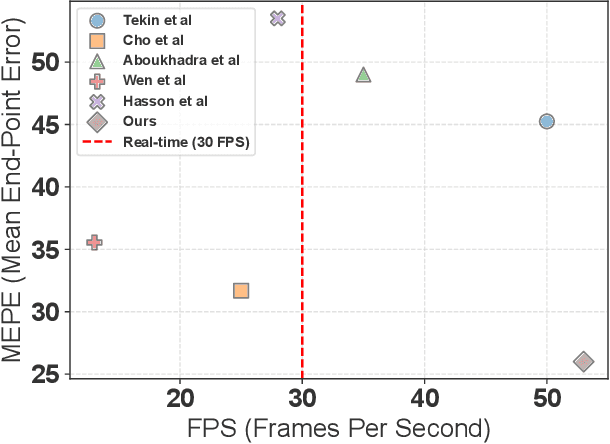
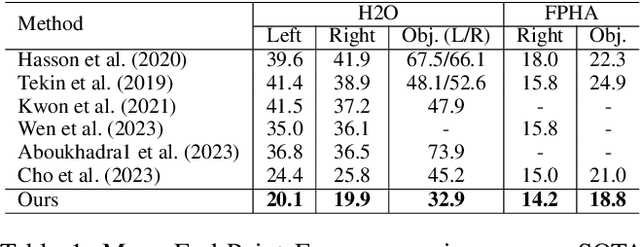
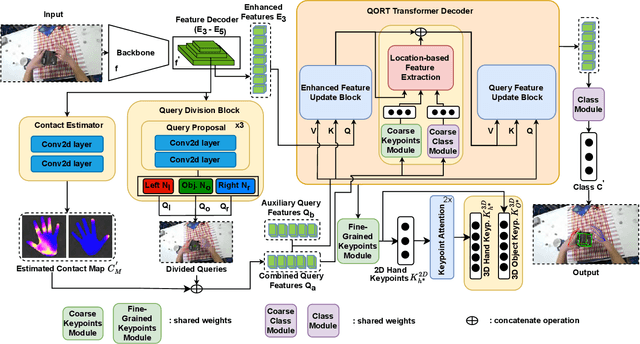
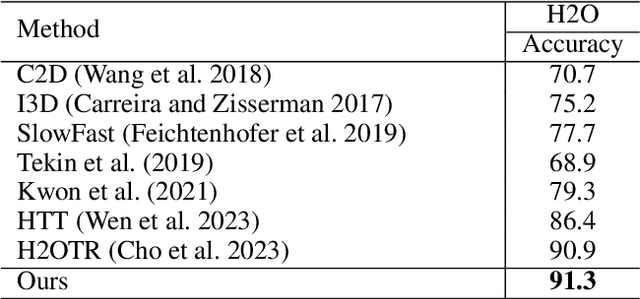
Significant advancements have been achieved in the realm of understanding poses and interactions of two hands manipulating an object. The emergence of augmented reality (AR) and virtual reality (VR) technologies has heightened the demand for real-time performance in these applications. However, current state-of-the-art models often exhibit promising results at the expense of substantial computational overhead. In this paper, we present a query-optimized real-time Transformer (QORT-Former), the first Transformer-based real-time framework for 3D pose estimation of two hands and an object. We first limit the number of queries and decoders to meet the efficiency requirement. Given limited number of queries and decoders, we propose to optimize queries which are taken as input to the Transformer decoder, to secure better accuracy: (1) we propose to divide queries into three types (a left hand query, a right hand query and an object query) and enhance query features (2) by using the contact information between hands and an object and (3) by using three-step update of enhanced image and query features with respect to one another. With proposed methods, we achieved real-time pose estimation performance using just 108 queries and 1 decoder (53.5 FPS on an RTX 3090TI GPU). Surpassing state-of-the-art results on the H2O dataset by 17.6% (left hand), 22.8% (right hand), and 27.2% (object), as well as on the FPHA dataset by 5.3% (right hand) and 10.4% (object), our method excels in accuracy. Additionally, it sets the state-of-the-art in interaction recognition, maintaining real-time efficiency with an off-the-shelf action recognition module.
GBOSE: Generalized Bandit Orthogonalized Semiparametric Estimation
Jan 20, 2023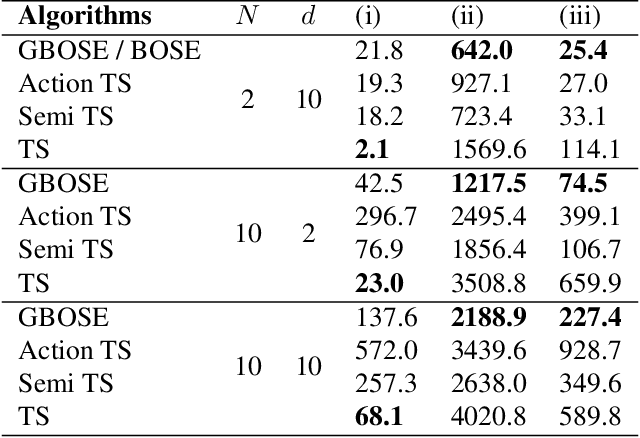
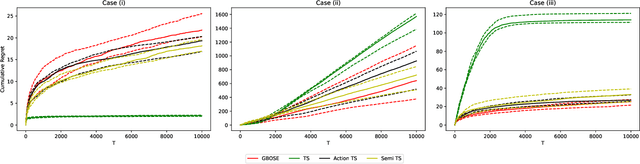
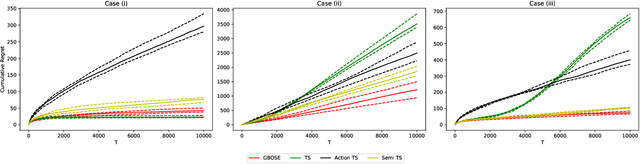
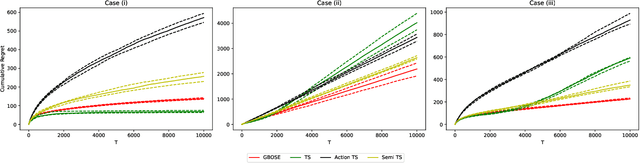
In sequential decision-making scenarios i.e., mobile health recommendation systems revenue management contextual multi-armed bandit algorithms have garnered attention for their performance. But most of the existing algorithms are built on the assumption of a strictly parametric reward model mostly linear in nature. In this work we propose a new algorithm with a semi-parametric reward model with state-of-the-art complexity of upper bound on regret amongst existing semi-parametric algorithms. Our work expands the scope of another representative algorithm of state-of-the-art complexity with a similar reward model by proposing an algorithm built upon the same action filtering procedures but provides explicit action selection distribution for scenarios involving more than two arms at a particular time step while requiring fewer computations. We derive the said complexity of the upper bound on regret and present simulation results that affirm our methods superiority out of all prevalent semi-parametric bandit algorithms for cases involving over two arms.