 Add to Chrome
 Add to Firefox
 Add to Edge
HandVQA: Diagnosing and Improving Fine-Grained Spatial Reasoning about Hands in Vision-Language Models
Mar 27, 2026
Understanding the fine-grained articulation of human hands is critical in high-stakes settings such as robot-assisted surgery, chip manufacturing, and AR/VR-based human-AI interaction. Despite achieving near-human performance on general vision-language benchmarks, current vision-language models (VLMs) struggle with fine-grained spatial reasoning, especially in interpreting complex and articulated hand poses. We introduce HandVQA, a large-scale diagnostic benchmark designed to evaluate VLMs' understanding of detailed hand anatomy through visual question answering. Built upon high-quality 3D hand datasets (FreiHAND, InterHand2.6M, FPHA), our benchmark includes over 1.6M controlled multiple-choice questions that probe spatial relationships between hand joints, such as angles, distances, and relative positions. We evaluate several state-of-the-art VLMs (LLaVA, DeepSeek and Qwen-VL) in both base and fine-tuned settings, using lightweight fine-tuning via LoRA. Our findings reveal systematic limitations in current models, including hallucinated finger parts, incorrect geometric interpretations, and poor generalization. HandVQA not only exposes these critical reasoning gaps but provides a validated path to improvement. We demonstrate that the 3D-grounded spatial knowledge learned from our benchmark transfers in a zero-shot setting, significantly improving accuracy of model on novel downstream tasks like hand gesture recognition (+10.33%) and hand-object interaction (+2.63%).

QORT-Former: Query-optimized Real-time Transformer for Understanding Two Hands Manipulating Objects
Feb 27, 2025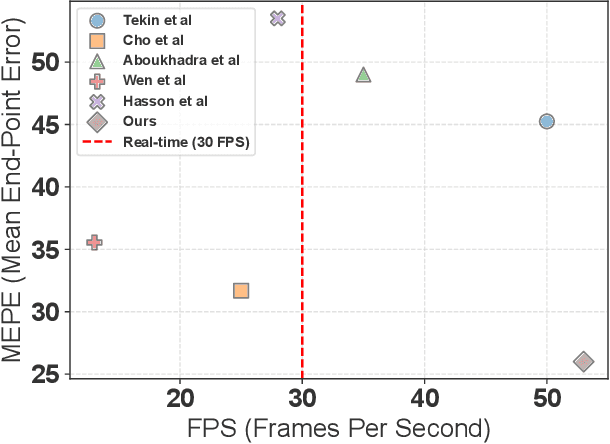
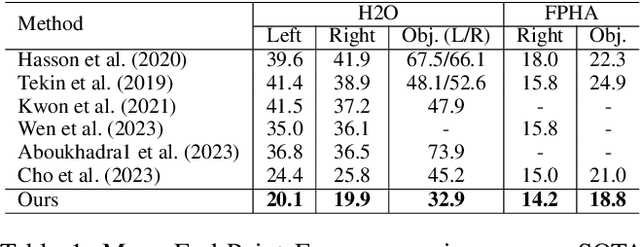
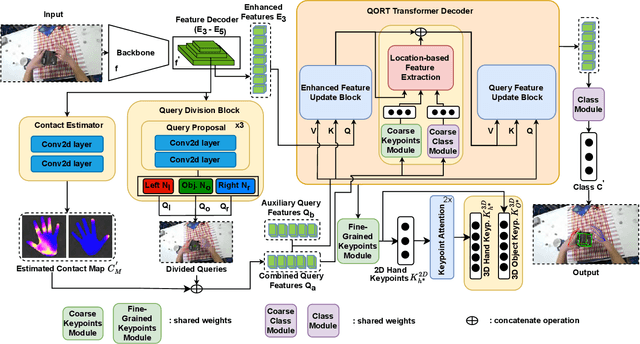
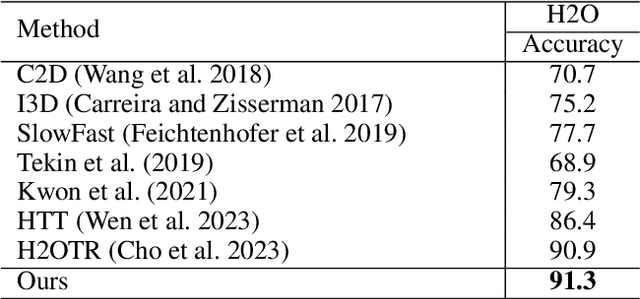
Significant advancements have been achieved in the realm of understanding poses and interactions of two hands manipulating an object. The emergence of augmented reality (AR) and virtual reality (VR) technologies has heightened the demand for real-time performance in these applications. However, current state-of-the-art models often exhibit promising results at the expense of substantial computational overhead. In this paper, we present a query-optimized real-time Transformer (QORT-Former), the first Transformer-based real-time framework for 3D pose estimation of two hands and an object. We first limit the number of queries and decoders to meet the efficiency requirement. Given limited number of queries and decoders, we propose to optimize queries which are taken as input to the Transformer decoder, to secure better accuracy: (1) we propose to divide queries into three types (a left hand query, a right hand query and an object query) and enhance query features (2) by using the contact information between hands and an object and (3) by using three-step update of enhanced image and query features with respect to one another. With proposed methods, we achieved real-time pose estimation performance using just 108 queries and 1 decoder (53.5 FPS on an RTX 3090TI GPU). Surpassing state-of-the-art results on the H2O dataset by 17.6% (left hand), 22.8% (right hand), and 27.2% (object), as well as on the FPHA dataset by 5.3% (right hand) and 10.4% (object), our method excels in accuracy. Additionally, it sets the state-of-the-art in interaction recognition, maintaining real-time efficiency with an off-the-shelf action recognition module.