 Add to Chrome
 Add to Firefox
 Add to Edge
From 'What' to 'How' and 'Why': Sharing LLM-Generated Retrospective Summaries of Older Adults' Passive Tracking Data with Remote Family Members
Jun 02, 2026
With the growing prevalence of modern ubiquitous computing technologies, multi-modal tracking systems hold promise for providing timely awareness and reassurance to stakeholders such as remote family members (RFMs) of older adults, who play a central role in care coordination. However, combining heterogeneous data streams into high-level, meaningful content - such as retrospective summaries - remains challenging. While recent work has demonstrated the promise of large language models (LLMs) for interpreting multi-modal tracking data, less attention has been given to generating narrative accounts for stakeholders like RFMs, who possess rich personal knowledge of older adults and strong emotional responsibility, yet have limited visibility into their daily lives and limited capacity for caregiving. In this work, we explore how LLMs can be used to generate retrospective summaries from multi-modal tracking data for RFMs of older adults. We leveraged and customized an existing system, Vital Insight, to generate initial summaries on different dates and data availability scenarios as technology probes, and conducted interviews with 11 RFMs to gather feedback. Based on these insights, we redesigned the system into a multi-layer, multi-agent, insight-driven summary approach that builds from objective statistics and descriptions to enriched, context-aware narratives. We then compared the redesigned summaries with the initial versions through a survey with the same 11 RFMs and found significant improvements in satisfaction, perceived helpfulness, trust, and willingness to receive the summaries. We conclude by presenting design implications for AI-generated summaries for RFMs and broader contexts, emphasizing the need to support RFMs' sensemaking shift from simply presenting ''What'' data were collected, to explaining ''How'' is my loved one doing and ''Why''.

Vital Insight: Assisting Experts' Sensemaking Process of Multi-modal Personal Tracking Data Using Visualization and LLM
Oct 18, 2024
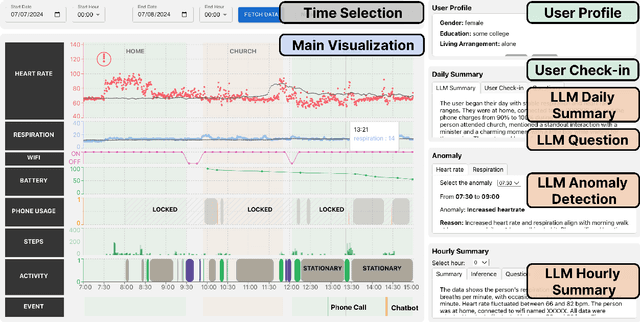
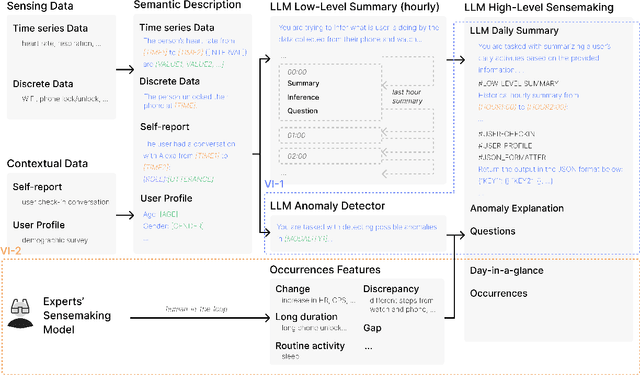

Researchers have long recognized the socio-technical gaps in personal tracking research, where machines can never fully model the complexity of human behavior, making it only able to produce basic rule-based outputs or "black-box" results that lack clear explanations. Real-world deployments rely on experts for this complex translation from sparse data to meaningful insights. In this study, we consider this translation process from data to insights by experts as "sensemaking" and explore how HCI researchers can support it through Vital Insight, an evidence-based 'sensemaking' system that combines direct representation and indirect inference through visualization and Large Language Models. We evaluate Vital Insight in user testing sessions with 14 experts in multi-modal tracking, synthesize design implications, and develop an expert sensemaking model where they iteratively move between direct data representations and AI-supported inferences to explore, retrieve, question, and validate insights.