 Add to Chrome
 Add to Firefox
 Add to Edge
A Benchmark of (MRI-) Foundation Models to Predict IDH Mutational Status in Glioma
Jun 22, 2026
Non-invasive prediction of glioma molecular status from routine magnetic resonance imaging (MRI) has shown promising performance, but model generalization remains challenging given small-scale matched imaging-genomic datasets. Foundation models may address this bottleneck, but a comprehensive benchmark is needed to establish the impact of diverse architectures, pre-training domains, and objectives. Given the use case of isocitrate dehydrogenase (IDH) mutation prediction from FLAIR and post-contrast T1 MRIs, we compared four image-based foundation models, BrainIAC, MRI-CORE, BiomedCLIP, and BrainDINO, against radiomics-based TabPFN and logistic regression baselines. Prediction performance and calibration were assessed across four public adult glioma cohorts and an external post-treatment cohort. Within-cohort, TabPFN matched or outperformed all visual encoders, achieving 0.92 (0.03) AUROC and 0.74 (0.17) AUPRC (mean (SD) across all datasets). Among visual encoders, BiomedCLIP performed best (0.85 (0.08) AUROC), with BrainDINO competitive (0.82 (0.09) AUROC), while MRI-specific encoders (BrainIAC, MRI-CORE) consistently underperformed. Cross-cohort transfer showed moderate AUROC degradation but stronger AUPRC sensitivity to prevalence shifts. On the external cohort, BiomedCLIP achieved the highest AUROC (0.74 (0.07)), whereas TabPFN provided superior calibration (Expected Calibration Error 0.07 (0.01)). These results indicate that representation modality and evaluation context critically influence foundation-model performance in MRI-based molecular prediction. Tabular foundation models on radiomic features provide a strong, well-calibrated baseline, while image foundation models may offer complementary value under clinically distinct distribution shifts. Code available at https://github.com/nathanhollet/idh-status-prediction

Uncertainty-driven Sanity Check: Application to Postoperative Brain Tumor Cavity Segmentation
Jun 08, 2018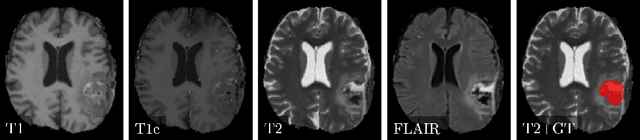
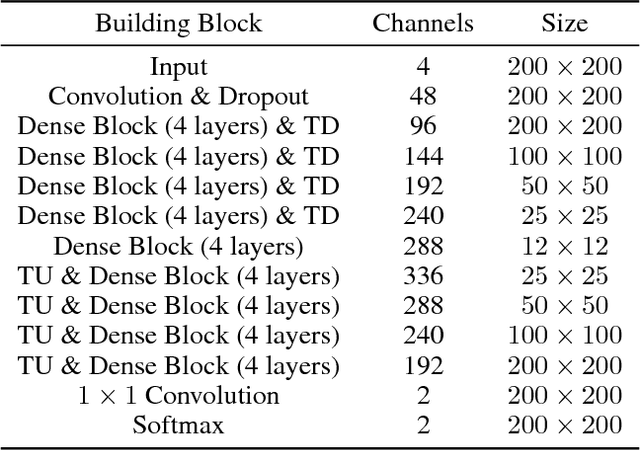
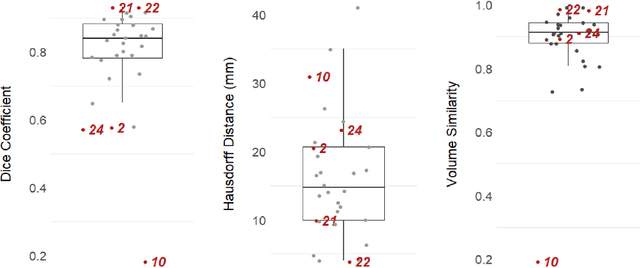
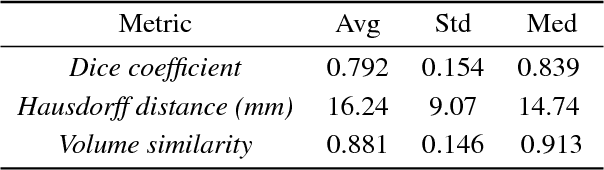
Uncertainty estimates of modern neuronal networks provide additional information next to the computed predictions and are thus expected to improve the understanding of the underlying model. Reliable uncertainties are particularly interesting for safety-critical computer-assisted applications in medicine, e.g., neurosurgical interventions and radiotherapy planning. We propose an uncertainty-driven sanity check for the identification of segmentation results that need particular expert review. Our method uses a fully-convolutional neural network and computes uncertainty estimates by the principle of Monte Carlo dropout. We evaluate the performance of the proposed method on a clinical dataset with 30 postoperative brain tumor images. The method can segment the highly inhomogeneous resection cavities accurately (Dice coefficients 0.792 $\pm$ 0.154). Furthermore, the proposed sanity check is able to detect the worst segmentation and three out of the four outliers. The results highlight the potential of using the additional information from the model's parameter uncertainty to validate the segmentation performance of a deep learning model.
On the Effect of Inter-observer Variability for a Reliable Estimation of Uncertainty of Medical Image Segmentation
Jun 07, 2018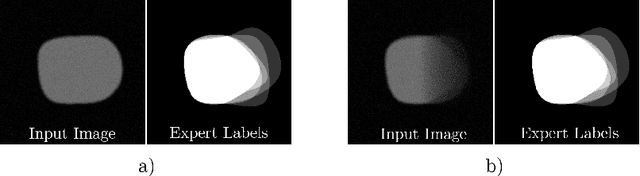
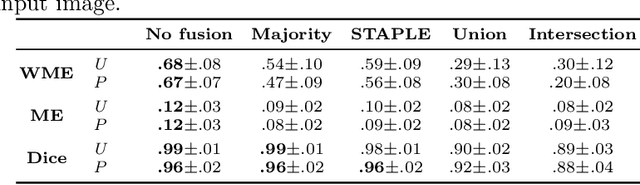
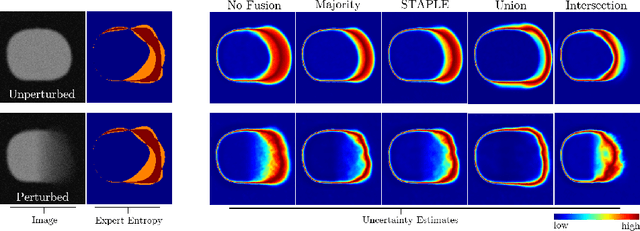
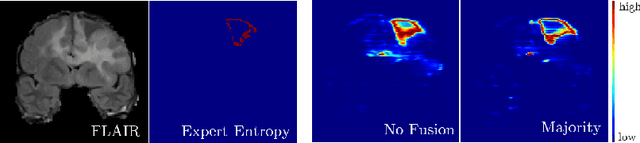
Uncertainty estimation methods are expected to improve the understanding and quality of computer-assisted methods used in medical applications (e.g., neurosurgical interventions, radiotherapy planning), where automated medical image segmentation is crucial. In supervised machine learning, a common practice to generate ground truth label data is to merge observer annotations. However, as many medical image tasks show a high inter-observer variability resulting from factors such as image quality, different levels of user expertise and domain knowledge, little is known as to how inter-observer variability and commonly used fusion methods affect the estimation of uncertainty of automated image segmentation. In this paper we analyze the effect of common image label fusion techniques on uncertainty estimation, and propose to learn the uncertainty among observers. The results highlight the negative effect of fusion methods applied in deep learning, to obtain reliable estimates of segmentation uncertainty. Additionally, we show that the learned observers' uncertainty can be combined with current standard Monte Carlo dropout Bayesian neural networks to characterize uncertainty of model's parameters.