 Add to Chrome
 Add to Firefox
 Add to Edge
ScenicRules: An Autonomous Driving Benchmark with Multi-Objective Specifications and Abstract Scenarios
Feb 17, 2026
Developing autonomous driving systems for complex traffic environments requires balancing multiple objectives, such as avoiding collisions, obeying traffic rules, and making efficient progress. In many situations, these objectives cannot be satisfied simultaneously, and explicit priority relations naturally arise. Also, driving rules require context, so it is important to formally model the environment scenarios within which such rules apply. Existing benchmarks for evaluating autonomous vehicles lack such combinations of multi-objective prioritized rules and formal environment models. In this work, we introduce ScenicRules, a benchmark for evaluating autonomous driving systems in stochastic environments under prioritized multi-objective specifications. We first formalize a diverse set of objectives to serve as quantitative evaluation metrics. Next, we design a Hierarchical Rulebook framework that encodes multiple objectives and their priority relations in an interpretable and adaptable manner. We then construct a compact yet representative collection of scenarios spanning diverse driving contexts and near-accident situations, formally modeled in the Scenic language. Experimental results show that our formalized objectives and Hierarchical Rulebooks align well with human driving judgments and that our benchmark effectively exposes agent failures with respect to the prioritized objectives. Our benchmark can be accessed at https://github.com/BerkeleyLearnVerify/ScenicRules/.

GENESIS-RL: GEnerating Natural Edge-cases with Systematic Integration of Safety considerations and Reinforcement Learning
Mar 27, 2024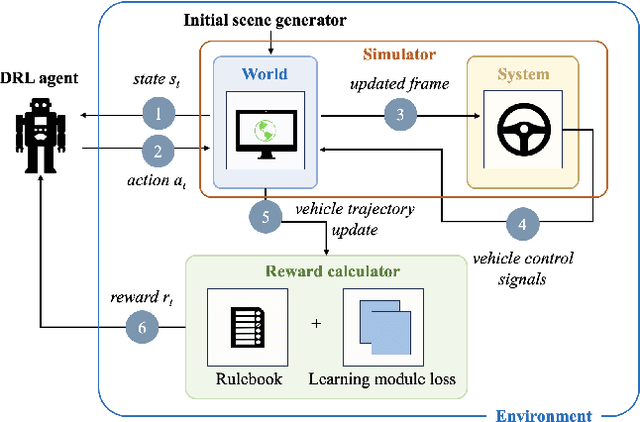
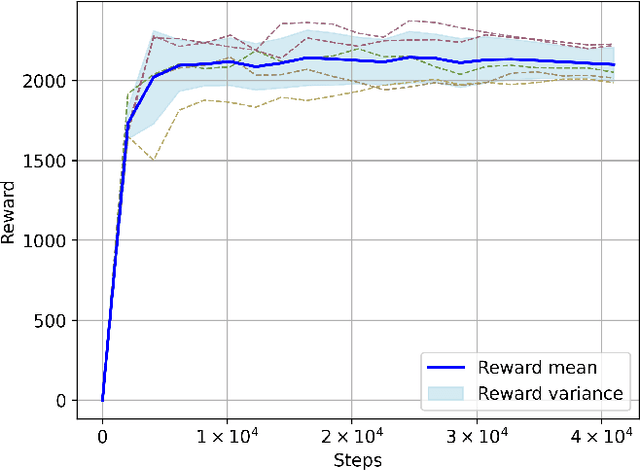
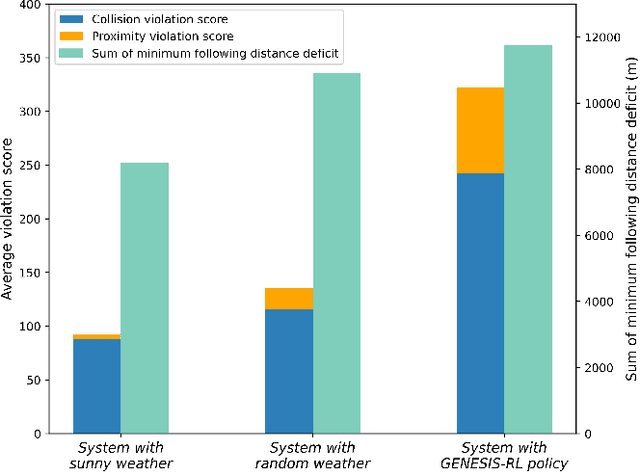
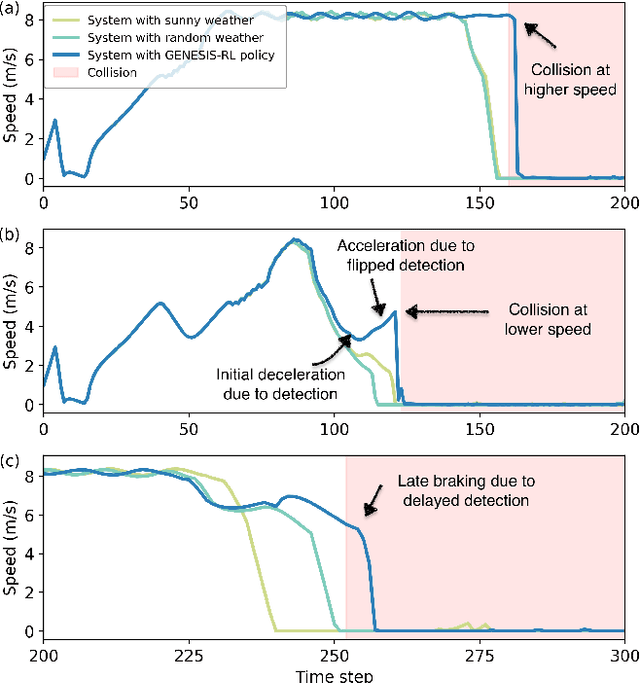
In the rapidly evolving field of autonomous systems, the safety and reliability of the system components are fundamental requirements. These components are often vulnerable to complex and unforeseen environments, making natural edge-case generation essential for enhancing system resilience. This paper presents GENESIS-RL, a novel framework that leverages system-level safety considerations and reinforcement learning techniques to systematically generate naturalistic edge cases. By simulating challenging conditions that mimic the real-world situations, our framework aims to rigorously test entire system's safety and reliability. Although demonstrated within the autonomous driving application, our methodology is adaptable across diverse autonomous systems. Our experimental validation, conducted on high-fidelity simulator underscores the overall effectiveness of this framework.