 Add to Chrome
 Add to Firefox
 Add to Edge
Towards Tight Bounds for Streaming Attention
Jun 05, 2026
The attention mechanism is a cornerstone of modern transformer architectures. However, its expressive power comes at the cost of quadratic runtime and linear space usage. In particular, the classical transformer architecture explicitly stores all previously seen input elements (tokens) in order to generate the next one. The problem of implementing a transformer in limited space, known as KV cache compression, has received much interest over the past few years, spurring the development of powerful heuristics. Recent works of Haris et al, COLT'25 and Kochetkova et al, NeurIPS'25, formalized KV cache compression as the streaming attention approximation problem, providing both upper bounds (based on discrepancy theory) and information theoretic lower bounds. However, those papers left open a significant gap between the upper and lower bounds. For example, the space usage of their algorithms increases with the precision parameter, but the lower bound does not get stronger. In this work, we revisit the streaming attention approximation problem and provide nearly tight bounds on its space complexity. On the algorithmic side, we achieve the result through a surprisingly tight interplay between three distinct methods for kernel density estimation: discrepancy-based coreset constructions (e.g., Charikar-Kapralov-Waingarten'24), the polynomial method (e.g., Greengard-Rokhlin'87, Alman-Song'23), and space partitioning (e.g., Andoni-Laarhoven-Razenshteyn-Waingarten'17, Charikar-Kapralov-Nouri-Siminelakis'20). On the lower bound side, our main technical contribution is a new technique for using the INDEX problem with a large amount of side information that we hope will prove useful in other high dimensional geometric estimation problems.

BalanceKV: KV Cache Compression through Discrepancy Theory
Feb 11, 2025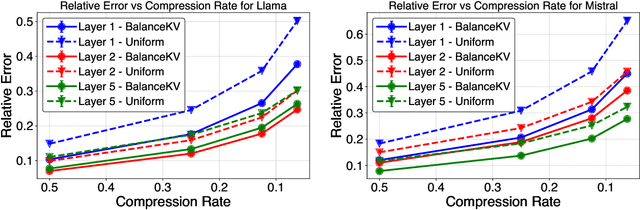
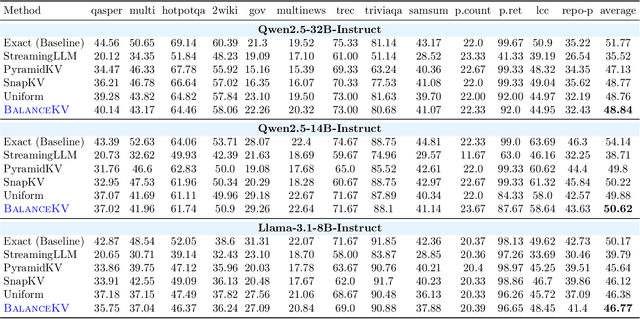
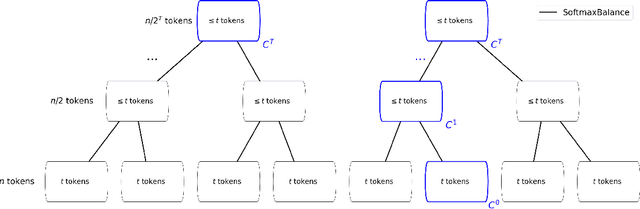
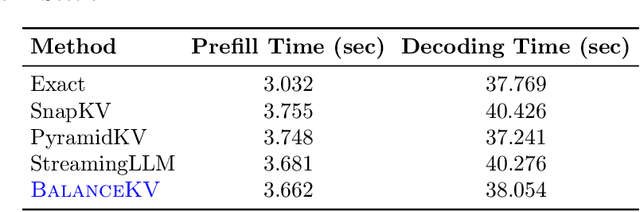
Large language models (LLMs) have achieved impressive success, but their high memory requirements present challenges for long-context token generation. The memory complexity of long-context LLMs is primarily due to the need to store Key-Value (KV) embeddings in their KV cache. We present BalanceKV, a KV cache compression method based on geometric sampling process stemming from Banaszczyk's vector balancing theory, which introduces dependencies informed by the geometry of keys and value tokens, and improves precision. BalanceKV offers both theoretically proven and empirically validated performance improvements over existing methods.