 Add to Chrome
 Add to Firefox
 Add to Edge
Operator Learning for Surrogate Modeling of Wave-Induced Forces from Sea Surface Waves
Apr 07, 2026
Wave setup plays a significant role in transferring wave-induced energy to currents and causing an increase in water elevation. This excess momentum flux, known as radiation stress, motivates the coupling of circulation models with wave models to improve the accuracy of storm surge prediction, however, traditional numerical wave models are complex and computationally expensive. As a result, in practical coupled simulations, wave models are often executed at much coarser temporal resolution than circulation models. In this work, we explore the use of Deep Operator Networks (DeepONets) as a surrogate for the Simulating WAves Nearshore (SWAN) numerical wave model. The proposed surrogate model was tested on three distinct 1-D and 2-D steady-state numerical examples with variable boundary wave conditions and wind fields. When applied to a realistic numerical example of steady state wave simulation in Duck, NC, the model achieved consistently high accuracy in predicting the components of the radiation stress gradient and the significant wave height across representative scenarios.

A Neural Operator-Based Emulator for Regional Shallow Water Dynamics
Feb 20, 2025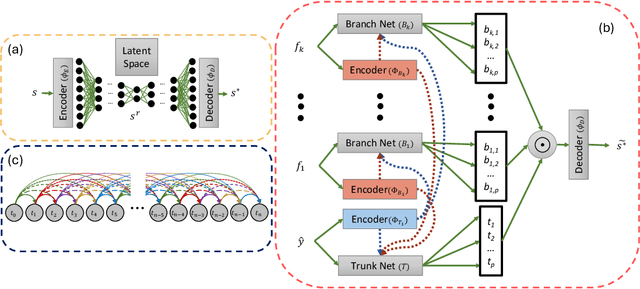

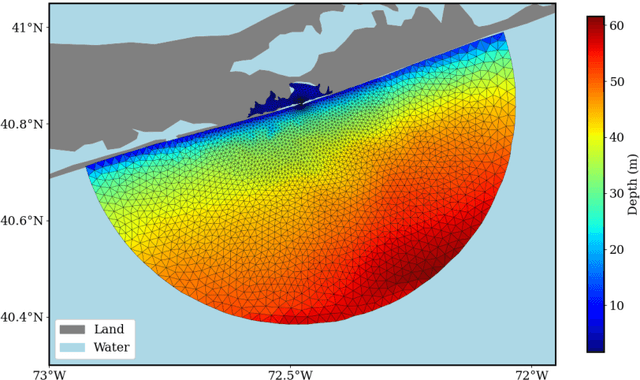
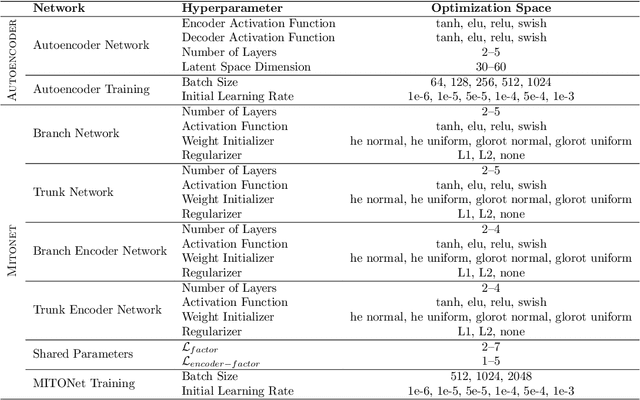
Coastal regions are particularly vulnerable to the impacts of rising sea levels and extreme weather events. Accurate real-time forecasting of hydrodynamic processes in these areas is essential for infrastructure planning and climate adaptation. In this study, we present the Multiple-Input Temporal Operator Network (MITONet), a novel autoregressive neural emulator that employs dimensionality reduction to efficiently approximate high-dimensional numerical solvers for complex, nonlinear problems that are governed by time-dependent, parameterized partial differential equations. Although MITONet is applicable to a wide range of problems, we showcase its capabilities by forecasting regional tide-driven dynamics described by the two-dimensional shallow-water equations, while incorporating initial conditions, boundary conditions, and a varying domain parameter. We demonstrate MITONet's performance in a real-world application, highlighting its ability to make accurate predictions by extrapolating both in time and parametric space.
Classification of COVID-19 X-ray Images Using a Combination of Deep and Handcrafted Features
Jan 21, 2021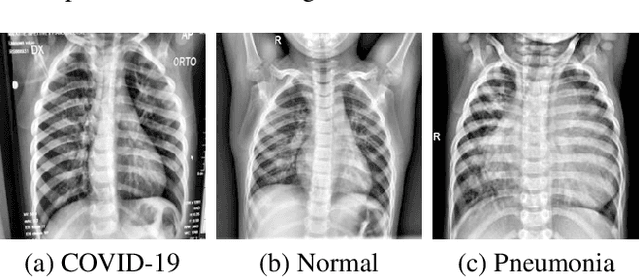
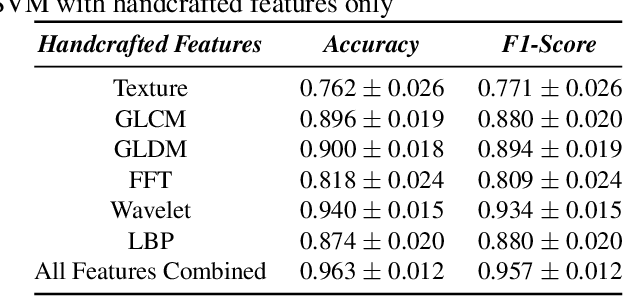
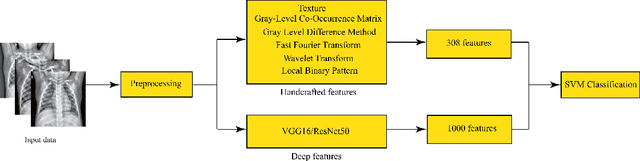
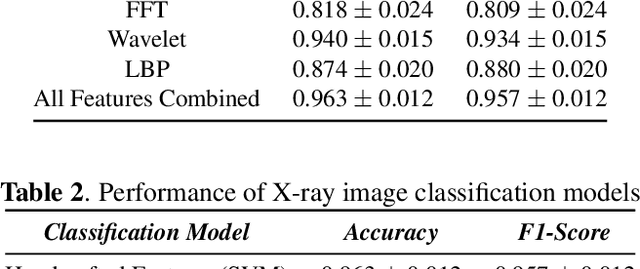
Coronavirus Disease 2019 (COVID-19) demonstrated the need for accurate and fast diagnosis methods for emergent viral diseases. Soon after the emergence of COVID-19, medical practitioners used X-ray and computed tomography (CT) images of patients' lungs to detect COVID-19. Machine learning methods are capable of improving the identification accuracy of COVID-19 in X-ray and CT images, delivering near real-time results, while alleviating the burden on medical practitioners. In this work, we demonstrate the efficacy of a support vector machine (SVM) classifier, trained with a combination of deep convolutional and handcrafted features extracted from X-ray chest scans. We use this combination of features to discriminate between healthy, common pneumonia, and COVID-19 patients. The performance of the combined feature approach is compared with a standard convolutional neural network (CNN) and the SVM trained with handcrafted features. We find that combining the features in our novel framework improves the performance of the classification task compared to the independent application of convolutional and handcrafted features. Specifically, we achieve an accuracy of 0.988 in the classification task with our combined approach compared to 0.963 and 0.983 accuracy for the handcrafted features with SVM and CNN respectively.