 Add to Chrome
 Add to Firefox
 Add to Edge
Linear representations in language models can change dramatically over a conversation
Jan 28, 2026
Language model representations often contain linear directions that correspond to high-level concepts. Here, we study the dynamics of these representations: how representations evolve along these dimensions within the context of (simulated) conversations. We find that linear representations can change dramatically over a conversation; for example, information that is represented as factual at the beginning of a conversation can be represented as non-factual at the end and vice versa. These changes are content-dependent; while representations of conversation-relevant information may change, generic information is generally preserved. These changes are robust even for dimensions that disentangle factuality from more superficial response patterns, and occur across different model families and layers of the model. These representation changes do not require on-policy conversations; even replaying a conversation script written by an entirely different model can produce similar changes. However, adaptation is much weaker from simply having a sci-fi story in context that is framed more explicitly as such. We also show that steering along a representational direction can have dramatically different effects at different points in a conversation. These results are consistent with the idea that representations may evolve in response to the model playing a particular role that is cued by a conversation. Our findings may pose challenges for interpretability and steering -- in particular, they imply that it may be misleading to use static interpretations of features or directions, or probes that assume a particular range of features consistently corresponds to a particular ground-truth value. However, these types of representational dynamics also point to exciting new research directions for understanding how models adapt to context.

WhisBERT: Multimodal Text-Audio Language Modeling on 100M Words
Dec 07, 2023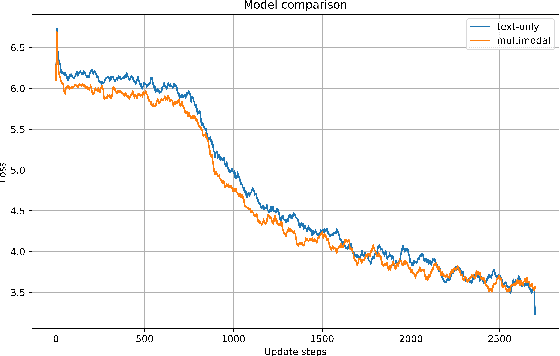
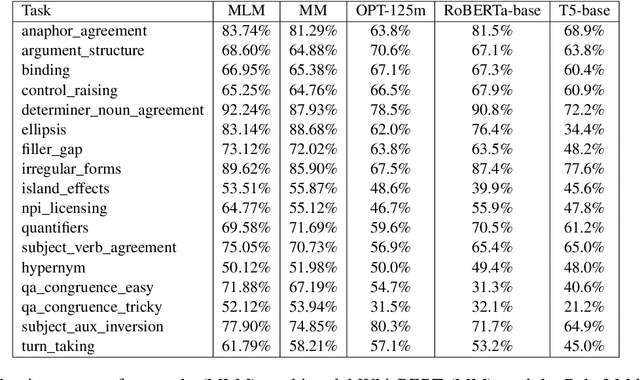
Training on multiple modalities of input can augment the capabilities of a language model. Here, we ask whether such a training regime can improve the quality and efficiency of these systems as well. We focus on text--audio and introduce Whisbert, which is inspired by the text--image approach of FLAVA (Singh et al., 2022). In accordance with Babylm guidelines (Warstadt et al., 2023), we pretrain Whisbert on a dataset comprising only 100 million words plus their corresponding speech from the word-aligned version of the People's Speech dataset (Galvez et al., 2021). To assess the impact of multimodality, we compare versions of the model that are trained on text only and on both audio and text simultaneously. We find that while Whisbert is able to perform well on multimodal masked modeling and surpasses the Babylm baselines in most benchmark tasks, it struggles to optimize its complex objective and outperform its text-only Whisbert baseline.