 Add to Chrome
 Add to Firefox
 Add to Edge
Explaining Reinforcement Learning Agents via Inductive Logic Programming
Jul 15, 2026
Explainable Reinforcement Learning (XRL) seeks to make Reinforcement Learning (RL) policies more transparent and interpretable, a key requirement in safety-critical and human-centric scenarios. However, it is mostly based on user studies, thus targeting the needs of a specific audience and lacking shared evaluation metrics. On the other hand, logic-based approaches within eXplainable Artificial Intelligence (XAI) provide compact, human-readable abstractions of decision-making. However, the systematic quantification of the explainability degree of logical representations remains an open problem. This work aims to advance the state of the art in XRL by introducing objective and planning-oriented metrics for policy explainability in RL settings. At the same time, it contributes to the field of logic for XAI by providing a principled way to quantify the explainability of logical rules, moving beyond common-sense assessments and simple propositional fragments. We employ Inductive Logic Programming (ILP) to extract symbolic representations of RL policies and define a novel set of explainability metrics, including activation rate, feature coverage, syntactic distance and semantic distance. These metrics quantify alignment between symbolic rules and agent behavior, the role of features in decision-making, and the evolution of policies during training and across agents in single and multi-agent RL. Experiments across different RL domains show that the proposed metrics highlight action-specific learning dynamics beyond global return, provide fine-grained insights into domain features beyond classical approaches for global feature importance estimation, and uncover coordination, specialization, and adaptation patterns in MARL. Moreover, they provide crucial insights for the transfer and generalization of action-specific policies.

Benchmarking Interaction, Beyond Policy: a Reproducible Benchmark for Collaborative Instance Object Navigation
Mar 31, 2026We propose Question-Asking Navigation (QAsk-Nav), the first reproducible benchmark for Collaborative Instance Object Navigation (CoIN) that enables an explicit, separate assessment of embodied navigation and collaborative question asking. CoIN tasks an embodied agent with reaching a target specified in free-form natural language under partial observability, using only egocentric visual observations and interactive natural-language dialogue with a human, where the dialogue can help to resolve ambiguity among visually similar object instances. Existing CoIN benchmarks are primarily focused on navigation success and offer no support for consistent evaluation of collaborative interaction. To address this limitation, QAsk-Nav provides (i) a lightweight question-asking protocol scored independently of navigation, (ii) an enhanced navigation protocol with realistic, diverse, high-quality target descriptions, and (iii) an open-source dataset, that includes 28,000 quality-checked reasoning and question-asking traces for training and analysis of interactive capabilities of CoIN models. Using the proposed QAsk-Nav benchmark, we develop Light-CoNav, a lightweight unified model for collaborative navigation that is 3x smaller and 70x faster than existing modular methods, while outperforming state-of-the-art CoIN approaches in generalization to unseen objects and environments. Project page at https://benchmarking-interaction.github.io/
Seldonian Reinforcement Learning for Ad Hoc Teamwork
Mar 05, 2025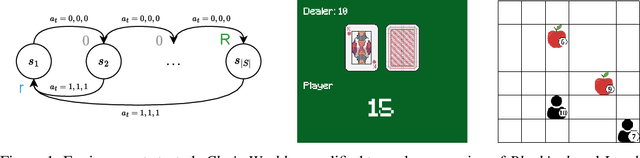
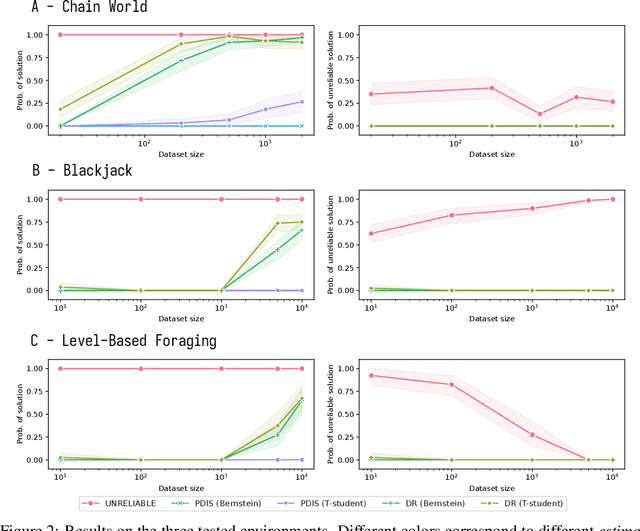
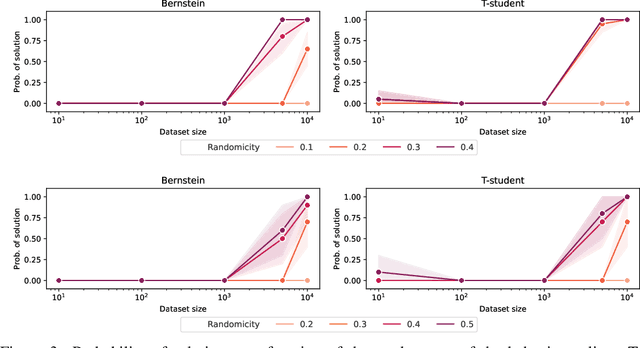
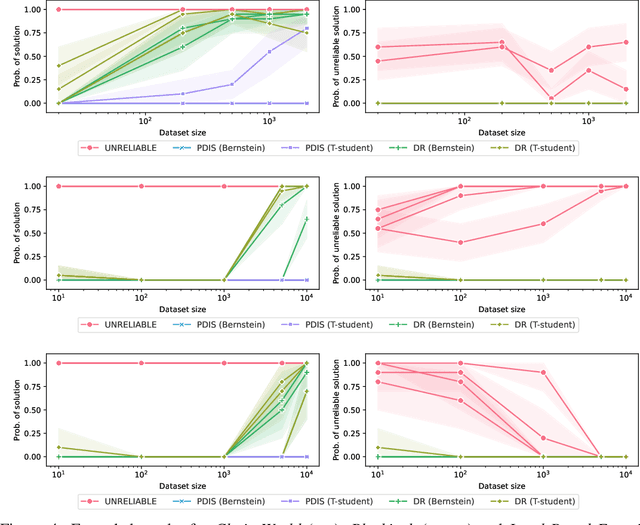
Most offline RL algorithms return optimal policies but do not provide statistical guarantees on undesirable behaviors. This could generate reliability issues in safety-critical applications, such as in some multiagent domains where agents, and possibly humans, need to interact to reach their goals without harming each other. In this work, we propose a novel offline RL approach, inspired by Seldonian optimization, which returns policies with good performance and statistically guaranteed properties with respect to predefined undesirable behaviors. In particular, our focus is on Ad Hoc Teamwork settings, where agents must collaborate with new teammates without prior coordination. Our method requires only a pre-collected dataset, a set of candidate policies for our agent, and a specification about the possible policies followed by the other players -- it does not require further interactions, training, or assumptions on the type and architecture of the policies. We test our algorithm in Ad Hoc Teamwork problems and show that it consistently finds reliable policies while improving sample efficiency with respect to standard ML baselines.
Collaborative Instance Navigation: Leveraging Agent Self-Dialogue to Minimize User Input
Dec 02, 2024Existing embodied instance goal navigation tasks, driven by natural language, assume human users to provide complete and nuanced instance descriptions prior to the navigation, which can be impractical in the real world as human instructions might be brief and ambiguous. To bridge this gap, we propose a new task, Collaborative Instance Navigation (CoIN), with dynamic agent-human interaction during navigation to actively resolve uncertainties about the target instance in natural, template-free, open-ended dialogues. To address CoIN, we propose a novel method, Agent-user Interaction with UncerTainty Awareness (AIUTA), leveraging the perception capability of Vision Language Models (VLMs) and the capability of Large Language Models (LLMs). First, upon object detection, a Self-Questioner model initiates a self-dialogue to obtain a complete and accurate observation description, while a novel uncertainty estimation technique mitigates inaccurate VLM perception. Then, an Interaction Trigger module determines whether to ask a question to the user, continue or halt navigation, minimizing user input. For evaluation, we introduce CoIN-Bench, a benchmark supporting both real and simulated humans. AIUTA achieves competitive performance in instance navigation against state-of-the-art methods, demonstrating great flexibility in handling user inputs.